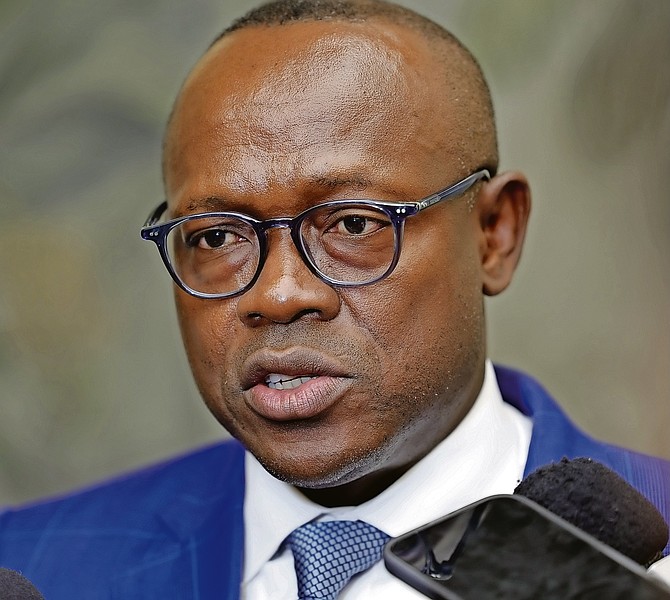
The Bahamas’ worsening teacher shortage, a long-running crisis labeled as an urgent priority by the nation’s leading education unions, has sparked a public debate over the government’s new plan to recruit hundreds of international educators to fill empty classroom seats. Deputy Prime Minister Chester Cooper, who recently took oversight of the Ministry of Education, has stepped forward to defend the administration’s policy, pushing back against criticism and clarifying that Bahamian educators will remain the first candidates considered for every open vacancy.
Cooper rejected claims that turning to overseas recruitment represents a break from long-standing Bahamian education practice, noting international educators have been part of the country’s public school system for generations. “This concept that there’s something wrong with bringing foreign teachers is really foreign to me,” he explained in a recent press briefing. “Since as a child 40 years ago I recall having teachers from Nigeria, Jamaica, Barbados, USA, Scotland, UK, Canada, so this is not a new concept for the schools in the Bahamas.”
The government’s current recruitment drive launched earlier this week, after the Ministry of Education confirmed it had accepted an offer from Ghana to help source up to 300 qualified educators to fill vacancies across the archipelago. To coordinate the effort, officials have established a new multi-agency task force tasked with overseeing candidate vetting, hiring and placement. The announcement drew immediate pushback from Belinda Wilson, president of the Bahamas Union of Teachers (BUT), who argued the union had not been consulted on the plan. Wilson also raised questions about the timing of the recruitment drive, noting negotiations over a new collective industrial agreement with the government remain unresolved, and called for full transparency around the qualifications, vetting protocols, employment benefits and placement plans for any incoming foreign teachers.
Cooper countered that the task force’s very first mandate is to conduct a comprehensive outreach effort to identify all qualified Bahamian educators who are willing to enter or rejoin the public school system. That search includes retired teachers, educators whose previous contracts have expired, and other trained education professionals who have left the profession but may be open to returning. All eligible local candidates will be reviewed and placed before any foreign educators are hired, he confirmed.
The Deputy Prime Minister added that he took on leadership of the Education Ministry specifically to address the teacher shortage, which both the BUT and the Bahamas Educators, Counsellors and Allied Workers Union (BECAWU) have flagged as one of the most critical challenges facing the country’s education system. “We are focused on solutions, we are focused on results, we are focused on supporting Bahamian teachers,” he said.
Cooper also clarified the status of ongoing collective bargaining with education unions, noting the government has already finalized a full industrial agreement with BECAWU, and negotiations with the BUT are nearly complete. “We’ve already agreed for the most part financial terms of pay, etc. with the BUT, and that negotiation is progressing,” he said. “Sometime last week, in fact, we reached out to the BUT to continue those discussions.” He added that the government and the union already align on most outstanding issues, and the administration will continue collaborating with all education stakeholders to address deep-rooted challenges in the public education system.
Any foreign educators hired through the recruitment drive will follow the government’s standard hiring process and be employed under the same standard contracts offered to local teachers, Cooper confirmed. Incoming educators will receive the same benefits and compensation as equivalent Bahamian hires, and will only remain employed in the public system for as long as their services are required. Emphasizing that the government would not cut corners on candidate screening, Cooper noted the shortage has been building for decades, and the ministry is pursuing a methodical approach even as it works to place qualified staff in classrooms ahead of the new academic year. “I assure Bahamian people that the vetting process is going to be robust,” he said. “We are going to ensure that any teacher we hire is qualified in terms of their credentials, but also in terms of their character. They will go through the full vetting process of the Bahamas police force, Interpol, Public Service Commission, and Department of Labor, etc.”
Beyond teacher recruitment, the ministry is also accelerating infrastructure repairs to public school campuses across the country ahead of the September start of the new academic year. Contracts for repair work have already been issued for schools in New Providence, Grand Bahama, and most of the country’s Family Islands, as the government races to complete all work before students return to classes.