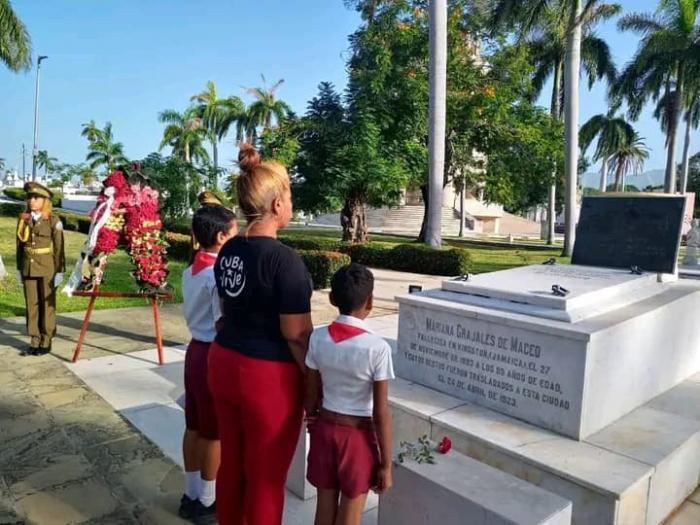
SANTIAGO DE CUBA — On the 211th anniversary of the birth of Mariana Grajales, the iconic matriarch of Cuba’s independence struggle widely known as the “Mother of the Nation,” Cuban leaders and residents gathered to honor her enduring legacy at her final resting place.
Born on July 12, 1815, in Santiago de Cuba — the city officially designated as Cuba’s “Hero City” for its central role in the nation’s fight for sovereignty — Grajales was celebrated at a solemn ceremony held at the Santa Ifigenia Heritage Cemetery, where her remains are interred in a dedicated funerary monument. A formal floral tribute, offered on behalf of the entire Cuban people, was placed at the historic site, while attendees gathered to reflect on her lasting contributions to Cuban national identity.
Elena Castillo Rodríguez, regional general secretary of the Federation of Cuban Women in Santiago de Cuba, emphasized that Grajales’ life and principles remain a critical guiding force for Cubans in the modern era. “Her enduring example serves as a guiding light today for defending the achievements of the Revolution, to which she gave her children and dedicated her life,” Castillo Rodríguez stated during the commemoration.
Grajales’ tomb is permanently maintained and guarded by an official honor guard, a testament to her status as one of Cuba’s most revered historical figures. In addition to official representatives from local political and mass civic organizations, hundreds of local residents joined the ceremony, laying individual loose blooms at her memorial as a personal gesture of respect.
As the matriarch of the legendary Maceo-Grajales lineage, a family deeply intertwined with Cuba’s independence movement, Grajales raised 14 children and committed her entire family to the fight for Cuban sovereignty. Driven by unwavering love for her homeland and a deep commitment to social justice, she became a defining symbol of rebellion against colonial rule, steadfast resistance in the face of hardship, and early female empowerment in Cuban history. To this day, her core values of duty, honor, and rigid discipline remain foundational to the national narrative she helped shape for the Cuban people.