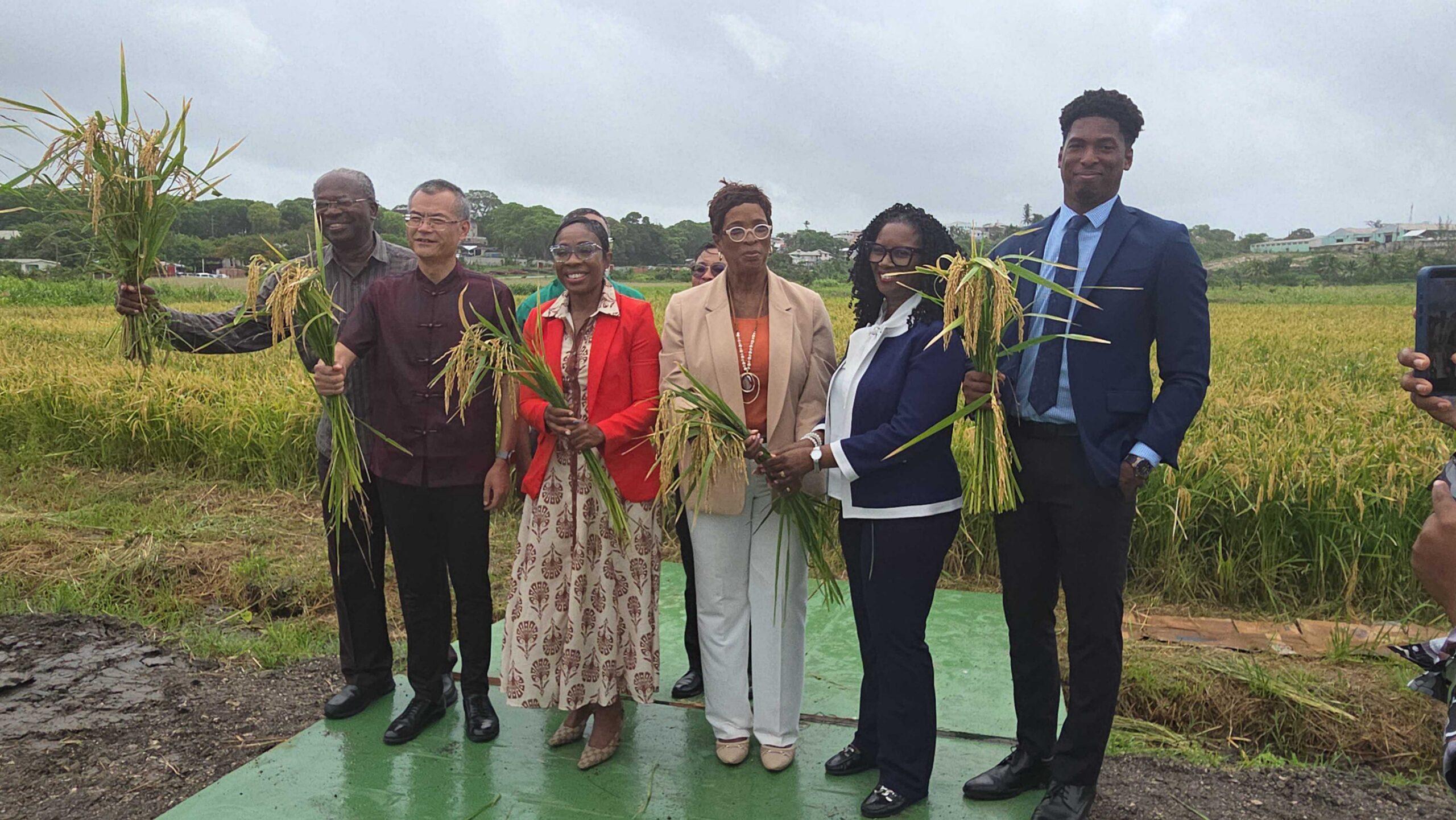
Against a backdrop of global supply chain volatility and growing climate uncertainty, Barbados’ Ministry of Agriculture, Food and Nutritional Security used Wednesday’s first official upland rice harvest to launch a sweeping package of agricultural initiatives aimed at boosting global market access while strengthening household-level food security across the island nation.
At the center of the government’s new policy agenda is an ambitious export expansion strategy that includes breaking ground on a certified, export-prepared packing facility within the next four months. Developed in partnership with state trade promotion agency Export Barbados, the packing house will enable domestic producers to scale output and access consumer markets beyond the Caribbean region. A second certified packing facility is already planned for the Groves district of St. George to further expand the country’s export processing capacity.
Addressing attendees at the harvest ceremony in the Pine Basin farming district, Agriculture Minister Dr. Shantal Munro-Knight outlined the country’s strategic pivot from a decades-long focus on domestic food self-sufficiency to active participation in global agricultural trade. “Feeding our own population has always been and remains a core national commitment, but we are now also prioritizing the development of export-ready agricultural industries,” she stated.
To support the growth of value-added agricultural commerce, the government has launched “Carmeta’s Crown,” a national innovation challenge that invites Barbadian entrepreneurs to submit original processed agro-product designs. Selected participants will receive targeted marketing support, production resources, and capacity-building training from the Barbados Agricultural Development and Marketing Corporation (BADMC), and will gain access to retail shelf space at BADMC-run Carmeta’s stores across the country. Complementing this commercial push is the upcoming rollout of Project Care, a community-focused initiative that empowers local residents to grow fresh fruits, vegetables and protein crops in their own backyards to supplement household food supplies.
Dr. Munro-Knight emphasized that the dual strategy of export growth and domestic food empowerment directly counters the long-held narrative that Barbadians lack interest in farming. Framing current global economic and climate challenges as a catalyst for local innovation, she noted: “We face a perfect storm of global market instability, climate change impacts, persistent supply chain constraints, and inherent limitations of being a small island developing state. But every crisis creates the conditions for large-scale innovation and transformative new progress.”
The new policy announcements coincided with the successful first harvest of upland rice from the Huan-Barbados Agricultural Technology Cooperation Project. Now in its third phase, the Golden Sickle Shared Food Security initiative is a technical partnership with China that has successfully introduced commercial upland rice cultivation to Barbados for the first time. The project has delivered hands-on on-farm training and demonstration for smallholders at Pine Basin, building long-term technical capacity and creating a clear pathway to agricultural diversification and reduced import dependence.
While acknowledging that eliminating total rice imports will be a gradual process, Dr. Munro-Knight hailed the harvest as a landmark milestone for the country’s agricultural sector. “Few people would have imagined even a few years ago that we could grow rice at scale here in Barbados, let alone have the capacity to expand production further,” she said. “We cannot replace all rice imports this year or even next, but the progress we have made in just two years is undeniable and sets a strong foundation for future growth.”
The rice cultivation project forms one part of a broader multi-commodity agricultural development push that also includes plans to expand production of premium West Indian Sea Island Cotton and scale up the national Black Belly sheep breeding program.
China’s Ambassador to Barbados, Zheng Bingkai, highlighted the transformative potential of upland rice cultivation to strengthen Barbados’ agriculture, boost climate resilience, and cut the country’s food import costs. Noting that the drought-tolerant upland rice variety is uniquely suited to small-scale producers with limited land holdings, he explained: “This variety fits perfectly with small plots of land, which makes it accessible for most local smallholders. Every year, Barbados spends $8 million on imported rice, so domestic cultivation creates clear economic opportunities for local farmers.”
Ambassador Zheng also framed the crop as a “climate-smart” solution for the island, as it requires almost no additional irrigation when planted in alignment with local weather patterns. “If cultivation runs from May to October, the entire growing cycle falls within the wet season, so almost no extra water is needed for irrigation,” he noted.
Reflecting on recent high-level policy discussions, Ambassador Zheng praised Barbados’ holistic, pragmatic approach to revitalizing domestic food production. As the two countries prepare to mark the 50th anniversary of diplomatic relations next year, agricultural and technological cooperation has become a core pillar of the bilateral partnership. “We are working to build a community with a shared future,” he said. “We are development partners, and our belief is that our success is tied to your success.”