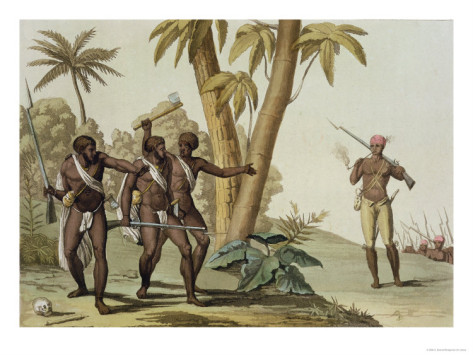
On the 9th of July 1725, a dark chapter unfolded in the colonial history of Grenada: 14 captured maroons — people who had escaped chattel slavery to build free communities in the island’s interior, one of whom was a woman — were put to death after being captured by French colonial forces. This violent conclusion capped off a year of growing tension between French plantation owners and the growing population of escaped enslaved people who had fled brutal working conditions on Grenada’s colonial estates.
By 1725, large numbers of enslaved people were escaping Grenada’s plantations. Many joined scattered maroon bands that lived off the land in the island’s remote interior, while others built makeshift canoes and small boats to sail to Spanish-controlled territories like Margarita, where they were welcomed and granted freedom. As the maroon population grew, their activities shifted beyond small-scale nighttime theft of food for survival. Led by prominent chiefs including Petit-Jean, La Fortune, Samba, Jacob and Bernard, around 60 maroons began targeting larger livestock, stealing sheep, calves and full-grown cattle from colonial estates. Eventually, they launched direct attacks on isolated plantations across northern and eastern Grenada, striking at the heart of the colonial agricultural system that had enslaved them.
Contemporary colonial records detail several violent encounters between maroons and white plantation inhabitants. In one incident, a maroon band attacked a woman named Luca who was home alone. After looting all of her belongings, they tore gold earrings from her ears; claims that she was sexually assaulted were never sufficiently verified in contemporary reports. In another well-documented case, at 9 o’clock in the morning, the young wife of a man named Cassé — who was traveling in France at the time — was attacked by a group of maroons armed with rifles, muskets and swords. Reports confirm the group burned her main house, kitchen and chicken coop, refusing to allow her to remove any of her personal property before the structures caught fire. Under the direct command of Petit-Jean, the maroons stole all of the estate’s cattle and poultry, then stood by to watch the buildings burn before beating drums and departing the property.
A third incident, carried out in the early morning, involved a surprise attack on a household where several white men were staying. The men were beaten with rifle butts; one sustained a severe eye injury that colonial doctors predicted would result in permanent blindness. The man’s wife, who had recently given birth to an infant, was dragged across the ground by her hair and kicked by the maroons. The group threatened to smash her newborn child’s head against a wooden post, forcing the new mother to kiss their buttocks in exchange for sparing the child’s life before stealing her earrings as well.
These coordinated attacks sparked widespread outcry among French colonial settlers, who pressured local authorities to take decisive military action to crush the maroon resistance. Settlers argued that the escaped slaves were in open revolt and demanded an immediate crackdown to protect colonial property and authority. In response, armed colonial militias launched large-scale “maroon hunting” expeditions across the island, killing 10 maroons during the operations and capturing 14 more. Among the captured were all of the maroon movement’s named leaders, plus a female maroon named Marion. The 14 captives were transported to Martinique for trial, and ultimately executed by colonial authorities on 9 July 1725. In a move that compensated slave owners for their lost “property,” the colonial state paid between 500 and 800 livres tournois to the owners of each executed enslaved person.
In the aftermath of the crackdown, colonial Grenada’s planter class petitioned the French crown to create a permanent local court with the authority to try captured maroons, with the explicit goal of making harsh punishments a public example to deter any other enslaved people from escaping and resisting colonial rule. One year later, in 1726, the French government authorized the creation of the Royal Chambre in Grenada, a special court granted sole power to prosecute enslaved people for crimes committed against the colonial order.