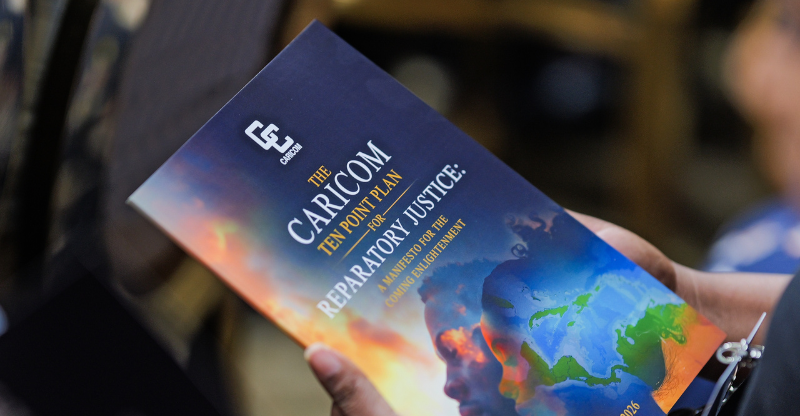
Against the backdrop of the 51st Regular Meeting of the CARICOM Heads of Government hosted in Saint Lucia, regional leaders and reparations advocates gathered this week to advance a long-running fight for redress for the harms of transatlantic chattel slavery and centuries of colonial rule. At a dedicated pre-conference workshop focused on advancing socio-economic reparatory justice, sustainable development, and historical truth-telling, attendees centered discussion on the newly unveiled *Manifesto for the Coming Enlightenment* and CARICOM’s updated 10-point action plan for reparatory justice.
During an opening panel discussion, former Saint Lucian Ambassador to CARICOM and the OECS Dr. June Soomer addressed one of the most persistent questions asked of reparations advocates: when, and if, the region will ever secure financial compensation for historical harms. In a response that shaped the entire conversation that followed, Dr. Soomer reframed the core purpose of the movement beyond direct financial payments. “It’s not about the money. Yes, the money is important, but it is about the return of our dignity, of our personhood, of who we are as a people,” she told the assembled delegates.
Professor Sir Hilary Beckles, chair of the CARICOM Reparations Commission, officially presented the landmark manifesto to attendees, framing the moment as a critical turning point for the global reparations movement. After decades of building momentum and laying ideological groundwork, Beckles argued that the movement has now entered a phase where the priority must shift from raising awareness to delivering tangible reparatory outcomes. “This is our time, our duty, our responsibility to honour the legacy of all our ancestors who demanded justice,” he said, urging Caribbean nations to maintain unified pressure on former European colonial powers.
The manifesto and accompanying 10-point plan lay out a holistic, multi-dimensional approach to reparatory justice that goes far beyond the financial compensation that dominates most public discussion of the issue. Each pillar of the plan is designed to address distinct, intergenerational harms rooted in slavery and colonial exploitation:
1. **A Formal Apology**: The plan rejects vague statements of regret from former colonial powers, demanding explicit, formal public apologies that acknowledge full legal and moral responsibility for the crimes of enslavement and colonial subjugation.
2. **Repatriation**: It codifies support for voluntary repatriation programs for descendants of enslaved Africans who wish to resettle in their ancestral homelands, including assistance with citizenship processing, housing, and cultural reintegration.
3. **Indigenous Peoples Development Programme**: Recognizing that Indigenous Caribbean communities continue to suffer the lingering impacts of genocide, forced displacement, and mass land dispossession, the plan calls for targeted, community-led investment to improve Indigenous social and economic outcomes.
4. **Cultural Institutions**: The commission advocates for increased investment in regional museums, research centers, and historical preservation projects that center Caribbean narratives of slavery and colonialism, arguing that truthful public storytelling is a foundational step in collective healing.
5. **Public Health**: The plan draws a direct line between the structural inequities of slavery and the disproportionately high rates of chronic illnesses such as diabetes and hypertension among modern Caribbean populations, calling on former colonial powers to fund regional public health infrastructure, research, and care initiatives.
6. **Illiteracy Eradication**: Citing the intentional underinvestment in education by colonial regimes that left many Caribbean societies with enduring high illiteracy rates, the plan calls for targeted support from former colonial powers to expand literacy programs and close longstanding educational gaps.
7. **African Knowledge Programme**: To reverse centuries of forced erasure of African cultural identity, the plan proposes cross-continental educational exchanges, cultural partnerships, and people-to-people programs to help Caribbean descendants of enslaved Africans reconnect with their ancestral heritage.
8. **Psychological Rehabilitation**: Acknowledging the intergenerational trauma inflicted by chattel slavery and colonial dehumanization, the plan calls for expanded community programming focused on emotional healing, collective identity-building, and public education about historical trauma.
9. **Technology Transfer**: The plan argues that intentional colonial policies blocked the development of independent Caribbean scientific and industrial capacity, creating long-term economic dependency. To redress this, it calls for expanded access to modern technology, innovation support, and technical expertise from former colonial powers to drive inclusive regional growth.
10. **Debt Cancellation and Financial Compensation**: The final pillar addresses the economic legacy of colonialism, calling for full cancellation of Caribbean sovereign debt held by former colonial powers, alongside targeted financial reparations to redress centuries of extracted wealth.
As the 51st CARICOM Heads of Government meeting progresses, the new framework makes clear that the regional reparations movement is pursuing far more than a one-time financial settlement. From closing educational gaps to preserving cultural heritage, supporting Indigenous self-determination to building modern economic capacity, the plan frames reparatory justice as a holistic project that restores the dignity, self-determination, and opportunity stripped from generations of Caribbean people — a goal that money alone cannot achieve.