In a major customs enforcement action that has sparked cross-border investigation, authorities in Trinidad and Tobago have launched a formal probe into the seizure of $2 million in U.S. cash intercepted at the South Terminal of Piarco International Airport on June 25, 2026. U.S. law enforcement agencies have already been brought on board to assist local officials in unpacking the circumstances of the suspicious shipment, according to local reporting from *Trinidad Express*.
The intercepted funds originated from a licensed local commercial bank in Trinidad and Tobago, and were slated for air cargo shipment to Miami, Florida, with a planned stopover in Jamaica. The seizure unfolded after officers from Trinidad and Tobago’s Customs and Excise Division flagged the shipment over what authorities described as “certain transactional and accountability deficiencies” that violated established shipping protocols.
Details of the operation are laid out in a June 29, 2026 report prepared by Dale Raymond, Deputy General Manager of the Airports Authority of Trinidad and Tobago, for Authority Chairman Aaron Henry. Per the report, senior Customs leadership received actionable intelligence on June 25 about the impending outbound cash shipment, scheduled to depart on Atlas Air Cargo Flight BW790, registered tail number N663GT. A joint tactical team consisting of Customs investigators and Airports Authority security officials was immediately deployed to Piarco’s South Terminal to intercept the shipment.
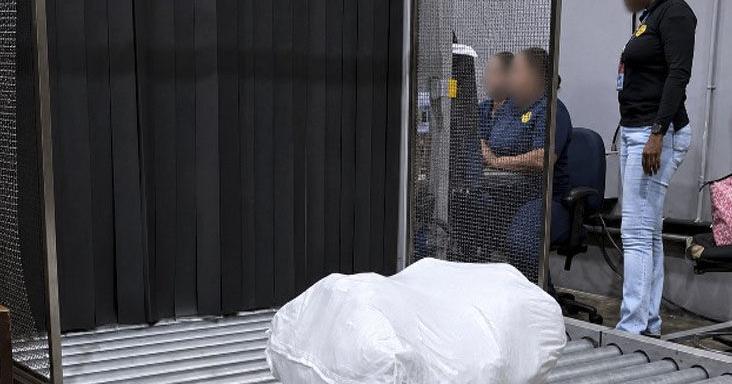
Customs Preventative Branch officers were positioned on the secure airside tarmac ahead of the shipment’s arrival. At approximately 6:30 p.m. local time, a G4S security van carrying the cash was spotted approaching the parked cargo plane, and was immediately stopped by waiting officers. The two drivers, both G4S corporals, confirmed they were transporting $2 million in U.S. currency. A search of the vehicle uncovered the full sum stowed inside a white crocus bag.
Shipping documentation confirmed the bag originated from the unnamed local bank, with ground handling firm Swissport listed as the official shipper. The security van was escorted to the Swissport bonded facility for further inspection, where an X-ray scan confirmed the cash was stacked in multiple neat piles. A line-by-line review of accompanying paperwork confirmed the initial red flags: multiple gaps in compliance and procedural documentation indicated that mandatory shipping and anti-money laundering protocols had not been fully followed.
Following the inspection, the entire cash shipment was secured inside the bonded facility under round-the-clock joint guard by Airports Authority Police Department officers and Customs personnel. Customs investigators formally verified the total amount, confirming it matched the declared sum of $2 million U.S. dollars. The funds have since been transferred to the Central Bank of Trinidad and Tobago for safekeeping while the investigation proceeds.
Central Bank officials confirmed to *Trinidad Express* that a formal investigation is underway, and senior representatives met with Customs leadership shortly after the seizure to coordinate next steps. Under Trinidad and Tobago’s existing financial regulations, authorized licensed banks are permitted to ship cash internationally under specific regulatory frameworks: common legitimate practices include shipping damaged or mutilated U.S. banknotes to overseas banks for replacement, with settlement processed via wire transfer, and importing new U.S. currency from U.S. financial institutions such as Bank of America to replenish local market demand for U.S. cash. Central Bank officials emphasized that this intercepted shipment differs materially from standard legitimate transactions, and that the involved bank will be required to provide extensive additional documentation and explanation for the shipment.
A senior anonymous international banking expert with expertise in Caribbean financial regulation explained that large U.S. cash transactions in the local system are subject to strict anti-money laundering (AML) rules. Under local law, any cash deposit exceeding $10,000 U.S. requires enhanced due diligence, and financial institutions are mandated to file a Suspicious Activity Report (SAR) with the Financial Intelligence Unit of Trinidad and Tobago (FIUTT) if there are reasonable grounds to suspect the funds are linked to money laundering or terrorist financing. This requirement is codified in the country’s Proceeds of Crime Act and Anti-Terrorism Act, which mandate all reporting entities including banks to file SARs when suspicion exists.
The expert noted that a $2 million U.S. cash deposit to a local financial institution would automatically qualify as a high-risk transaction requiring enhanced scrutiny under Trinidad and Tobago’s AML and counter-terrorist financing (CFT) regime. Whether a SAR is required hinges on whether the bank had reasonable suspicion that the funds are proceeds of criminal activity or connected to terrorist financing, the expert added, noting that more details about the origin of the funds and the bank’s internal due diligence are needed before any definitive conclusions can be drawn about compliance.
*Trinidad Express* reached out to a representative of the involved bank for comment, who confirmed the institution planned to release an official statement on the matter by the evening following the seizure. As the investigation continues, authorities have not yet announced any formal charges or identified any persons of interest in connection with the seized shipment.