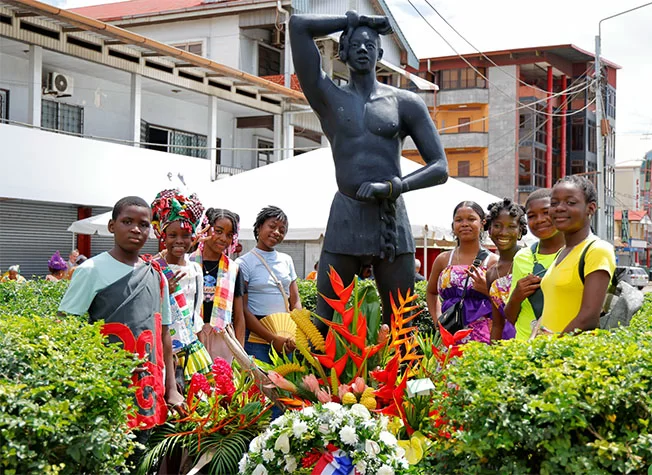
On July 1, during the annual Keti Koti commemoration marking the abolition of slavery, Suriname President Jennifer Simons has announced a landmark push to expand scholarly research into the nation’s history of enslavement and the broader legacy of African civilizations. Speaking after a wreath-laying ceremony at the Kwakoe monument on Dokter Sophie Redmondstraat, Simons outlined plans to establish a dedicated university chair focused on the history of slavery, African heritage, and the global contributions of African civilizations to human development.
In her remarks at the event, which was jointly organized by the Committee for the Commemoration of the Abolition of Slavery and the Feydrasi Fu Afrikan Srananman under the theme “Recognition, Justice and Development”, Simons pushed back against incomplete historical narratives that reduce African history solely to the era of transatlantic chattel slavery. “Africans were not inherently enslaved people,” she emphasized. “Long before the slave trade, they built sophisticated kingdoms, advanced systems of governance, pioneered scientific knowledge, and cultivated extraordinary rich cultural traditions. For far too long, this full history has been erased and hidden from mainstream education and public discourse.”
Simons stressed that rigorous independent academic research is a foundational step to building a more complete, balanced understanding of national and global history. She also highlighted the role of Suriname’s annual Heritage Month, held each August, as a key platform to advance public education around cultural heritage, cross-community connection, and national identity. The month-long initiative is designed to create space for all of Suriname’s diverse population groups to explore their own unique histories and learn about the ancestral backgrounds of fellow communities.
The president called on all sectors of Suriname’s multi-ethnic society to work collectively to foster greater mutual understanding and social cohesion. Referencing the country’s long-held concept of a “mamio-society” – a community rooted in shared living and mutual care – Simons noted that learning about one another’s histories is the pathway to deeper self-understanding as a nation. “This shared understanding is the only solid foundation we can build upon to move forward together as one nation, rooted in pride, freedom, and mutual respect for all,” she said.
Simons also re-framed the meaning of the 1863 abolition of slavery, rejecting the common narrative that framed emancipation as a gift from colonial rulers. Instead, she emphasized that the end of chattel slavery was the hard-won outcome of the relentless courage and resistance of generations of enslaved people. She further noted that the intergenerational impacts of slavery on identity, cultural belonging, and human dignity continue to shape Suriname’s society today, meaning the process of national repair and healing is far from over.
“For decades, the prevailing narrative said the harm of slavery is all in the past, that it’s over and done with,” Simons said. “But it is not over. It will only reach closure when we come together to do the work of healing and repair. That work begins with recognition, open dialogue, remembrance, and honest understanding of what our ancestors endured.”