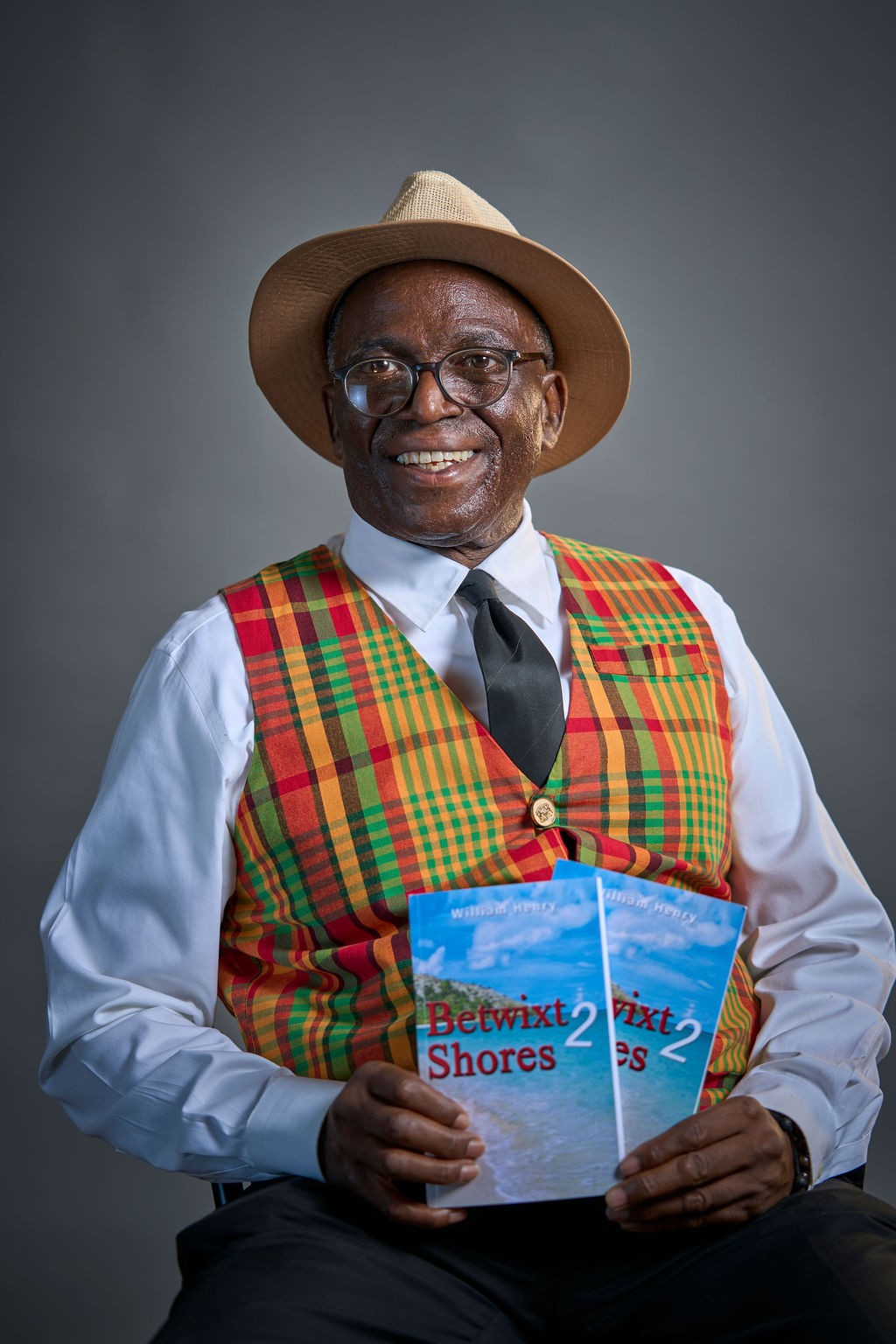
Two evocative photographs hold layers of meaning that extend far beyond simple portraiture, weaving together the personal journey, cultural legacy, and generational experience of Antiguan author William Henry. His recently released memoir *Betwixt 2 Shores* chronicles the fateful journey Henry took in February 1970, when he left his home in Antigua as an unaccompanied 10-year-old minor to build a new life in London.
At the core of the first photograph sits a well-worn, vintage grip — a small, sturdy suitcase that carries far more cultural weight than its size suggests. For generations of Antiguan travelers, a grip was more than luggage; it was a steady companion for every journey, big or small. In this image, the scuffed, lived-in grip transforms into a potent symbol: it stands for the pain of separation from home, the displacement of moving across oceans, the quiet resilience of young migrants, and the persistent hope that drives people to seek better futures. It mirrors Henry’s own transatlantic journey, and through him, it represents the experience of an entire generation of Caribbean children whose lives were permanently reshaped by migration, early separation from family, and the dream of opportunity abroad.
The second central image element is no less meaningful: the vibrant, traditional national dress Henry wears with obvious pride. Woven from iconic Madras fabric, the garment carries the distinct cultural heritage of Antigua and Barbuda. The fabric’s own journey mirrors the complex history of the region: it originated in Madras, now Chennai, India, before traveling to the Caribbean via colonial trade routes. Over centuries, it became an integral part of daily life for people of African descent across the Caribbean, eventually evolving into a lasting emblem of Antiguan and Barbudan national identity.
Today, this traditional national dress means far more than colorful cultural attire. It stands as a reminder that Antigua and Barbuda’s national character is shaped not only by its stunning natural landscapes, but also by a powerful history of resilience, perseverance, and unyielding cultural pride. It honors generations of Antiguans who turned hardship into hope, whose determination built the nation, and whose legacy continues to shape its identity today.
As a long-respected Antiguan writer, Henry has dedicated much of his career to preserving this cultural heritage for future generations. Much of his body of work explores interconnected themes of personal identity, transnational migration, family separation, belonging, and collective memory, ensuring that stories rooted in Antigua’s unique history are not lost to time and are passed down to new audiences.
The complementary symbolism of the grip and the national dress comes together seamlessly in the pages of *Betwixt 2 Shores*. The dress anchors Henry to the cultural heritage that stayed with him across decades and continents, enduring despite distance and change. The grip represents the life-altering journey that pulled a young boy away from his homeland and permanently altered the trajectory of his life. Combined, the two symbols tell a story shared by thousands of Antiguan and broader Caribbean families, whose collective histories have been shaped by migration, sacrifice, and the unwavering hope for a better life for coming generations.
These photographs are far more than static portraits. They are living visual narratives that celebrate the enduring resilience of the Antiguan people, the fundamental importance of preserving cultural identity, and the unbreakable bond between the homeland and its global diaspora.
At its core, *Betwixt 2 Shores* carries a universal message that resonates with migrants and diaspora communities across the world: no matter how far life carries people between distant shores, they remain forever anchored by their history, their culture, and the stories that make them who they are. Copies of the memoir are currently available for purchase on Amazon.