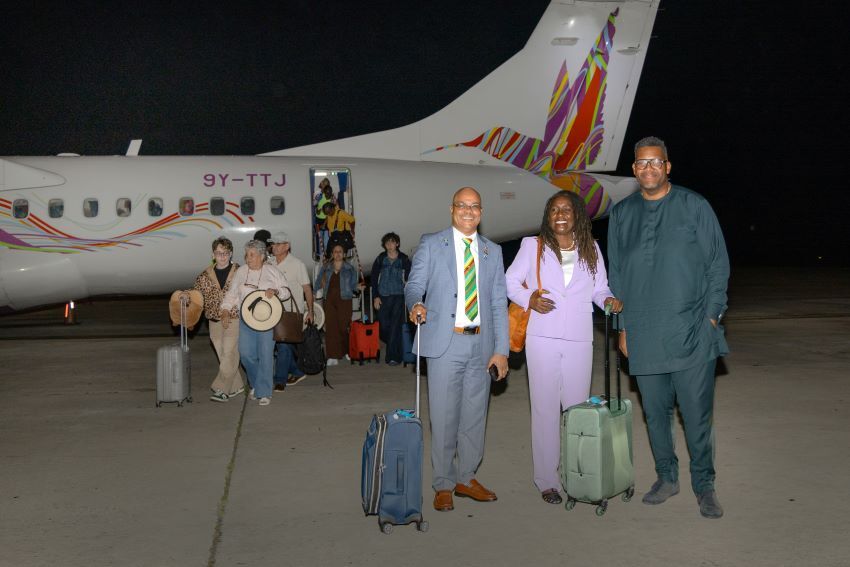
Starting July 1, a new historic milestone in regional integration has come into force for two Caribbean nations: Barbados and Guyana now allow their respective citizens to travel between their borders using ICAO-compliant digital national identification cards as valid travel documents, eliminating the mandatory requirement for a passport for most eligible travelers.
The launch of this bilateral initiative was marked by a ceremonial inaugural travel on Caribbean Airlines flight BW 0217, which carried senior government and immigration officials from Guyana to Barbados to mark the occasion. The official delegation included Barbados’ Senator Jonathan Reid, Minister of Innovation, Industry, Science and Technology (MIST), Barbados Chief Immigration Officer Margaret Inniss, and Guyana’s Deputy Chief Immigration Officer Stephen Telford, a Senior Superintendent of Police.
Minister Reid outlined that the agreement, first negotiated between Barbadian Prime Minister Mia Mottley and Guyanese President Dr Irfaan Ali, progressed from negotiation to full implementation in less than six weeks, a timeline he called remarkably efficient. He emphasized the collaborative work between his ministry and Guyanese authorities to align technical systems, share critical verification infrastructure, and standardize identity checking protocols to bring the leaders’ shared vision of easier cross-border movement to life. Calling the launch “a really exciting moment,” Reid noted that the cross-agency partnership laid the groundwork for broader regional expansion of the program.
Chief Immigration Officer Inniss explained that the new system operates seamlessly alongside existing immigration protocols, streamlining the travel experience for ordinary citizens while maintaining strict border security. While it is a bilateral pilot initiative between the two countries, Inniss stressed that the program directly advances the broader free movement goals outlined in Article 45 of the Revised Treaty of Chaguaramas, the foundational agreement governing the Caribbean Community (CARICOM) bloc. “First of July 2024 is a historic moment indeed, a change that helps to integrate full free movement in accordance with Article 45,” she stated.
The initiative includes specific caveats for travelers to ensure ongoing compliance. For Barbadian travelers under the age of 16, a valid passport remains mandatory for cross-border travel between the two countries. All travelers, regardless of age or nationality, are also advised to carry their passports as a secondary document, in the event that an airline diverts a flight to a third country that is not part of the bilateral ID travel agreement.
Deputy Chief Immigration Officer Telford echoed his Barbadian counterparts’ enthusiasm for the initiative, noting that it represents a transformative shift for Guyanese travelers who previously needed a passport to enter Barbados. “Today is a significant day for Guyana. This is an exciting time for Guyana, and this is so wonderful to know that you can travel with a card from Guyana to Barbados and back, if you don’t have a passport,” he said. Addressing concerns over identity fraud, Telford confirmed that the approved digital ID cards include the same level of embedded security features as traditional passports. Hidden security markers can be detected using standard verification equipment used by immigration officials, allowing for fast, reliable authentication of document validity.
To ensure a smooth travel process, officials have reminded all passengers of mandatory pre-departure requirements: all travelers must complete both the Guyana Embarkation/Disembarkation Form, accessible via the Guyana Police Force’s official portal, and the Barbados Online ED Card via Barbados’ official travel form website, before departing for their trip. Officials also clarified key details for filling out these forms: the document number requested on immigration forms is not the national ID number printed on the card, but a separate identifier located on the front of the ID card below the embedded chip, with Guyanese identifiers starting with a letter followed by a sequence of numbers.
In closing, Inniss and Telford urged eligible Barbadian and Guyanese citizens to take advantage of the simplified travel process for upcoming trips between the two nations. They also extended an invitation to other CARICOM member states to join the initiative, advancing the regional bloc’s decades-long goal of establishing full free movement of people across all member borders.