A recent analysis published by the Caribbean Community (CARICOM) Statistics Agency CARISTATS has uncovered striking variation in urban population shares across the bloc’s 14 member states, challenging common assumptions that economic development correlates directly with higher urbanization rates.
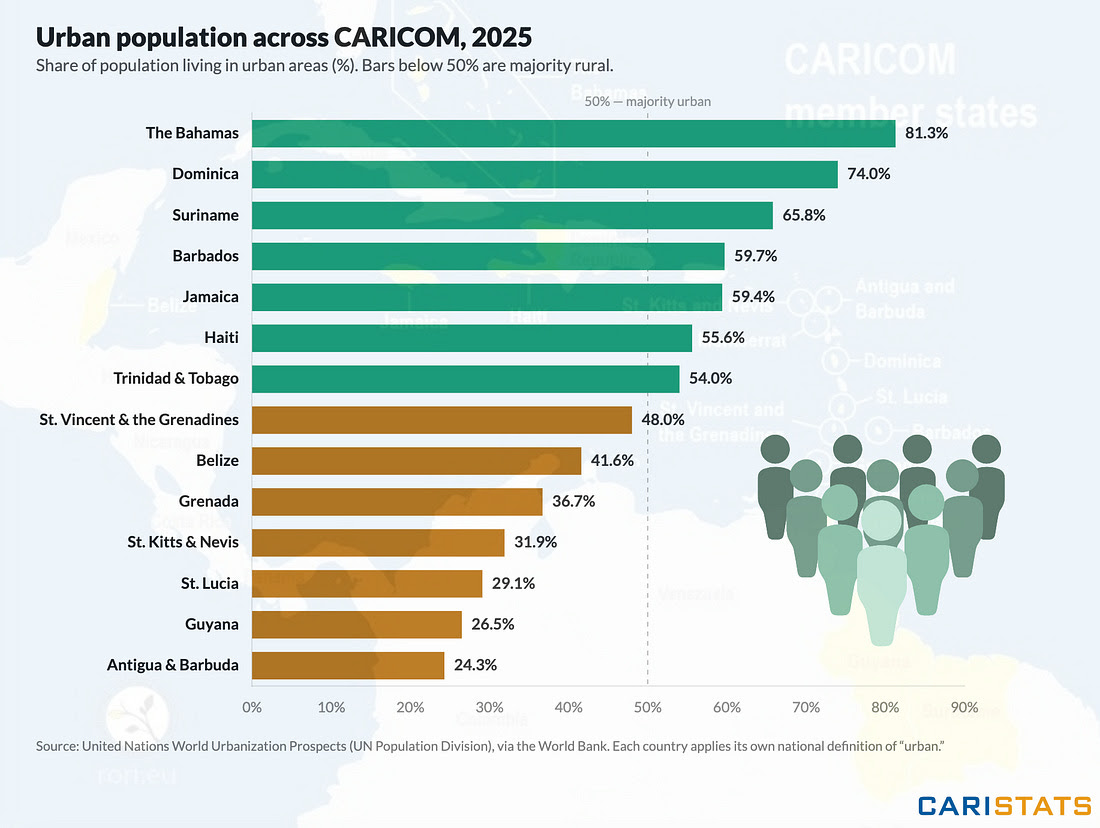
According to 2025 population estimates drawn from the United Nations World Urbanization Prospects dataset, managed by the UN Population Division and accessed via the World Bank, urban population shares across member states span from a low of 24.3% in Antigua and Barbuda to a high of 81.3% in The Bahamas. This puts Antigua and Barbuda at the bottom of the regional ranking for urban population share.
Counter to widespread expectations, the data confirms that a country’s level of economic development does not align with its degree of urbanization. Several small, high-income CARICOM economies actually rank among the most rural in the bloc. Beyond Antigua and Barbuda, Saint Lucia reports just 29.1% of its population living in urban areas, while Saint Kitts and Nevis registers 31.9% urban population. These nations join the lower-income South American member state Guyana, which counts only 26.5% of its residents as urban, at the lower end of the regional ranking.
On the opposite end of the spectrum, The Bahamas leads the region in urban concentration, followed closely by Dominica at 74% and Suriname at 65.8%. In most of these highly urban member states, the vast majority of the population is clustered around a single capital city or along developed coastal belts.
CARISTATS researchers note that much of this wide variation stems not from actual differences in population density, but from divergent national definitions of what qualifies as an “urban” area. Each CARICOM member state sets its own criteria for classifying urban settlements, basing the designation on factors such as minimum settlement population size, administrative status as a town or city, or the dominant type of economic activity in the area. This means that even tightly packed residential development on a small compact Caribbean island can still be officially classified as rural under a country’s own national guidelines.
Overall, the report concludes that for a majority of CARICOM’s population, most residents still reside in areas classified as rural by their national governments, a reality that diverges from the region’s popularly held image as predominantly urbanized.