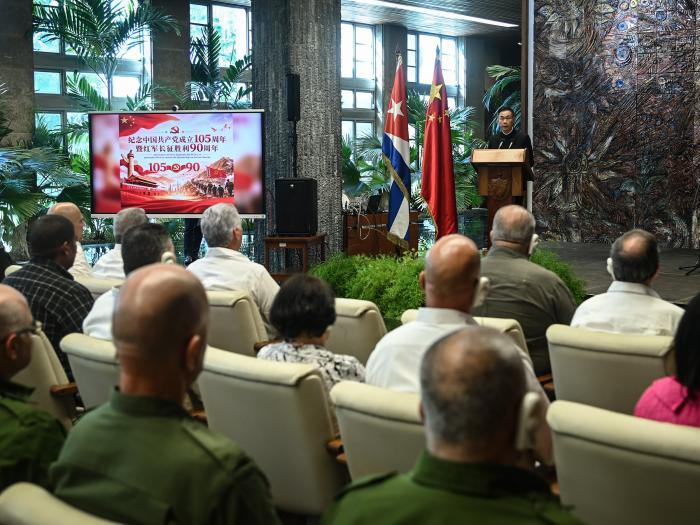
On the eve of the 105th anniversary of the founding of the Communist Party of China (CCP) and the 90th anniversary of the victory of the Long March, an official commemorative ceremony co-hosted by the Central Committee of the Communist Party of Cuba (PCC) and the Chinese Embassy in Cuba was held on Monday afternoon at Havana’s Palace of the Revolution, gathering senior political leaders, diplomatic envoys and representatives from both countries to celebrate these landmark events in modern Chinese history and strengthen socialist fraternity between the two nations.
The highest-ranking guest of the ceremony was Miguel Díaz-Canel Bermúdez, First Secretary of the PCC Central Committee and President of the Republic of Cuba, whose presence underscored the deep strategic bond between the two socialist parties and countries. The event also drew a wide range of attendees from Cuba: members of the PCC Political Bureau, senior leaders of the Cuban state and government, representatives of the Young Communist League, mass organizations, the Revolutionary Armed Forces, the Ministry of the Interior, the Cuban Institute of Friendship with the Peoples, alongside other invited guests. From the diplomatic community, ambassadors and other members of the diplomatic corps accredited to Cuba were in attendance, while Chinese participants included embassy officials, Chinese students studying in Cuba, and representatives of Chinese enterprises operating on the island.
Speaking at the ceremony from Portocarrero Hall, Hua Xin, China’s Extraordinary and Plenipotentiary Ambassador to Cuba, opened his remarks by extending sincere gratitude to the PCC Central Committee for organizing the event, and conveyed warm greetings to the Cuban party, government, and people from all sectors who have long upheld friendship between the two sides. He noted that shared ideological convictions and shared experiences of revolutionary struggle have long bound the two socialist nations, both led by communist parties, in an unbreakable fraternal tie.
“The Communist Party of China will always stand with the Communist Party of Cuba,” Hua affirmed, before outlining the core ideological legacy of the CCP over its 105-year history. He recalled the founding spirit forged by the CCP’s early pioneers: adhering to truth, upholding ideals, staying true to the original aspiration, shouldering historical missions, being ready for sacrifice, waging heroic struggle, and remaining loyal and committed to the people. This spirit, he emphasized, remains the eternal spiritual source of the CCP.
Hua went on to note that the CCP’s century of extraordinary achievements stems from its consistent commitment to strengthening its own governance capacity. Over 105 years, the party has synthesized accumulated experience, integrated innovative theoretical approaches and governance strategies, with Xi Jinping Thought on Socialism with Chinese Characteristics for a New Era playing a central guiding role. This process has reinforced a core conclusion: Party leadership is the defining feature of socialism with Chinese characteristics.
Turning to the current challenges facing Cuba, Hua reaffirmed China’s unwavering solidarity. “Today, faced with the escalating blockade imposed by the United States, as well as its military threats, the Party, the Government, and the people of Cuba remain steadfast in their conviction, will not yield to pressure, and will resolutely defend national sovereignty and the socialist cause,” he stated. Hua categorically opposed illegal unilateral sanctions and all forms of military intervention against Cuba, called on the United States to immediately end its decades-long blockade and all coercive measures against the Caribbean nation, and demanded an end to violations of the Cuban people’s inalienable rights to survival and development. He added that China firmly supports Cuba in exploring a socialist development path aligned with its own national conditions, applauds the PCC’s courageous push for economic and social transformation reforms, and expressed full confidence that under PCC leadership, the Cuban people will overcome current difficulties and secure new victories in socialist construction.
The keynote address was delivered by Emilio Lozada García, member of the PCC Central Committee and head of its International Relations Department. Lozada traced the CCP’s extraordinary growth, noting that what began as a small group of just 50 revolutionary militant pioneers has grown into the world’s largest communist party, boasting more than 100 million members today.
Recounting the CCP’s 105 years of historic victories, Lozada highlighted the 1934–1936 Long March led by the Red Army as one of the most defining episodes in the party’s revolutionary history. “This campaign gave a new and decisive direction to the Chinese revolution and demonstrated what a people, guided by its Communist Party, is capable of achieving,” he said. Lozada further noted that the CCP’s more than 70 years of guiding China’s complex, long-term process of socialist construction represents an unprecedented contribution to global socialist practice.
On the global stage, Lozada praised the CCP’s consistent commitment to advancing world peace, multilateralism, upholding international law, and defending the purposes and principles of the United Nations Charter. He singled out the major global initiatives put forward by General Secretary Xi Jinping in recent years—including the Belt and Road Initiative, the vision of a Community with a Shared Future for Mankind, and the Global Development Initiative, Global Security Initiative, Global Civilization Initiative, and Global Governance Initiative—as particularly impactful contributions to global progress.
Lozada stressed that the PCC and CCP are currently working together to build a bilateral China-Cuba Community with a Shared Future, and expressed deep gratitude for China’s unwavering support for Cuba in the face of U.S. aggression. “We appreciate the firm and unwavering support of the Communist Party of China against the economic, commercial, and financial blockade and the energy embargo imposed by the United States government, as well as against the infamous accusation against Army General Raúl Castro Ruz,” he said. “The Communist Party of Cuba is grateful for the constant support and accompaniment of the Communist Party of China, especially in the current circumstances of collective punishment and silent genocide against the Cuban people.”
Closing his remarks, Lozada reaffirmed the Cuban perspective on the CCP’s global significance: “The Communist Party of China is today an indispensable reference point in the process of building socialism and has demonstrated that the socialist system is a viable alternative to the savage capitalism that they are trying to impose on us from the North. Its commitment to achieving a more just, democratic, and equitable international order reaffirms that a better world is possible.”