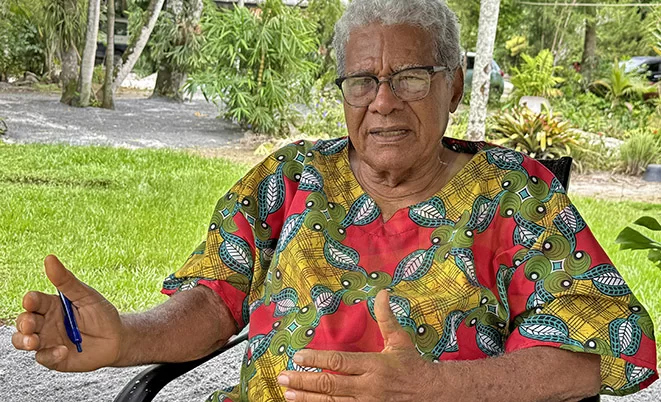
As the Feydrasi fu Afrikan Srananman (Federation of Afro-Surinamese People) marks its 30th anniversary, its founding president Iwan Wijngaarde reflects on three decades of advocacy for addressing the intergenerational harms of the transatlantic slave trade, arguing that official apologies for historical slavery are a critical starting point — but never an endpoint.
The federation was founded in 1996, when a coalition of Afro-Surinamese community groups and individual activists came together out of shared deep concern: for generations, the Afro-Surinamese community had faced systemic social, economic, and political marginalization that traced directly back to the legacy of slavery. Organizing a cohesive leadership structure proved challenging in the early days, with no volunteers stepping forward to lead the new coalition before an elder member nominated Wijngaarde to take on the role.
The early years were defined by grassroots pioneering. To keep the organization financially stable, members ran fundraising events and sold homemade food to cover operating costs. Over time, the federation grew into Suriname’s leading organizer of public commemoration events, educational lectures, and cultural programming centered on Afro-Surinamese identity, historical awareness, and equity, rather than solely focusing on past trauma.
One of the federation’s earliest milestones was hosting prominent American activist Louis Farrakhan just months after its founding. It also established enduring annual community traditions, most notably Blakaman Dey, later renamed Black Civilization Day, held every first Sunday of January. The holiday is designed to let the community start each new year by centering their own cultural heritage, carrying that identity and traditions forward through the rest of the year.
Wijngaarde has been clear that apologies from institutions and governments for slavery must be paired with sustained action, not treated as a solution in themselves. He emphasizes that apologies must include clear explanation of why they are necessary, and points to the harmful framing of emancipation in 1863, when formerly enslaved people were pressured to thank their former enslavers and colonial authorities during post-emancipation thanksgiving services. He also notes that abolition was only achieved through widespread resistance by enslaved people, a history that has often been erased from mainstream narratives.
Wijngaarde argues that religious institutions, particularly the Christian church, have a unique responsibility to participate in the healing process. The church played an active role in erasing Afro-Surinamese cultural identity during the colonial and slavery eras, he says, and now must contribute to the rehumanization of the Afro-Surinamese community by acknowledging this historical role.
Over 30 years, the federation has expanded its programming to honor the full spectrum of Afro-Surinamese and Black resistance history. It leads annual commemorations of freedom fighters Kodjo, Mentor, and Present; honors 18th-century Maroon warrior Boni on Boni Dey; and holds public remembrances of the 1757 Tempati Uprising, the 1791 Haitian Revolution, and M’ma Seri, an enslaved woman tortured and killed by her enslaver in 1743. Every December, it organizes the national Switiwatra ritual cleansing herbal bath, a traditional practice adapted from small-scale plantation and family ceremonies that has grown into a major public event since the federation took over its organization in 2014. The federation also hosts an annual remembrance for the approximately 700 African people who died in the 1738 sinking of the slave ship Leusden.
Wijngaarde acknowledges the federation has faced significant challenges across its three decades. It has faced opposition from hostile groups, struggled to retain long-term volunteer engagement, and navigated internal tensions driven by clashing egos, differing strategic visions, and power imbalances. These challenges, he says, are themselves a legacy of the colonial system of division and dehumanization that the federation works against. To counter that, the organization centers a collective “we philosophy” rather than individualism, a core principle that has kept it moving forward.
This 30th anniversary year marks a new milestone for the federation: for the first time, it will co-host July 1 emancipation commemorations alongside Indigenous Surinamese organizations, following months of collaborative planning. Wijngaarde says the partnership is designed to build collective power, and the next phase of the federation’s work will focus on collaborative development beyond remembrance — leveraging the spiritual and economic strengths of both marginalized communities, and seeking international partnerships when local knowledge and resources are insufficient.
Wijngaarde welcomes the 2023 formal apology for Dutch slavery issued by King Willem-Alexander, calling it an important foundational step for future work. However, he criticizes the king’s 2025 visit to Suriname for falling short on substantive engagement, arguing that the wreath-laying ceremony at the Mama Sranan national slavery monument remained overly symbolic with little concrete discussion of ongoing harms. He notes that the Kwakoe statue remains the only small-scale public monument to slavery in Suriname, highlighting how much work remains to embed this history in public consciousness.
Looking back on 30 years of organizing, Wijngaarde identifies three core values that have sustained the federation through challenges including the COVID-19 pandemic, when the organization refused to pause its programming: patience, love, and mutual respect. Healing the intergenerational harm of dehumanization cannot happen overnight, he explains, so sustained patience is essential. The work also requires mutual love within the community, and respect for one’s culture and all community members.
On July 1, the federation will celebrate its 30th anniversary with a full schedule of public events, including a historical exhibition, cultural performances, the launch of a commemorative book, a public community reception, and the annual wreath-laying at the Kwakoe statue.