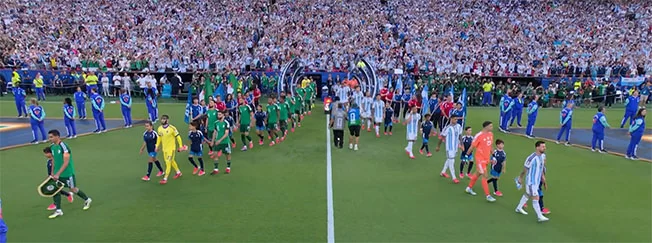
Before the opening kickoff of every high-stakes World Cup match, when broadcast cameras are rolling, national anthems are poised to play, and superstars step out of the tunnel toward the pitch, they do not walk alone. Clasped in each player’s hand is the small hand of a child, a tiny figure standing shoulder to shoulder with sporting legends, where childhood dreams meet the reality of the world’s biggest football stage. For one brief, shining minute, the World Cup feels less like a spectacle of multi-million dollar contracts, packed stadiums and global superstars, and more like a moment for children to step into the center of the football world they love.
These children are officially known as player escorts, the young guests who accompany players onto the pitch before matches, stand beside them during pre-match national anthem ceremonies, and then exit the field to make way for the game. That short appearance masks a carefully structured program with a meaningful global legacy, rooted in a partnership between FIFA and UNICEF that brought this tradition to worldwide attention during the 2002 World Cup. Launched as part of the landmark “Say Yes for Children” campaign, the initiative carried a simple but powerful message: football should use its global platform to advocate for children’s rights, access to healthcare, education, and safe recreation around the world. Ever since that 2002 tournament, child escorts have become a permanent, beloved pre-match fixture at top international football competitions.
For the 2026 World Cup, co-hosted across the United States, Mexico and Canada, hundreds of child escorts are being selected through grassroots youth and community programs run across the host nations. In the U.S. and Canada, recruitment is led in part by global social sport organizations Quaker and Common Goal, working in close collaboration with local football governing bodies. Unlike common misperceptions that spots are only awarded to competition winners or children from wealthy backgrounds, the 2026 program intentionally prioritizes kids from underprivileged communities, giving them a once-in-a-lifetime chance to walk onto the World Cup pitch alongside their football idols. Most candidates are nominated by local football clubs, non-profit organizations, schools, and youth development programs, and many of the selected children already participate in local football or community initiatives focused on sport, health, nutrition, and personal growth. Far from being a commercial perk sold to wealthy parents, the escort program at the 2026 World Cup is an intentional component of the tournament’s broader social outreach mission.
The age range for participants varies by tournament and program, but most selected children fall between 6 and 12 years old, with a small number of programs allowing slightly older participants. Before match day, all escorts complete pre-event training to learn the protocol: how to walk in line with players, where to stand during anthems, when to release players’ hands, and how to exit the pitch safely and efficiently after the pre-match ceremony. Every step is carefully planned, as the entire player procession is broadcast live to a global audience and forms an official part of match protocol.
After their on-pitch appearance, most escorts stay in the stadium for the full match, accompanied by adult chaperones before being reunited with their families or guardians. Many get to watch the entire World Cup match from their seats, and for a large share of these children, this marks the very first time they have ever attended a professional football match or any major sporting event in a stadium.
Alongside player escorts, the 2026 World Cup features another young participant that often catches viewers’ attention: the child who walks out ahead of the referee carrying the official match ball. This role is distinct from that of a player escort, as this child is officially titled the Match Ball Carrier, tasked with carrying the game’s official ball onto the pitch and presenting it to the head referee before kickoff, a symbolic act that formally marks the start of the match. At this year’s tournament, the official match ball carrier program is supported by long-time FIFA partner Kia.
The funding structure for pre-match child participation programs varies widely across leagues and countries. At some club competitions in Europe, parents can pay hundreds of euros to secure a mascot spot for their child on matchday. But for major tournaments like the World Cup, the model is entirely different: all costs related to uniforms, chaperoning, and event organization are covered by tournament sponsors, FIFA partners, and the event organizing committee, with no out-of-pocket costs passed on to participating children or their families.
Still, the tradition has faced occasional criticism. Critics argue that when sponsors hold influence over participant selection, questions remain about equitable access, and whether marginalized children are still locked out of these life-changing opportunities. That said, the 2026 World Cup program has been explicitly designed to counter this gap, prioritizing outreach to children from low-income neighborhoods and marginalized backgrounds who would otherwise never get the chance to stand on a global football stage.
For star players, this pre-match walk may feel like routine: shake a small hand, walk onto the pitch, stand for the anthem, then focus on the game ahead. But for the children who participate, it is a memory that will last a lifetime. They get to stand shoulder to shoulder with the legends they have only seen on television – names like Harry Kane, Kylian Mbappé, Lionel Messi, and Cristiano Ronaldo. They hear the roar of 80,000 fans echoing through the stadium, feel the buzz of anticipation in the tunnel before kickoff, and experience firsthand that football is far more than what they see on a screen – it is the smell of fresh-cut grass, the buzz of pre-match nerves, the bright glow of stadium lights, and the roar of the crowd that vibrates in your chest.
That is what makes that small pre-match moment so powerful. It reminds the whole world that football is about far more than final scores, trophies, or transfer fees. While adults debate tactics, prize money, VAR calls, group stage standings, and multi-million transfers, these children walk onto the pitch as a quiet, powerful reminder that this beautiful game ultimately belongs to the next generation too.
The World Cup does not begin when the referee blows the first whistle. It begins when a young carrier carries the official match ball onto the pitch. It begins when small hands clasp the hands of superstars, walking out into the light to say, quietly but clearly: this dream is ours too.