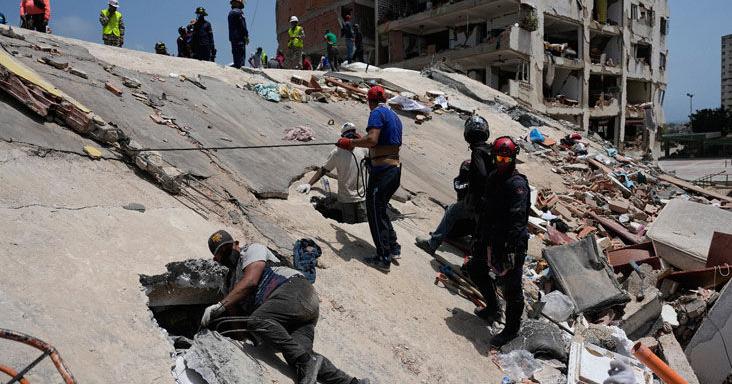
Just days after two powerful back-to-back earthquakes tore through northern and coastal regions of Venezuela, updated official figures have pushed the confirmed death toll past 900, marking one of the deadliest seismic events to strike the South American nation in modern history. The disaster has also left tens of thousands unaccounted for, thousands injured, and hundreds of critical infrastructure sites damaged or destroyed, triggering a large-scale international relief effort as local communities and neighboring nations rush to support response operations.
National Assembly Leader Jorge Rodriguez announced the updated casualty figures in a nationwide televised address Thursday, correcting earlier, far lower estimates that excluded data from the hardest-hit region. The twin quakes, registered at magnitudes 7.2 and 7.5, struck on June 24; initial reports put the death toll at just over 30, but as search and rescue teams reached isolated impact zones, that number rose to 920 confirmed fatalities by Thursday afternoon. To date, more than 51,000 people remain listed as missing, 3,360 have sustained injuries, and at least 3,000 people have been displaced from their destroyed homes, Rodriguez confirmed.
Earlier public estimates from interim President Delcy Rodriguez had fallen far short of the updated toll, as those figures did not include data from La Guaira state, the small coastal district adjacent to the capital Caracas that bore the brunt of the disaster. In La Guaira alone, hundreds of residential structures ranging from single-family homes to multi-unit apartment buildings have been leveled or severely damaged, prompting authorities to declare a state of emergency and deploy full military control across the region. The most heavily impacted communities within the state include Caraballeda, Macuto, Los Corales, Catia La Mar, and the Playa Grande sector.
Across the entire country, the disaster has damaged more than 1,400 critical infrastructure sites, including 1,012 general structures, 13 hospitals, and 25 commercial centers, per official counts. In the 48 hours following the initial two major quakes, Venezuela’s geologic monitoring services recorded an additional 302 aftershocks along three active fault lines running through the country. Rodriguez noted that the magnitude of the initial quakes placed them among the most powerful seismic events recorded on the planet in the last thousand years.
As civilian solidarity efforts swelled across the country in the days after the disaster, with ordinary Venezuelans organizing spontaneous convoys to carry aid into La Guaira, Rodriguez urged civilians to avoid traveling to the impacted region to prevent congestion that would slow official emergency operations. “We understand the desire to help others has been overwhelming and heartfelt on the part of all of you,” he stated. “However, this also causes congestion on the roads we are using to evacuate affected residents and transport the injured either to shelters or to hospitals in the capital city and in Miranda state. The best way you can help, the greatest support you can provide is by not congesting the roads, so that medical teams can transport patients quickly and so that the armed forces, police, and rescue teams can carry out their work more effectively.” Rodriguez added that the Bolivarian National Armed Forces maintain full control of La Guaira to uphold public security and support around-the-clock rescue operations.
The international community has rapidly mobilized to support Venezuela’s relief efforts, with hundreds of specialist rescue workers from the United States, El Salvador, Colombia, Mexico, Spain and other nations already deployed to the impact zone. The disaster comes as Venezuela’s diplomatic relations with the United States continue to thaw following the deposition of former president Nicolas Maduro, and the U.S. Southern Command announced Thursday it would expand its military presence in the region to support relief operations. Two U.S. Air Force C-17 Globemaster aircraft carrying search and rescue teams and heavy load-movement equipment landed in Caracas Thursday evening, and the USS Fort Lauderdale (LPD 28) – an amphibious warship that recently took part in a large Caribbean military buildup – arrived in Venezuelan coastal waters Thursday to begin supporting response efforts. The United Nations also announced Thursday that $15 million from its Global Emergency Fund has been allocated to support Venezuelan relief operations, and top Venezuelan diplomatic officials have held multiple calls with international leaders to coordinate solidarity and aid pledges.
Neighboring Trinidad and Tobago has launched a coordinated national relief campaign to support affected Venezuelans, following an initial solidarity pledge from Prime Minister Kamla Persad-Bissessar. The country’s Ministry of Foreign and Caricom Affairs announced a formal national humanitarian response after a coordinating meeting with senior officials from defense, health, and disaster management agencies, alongside representatives of major local business groups including the Trinidad and Tobago Chamber of Industry and Commerce, the Trinidad and Tobago Manufacturers’ Association, the American Chamber of Commerce of Trinidad and Tobago, the Energy Chamber, and SEWA International TT.
The Trinidadian government is partnering with the private sector to run a national donation collection drive kicking off Monday, accepting contributions at Port of Point Lisas’ Warehouse Sheds 1 and 2 between 8 a.m. and 4 p.m. every day, in partnership with all 14 of the country’s municipal corporations. Monetary donations can be made to the dedicated Disaster Relief Fund-Venezuela at any First Citizens branch or via online transfer to account number 3209042. Authorities are specifically requesting over-the-counter medical supplies, personal hygiene products including feminine hygiene items, non-perishable food and bottled water with a minimum three-month shelf life, and mattresses and cots.
Independent organizations have also launched their own relief initiatives: SEWA TT has launched a standalone Venezuela Earthquake Relief Campaign to raise funds for impacted families, partnering with seven major local supermarket chains including Xtra Foods Supermarket, Better Deal Supermarket, and Low Cost Supermarket to allow customers to add voluntary donations to their grocery bills, with all proceeds going directly to relief efforts. Venezuelan migrant communities based in Trinidad and Tobago have also organized grassroots aid efforts, planning to ship collected donations to Venezuela by boat as early as Monday. Activist groups have set up donation drop-off points across six population centers, accepting high-demand items including diapers, non-perishable food, and common medications including paracetamol, antibiotics, and first aid supplies. “Right now everybody is sad and distressed. It is a difficult situation that caused a big shock to the community here,” local Venezuelan activist Yesenia Gonzales told local outlet the Express. “We are asking for prayer and donations to help. All the Venezuelans here have banded together to put together donations. We have places to donate clothes; there is a boat that goes and we are willing to take it there. We are trying to raise funds because this is very bad. We are putting things together.”