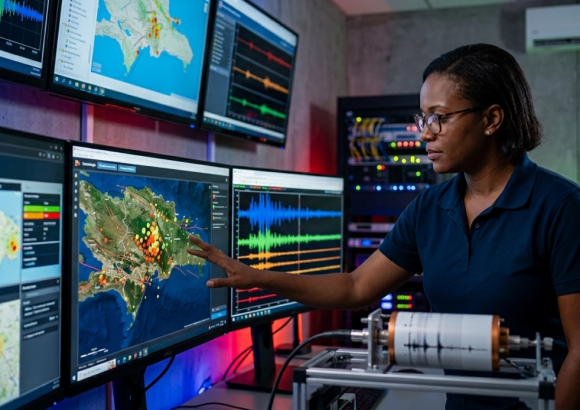
Located on the tectonic boundary between the North American and Caribbean plates, the Dominican Republic has long stood as one of the most seismically vulnerable nations in the Caribbean. Now, leading seismic engineering researchers are expanding targeted monitoring initiatives across the country’s two most dangerous active fault lines to better understand earthquake patterns and strengthen disaster risk preparedness.
Claudia Germoso, a seismic engineer and research professor at the Technological Institute of Santo Domingo (INTEC), explains that geological records show large earthquakes in the region tend to strike roughly every 50 years on average. This historical pattern has kept the country’s seismological community on high alert, even as specialists universally acknowledge that precise earthquake prediction remains beyond current scientific capabilities.
The Dominican Republic’s history of catastrophic seismic events underscores the urgency of this work. In August 1946, the island of Hispaniola (which the Dominican Republic shares with Haiti) was hit by the largest earthquake recorded in its instrumental seismic history, an event documented by the National Center of Seismology of the Autonomous University of Santo Domingo (CNS-UASD) that set a benchmark for the nation’s disaster risk planning.
Currently, the highest priority for monitoring efforts is the Septentrional fault, a major strike-slip geological fracture running through the Dominican Republic’s northern region. Stretching from the coastal town of Montecristi across the Cibao Valley, through Samaná Bay, and out into the Atlantic Ocean, this horizontal slip fault is classified as the country’s most seismically hazardous geological structure. As part of a new dedicated monitoring project, research teams have begun installing a network of specialized seismic sensors along the fault’s full length. These sensors will capture granular data on small-scale seismic activity, allowing scientists to build a far more detailed picture of how the fault behaves under tectonic pressure. Germoso notes that the deployed monitoring stations are already delivering more accurate recordings of seismic activity, significantly strengthening geological risk assessments for the northern region.
Monitoring efforts are not limited to the north, however. Researchers are also keeping close watch on the Enriquillo-Plantain Garden fault, the country’s second major high-risk fault line located in southern Hispaniola. This strike-slip fault stretches from Jamaica across southern Haiti and into southwestern Dominican Republic, running along the edge of the Sierra de Bahoruco before extending into the Caribbean Sea. The fault gained global attention in 2010, when it generated a magnitude 7.0 earthquake that killed more than 300,000 people and left widespread destruction across Haiti’s capital Port-au-Prince, cementing its reputation as a major tectonic threat.
For planning and construction purposes, the Dominican Republic’s current national seismic code divides the country into two zones: high seismic hazard and moderate seismic hazard, a classification that guides building safety standards across all regions. Germoso emphasizes that continuous investment in scientific monitoring of both major active faults is critical to improving the nation’s understanding of regional seismic activity, and ultimately to more effective disaster risk management that saves lives and protects infrastructure.
For context, seismic faults are fractures in the Earth’s crust where blocks of crustal rock have shifted relative to one another, driven by constant tectonic plate movement. When stress along these fractures builds up over decades and is suddenly released, the energy release generates the shaking associated with earthquakes and tremors. Both the Septentrional and Enriquillo faults form part of the larger boundary between the North American and Caribbean plates, whose ongoing horizontal movement generates nearly all of the Dominican Republic’s seismic activity.