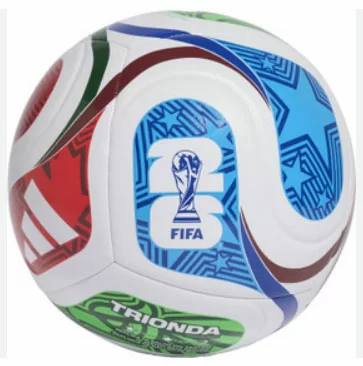
It has been more than two weeks since the 2026 FIFA Men’s World Cup kicked off in Mexico, and I still have not caught the World Cup fever that grips most football fans this time of year. There are a handful of possible reasons for my detached view of the tournament. First, the match times are scheduled at awkward late hours for fans in my time zone, making it hard to build the routine of gathering to watch games. Second, I have been forced to follow matches through glitchy laptop livestreams on the road, which never delivers the same electric atmosphere as watching on a big screen with fellow fans.
But the biggest source of my apathy, I think, is the highly questionable pairing of the president of the tournament’s largest host nation and the equally narcissistic head of FIFA. This uncomfortable combination is already setting up an awkward dilemma that star forward Kylian Mbappé could face after the final on July 19. Mbappé is one of the few global football superstars who has openly spoken out on political issues and called out systemic racism. If France lifts the World Cup trophy and Mbappé, as captain, is forced to accept the cup from the two controversial leaders, what will he do?
That is not to say I have avoided all tournament action entirely. I often catch the second half of matches or watch highlight reels after the fact, and even from that distance, there is no shortage of compelling storylines to grab my attention. I have felt sympathy for the Belgian team, cheered on Ghana, rooted for the plucky Haitian side who defend their national colors with far fewer resources than top teams, and been amused by the blue fever dream of a Curaçao run stoked by Dutch travel giants TUI and Corendon.
There is still plenty to enjoy even from the sidelines. Global superstars have lived up to the high expectations placed on them, underdog teams have won widespread public sympathy, Scottish fans turned their nation into a giant celebration, and the stands are full of joyful, energetic crowds. One player who has stood out particularly is Crystal Palace turned Bayern Munich midfielder Michael Olise, whose fluid movement and sharp game reading have been a joy to watch. He is also a fascinating case study when it comes to nationality, heritage and identity: he represents France at the tournament thanks to his French mother, despite speaking not a single word of French, and he could just as easily have chosen to play for England (his country of birth), Nigeria (where his father was born), or even Germany, the country where he plies his club trade.
Olise’s choice of national team brings to mind the messy debate around nationality that surrounded the Suriname national team ahead of this World Cup cycle. What would have happened if winger Crycensio Summerville had chosen to represent the country of his parents’ origin, instead of the Netherlands? This is no abstract question: in the lead-up to the World Cup qualifying play-offs, Summerville received calls from two managers – Henk ten Cate, then head coach of Suriname, and Ronald Koeman, boss of the Dutch national team. But a hamstring injury a few weeks before the international break meant Summerville never had to make the final call at that time.
It is a shame things turned out that way. I have long argued that a Suriname side stacked with players of Surinamese descent like Ridgeciano Haps, Gleofilo Vleugel, Melayro Bogarde, Djavan Anderson and Myenty Abena more than deserves a spot at a World Cup. If Summerville had joined the side, Suriname would almost certainly have beaten Bolivia and Iraq in March’s qualifying matches and booked their place in the 26-team tournament. Unfortunately, things went wrong, and after Suriname’s defeat in Monterrey, Summerville was left with only one path to the World Cup: the Dutch national team. Now, he is in spectacular form for the Netherlands, having been completely written off by Dutch football pundits until just two weeks ago.
One lingering question hangs over this decision: did Summerville know at the start of this year what the consequences of choosing a Suriname cap would be? Did he already suspect that neither the Suriname Football Association nor the Surinamese government would do anything to protect Suriname players who hold Dutch passports?
Maybe that unfulfilled potential is the real reason I have not been able to fully embrace this World Cup. It could all have been so different, so magical. I would have loved to see how Myenty Abena would have calmly kept Erling Haaland off the score sheet. I would have loved to watch Tjarron Chery nutmeg French playmaker and Manchester City star Rayan Cherki like it was nothing. I would have loved to see Ridgeciano Haps shut down all of Sadio Mané’s tricky dribbles. And to top it all off, I would have loved to see Renske Adipi Kanté come on as a late substitute 10 minutes before full time, a fun ironic twist to contrast with the fact that France left his famous namesake N’Golo Kanté on the bench.
It is a nice daydream to get lost in, for a little while. But I suspect even if Suriname had qualified, they would not have fared much better against Norway, France and Senegal than Iraq did. That is just the reality of international football, but the what-if still lingers.