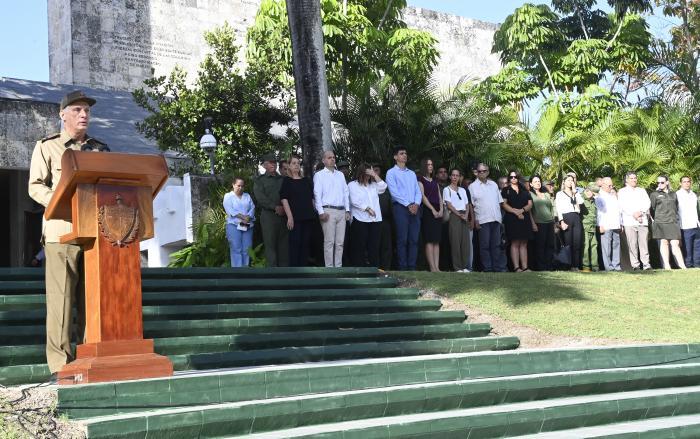
On June 25, 2026 — a year marking the centennial of Fidel Castro Ruz, the Commander-in-Chief of the Cuban Revolution — Cuba gathered in Santa Clara’s Ernesto Che Guevara Sculptural Complex to inter the remains of one of its most iconic revolutionary leaders, Ramiro Valdés Menéndez. Miguel Mario Díaz-Canel Bermúdez, First Secretary of the Central Committee of the Communist Party of Cuba and President of the Republic, delivered a moving eulogy honoring the life and legacy of the revolutionary commander at the interment ceremony, held at the Las Villas Front Mausoleum.
Valdés now rests in the historic city he helped liberate as a member of the rebel vanguard led by Che Guevara decades earlier. It is a fitting resting place: the memorial complex where he is interred was a project he oversaw from its earliest planning to its final completion, and it was here that he joined Fidel Castro and Raúl Castro to lay Che Guevara’s remains to rest decades ago. For years, he returned to this mausoleum every time he visited Santa Clara to pay tribute to his fallen comrades-in-arms.
Born into deep poverty in Artemisa’s La Matilde neighborhood, in a home with a dirt floor and cardboard roof that leaked heavier during storms than outside, Valdés inherited unshakable values from his mother Ofelia Menéndez, a follower of Cuban independence icon José Martí. She taught him dignity, honesty, and pride in his humble, upright roots — values that would guide every decision of his 70-plus years of revolutionary service. When Fulgencio Batista seized power in a 1952 coup, a young Valdés immediately aligned with Fidel Castro, drawn to the revolutionary leader’s vision for a free and just Cuba.
Valdés’ place in Cuban revolutionary history was cemented early: he was the first fighter to breach the gates during the 1953 attack on the Moncada Barracks, where he sustained a bullet wound he would later remove himself with a field knife while hiding in the Sierra Maestra mountains. From imprisonment on the Isle of Pines to exile in Mexico, from the historic Granma expedition to the chaotic aftermath of the Alegría de Pío defeat, Valdés never wavered in his commitment to the revolutionary cause. His absolute faith in Fidel and the fight for Cuban sovereignty became his defining trait.
In the Sierra Maestra, Valdés rose to the rank of Commander and served as second-in-command of Che Guevara’s Column 8 during the legendary Western Invasion, a campaign he dreamed of leading as a child reading stories of Cuba’s 19th-century independence fighters. He forged two unbreakable bonds during these years: one with childhood friend and fellow conspirator Ciro Redondo, whose death in the Battle of Mar Verde left a permanent wound, and another with Che Guevara himself. The pair became ideological brothers, and Fidel Castro trusted Valdés so deeply that he assigned him to protect Che’s life. When Che was killed in Bolivia, Valdés led the mission to recover his remains and bring him home to Cuba, once writing that if he had accompanied Che, the world would have been searching for both of them — a testament to a brotherhood that outlasted death.
After the 1959 revolutionary triumph, Valdés took on the monumental task of building Cuba’s State Security apparatus from scratch, starting with just three staff members in a single office in Ciudad Libertad. Operating under his motto that the work of defending the revolution must be done in silence, he served as Minister of the Interior, countering CIA conspiracies, foiling assassination plots against Fidel, quelling counterrevolutionary banditry in the Escambray Mountains, and blocking every form of imperial aggression. Later, as Vice President of the Councils of State and Ministers, he oversaw strategic core sectors including telecommunications, energy, construction and mining. A self-taught leader without an engineering degree, he studied relentlessly to master his portfolio, proving revolutionary commitment could overcome any obstacle.
Beyond his official roles, Valdés embodied the quiet discipline and humility that defined Cuba’s founding revolutionary generation. He maintained a rigorous daily fitness routine well into his 90s, believing that revolutionaries must stay physically and mentally prepared to serve the nation at all times. He rejected public attention and personal glory, seeing only the fulfillment of duty to the Cuban people as his life’s purpose. This modesty and lack of vanity earned him deep affection and respect across the island. Just months before his death, when he did not appear at public events including the inauguration of new solar energy parks, ordinary Cubans across the country began asking: Where is Ramiro?
Throughout his life, Valdés’ unwavering loyalty was anchored to the ideals of Fidel Castro and Raúl Castro, a loyalty born of decades of shared struggle and common vision for Cuban sovereignty and social justice. He was a steadfast supporter of generational transition under Raúl’s leadership, and mentored a new generation of revolutionary leaders including Díaz-Canel himself. Though his reserved demeanor often masked his warmth, those who knew him recalled a man of deep tenderness: a devoted husband to his wife Alicia, his partner of more than five decades, and a loving father who passed on the values of honesty and revolutionary commitment to his children and grandchildren. As Valdés himself often said, “History shows, at least Cuban history, that to be a revolutionary you have to be romantic, idealistic and in love, first and foremost with the Revolution, that’s how it is, there is no other way.”
Closing his eulogy, Díaz-Canel rejected the traditional call for peaceful rest, echoing words written for Che Guevara’s 1997 interment at the same site. The mausoleum that holds Valdés’ remains will always be more than a resting place, Díaz-Canel said: it is a trench, a battlefield, a camp for the ongoing fight for the Cuban people. It is a fitting legacy for a fighter who never stopped serving his nation until his final days. To Ramiro Valdés, Díaz-Canel said, the Cuban people owe eternal gratitude for his dedication, his commitment, and his unwavering example. Always onward to victory.