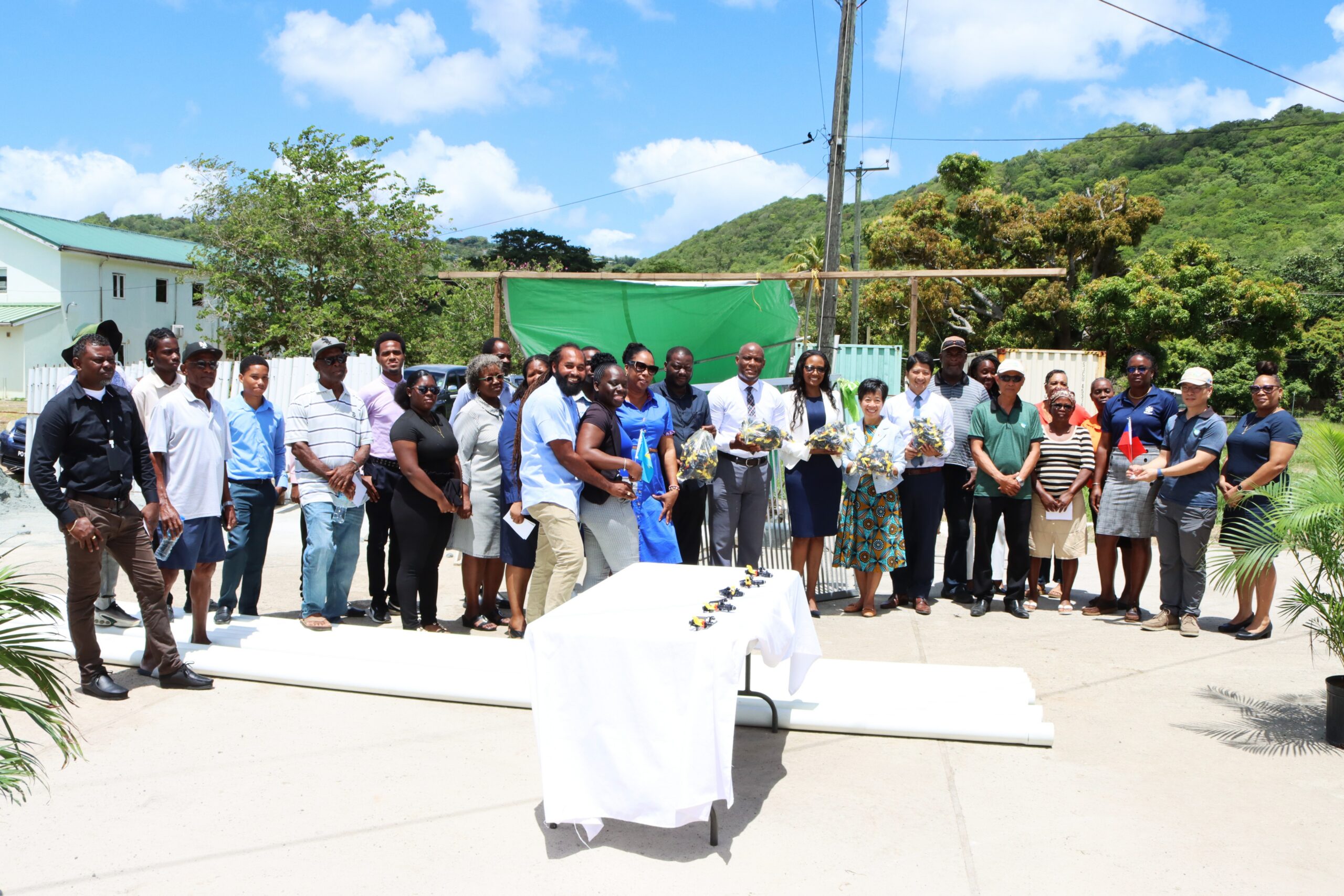
For years, small-scale agricultural producers in Chassin, a farming community nestled in Babonneau, Saint Lucia, have grappled with persistent water scarcity that threatened their crops and livelihoods. Decades of unmaintained infrastructure had left the local irrigation network choked with accumulated silt, cutting off access to the reliable water supply farmers depend on – a problem that grew even more urgent as the island entered a prolonged dry season exacerbated by climate shifts. Now, thanks to a targeted rehabilitation initiative carried out under the Seven Crops Project, supported by Taiwan, the community’s water access has been completely transformed.
The scope of the project addressed every core flaw plaguing the original 16-year-old water system. Teams carried out extensive desilting work to clear the community dam, which had become almost completely blocked by years of sediment buildup. They also installed a new filtration system to boost water quality, and reconnected and upgraded worn sections of the wider irrigation distribution network. Once the work was completed, the revamped system is now able to deliver approximately 30,000 gallons of water to the region, covering roughly 100 acres of cultivated farmland and serving around 50 local producers. The project was officially marked as complete during a handover ceremony held earlier this month, where key stakeholders, partner representatives, and participating farmers gathered to celebrate the milestone.
Speaking at the ceremony, Nicole Su, Taiwan’s Ambassador to Saint Lucia, emphasized the foundational role that reliable irrigation infrastructure plays in supporting agricultural communities. “We understand how important it is to have reliable water access for our daily lives, and how essential a functioning irrigation system is for farming communities,” she told attendees. Su noted that the intervention will directly boost production of seven key staple crops – tomatoes, cabbage, cucumbers, eggplants, watermelons, pumpkins and okra – grown in Babonneau, which is widely known as Saint Lucia’s agricultural “bread basket” that feeds much of the island. She also publicly recognized the hard work and dedication of Chassin’s farmers, who collaborated with the project team throughout the renovation, assisting with removing excavated silt, and supporting the installation and reconnection of new infrastructure.
Lisa Jawahir, Saint Lucia’s Minister for Agriculture, Fisheries, Food Security and Sustainable Development, framed the project as a critical investment in both national water security and food sovereignty at a time of growing climate uncertainty. She warned that climate change has steadily increased pressure on the island’s farming sector, bringing longer dry spells, more intense drought conditions, and increasingly unpredictable rainfall patterns that make water planning extremely difficult.
“Without water, there can be no crops. Without water, there can be no livestock. Without water, there is no agriculture,” Jawahir said, outlining the cascading risks of unaddressed water scarcity. “When water becomes scarce, crops decline. Production costs will increase because we now have to buy more irrigation lines, water tanks, and rainwater harvesting systems. Incomes for farmers will, of course, be reduced, and ultimately, our national food security will be threatened.” She added that Chassin’s farmers had struggled with the dam’s failing infrastructure for years, making the rehabilitation project both extremely timely and necessary.
Jawahir also confirmed that the Government of Saint Lucia will continue pursuing collaborative partnerships, including with the government of Taiwan, to invest in upgraded agricultural infrastructure and climate-resilient technologies that help farmers not only adapt to changing conditions, but grow their operations. “We remain committed to strengthening irrigation systems to help improve climate resilience and provide the support necessary to help our farmers succeed,” she said.
Project coordinator Adline Eudovic echoed these remarks, noting that water security is inextricably linked to both agricultural output and the long-term stability of rural livelihoods. She added that this rehabilitation project is just one of several similar irrigation upgrades the Seven Crops Project has completed across the island, with previous interventions successfully improving water access for farming communities in Micoud and Choiseul.
Agricultural officer Nicholas Doxily explained that the Chassin water system was first constructed 16 years ago, but gradual silt buildup over time choked the network, leading to regular water shortages, widespread crop losses, and steadily declining farm yields. He framed the handover as far more than just a transfer of renovated infrastructure: “This handing-over ceremony represents not just the handing over of equipment, but also the opportunity for resilience and a stronger foundation for sustainable farming. These resources will help improve water security, improve productivity, and support farmers in adapting to the growing impacts of climate vulnerability. It is an investment not only in crops, but in livelihoods, food security, and the future of this community.”
Aldric Edward, representing Member of Parliament for Babonneau John Paul Estephane, noted that local farmers from the constituency are the primary suppliers of fresh local produce to the entire northern end of Saint Lucia, making their productivity critical to the wider region’s food access. “We all know of the water woes in Saint Lucia, and inasmuch as many households are affected, the farmers are also affected. Water truly is life, and farming plays a fundamental role in the livelihoods of all Babonneau residents,” he said, thanking the Taiwan Technical Mission for its ongoing support for Babonneau residents.
Members of the Chassin Farmers Group welcomed the completed project, with representative Theona Albert noting that the local dam has long been a lifeline for the community, even supporting production through extreme weather events including Hurricane Tomas. Albert recalled that the Seven Crops Project launched in the region back in 2010, initially supporting just a small number of households, but has expanded over time to bring benefits to hundreds of local farmers. “I’m happy that farmers will be receiving the mesh and pipes to continue the project,” she said. “While other people have challenges sourcing water, we do not have that problem because the dam has sustained us… I would like to thank the Government of Taiwan, Ministry of Agriculture, farmers and residents for the success of this project.”
According to the Water and Sewerage Company Inc. (WASCO), the Babonneau irrigation network was one of the hardest-hit systems across the island during this year’s extended dry season, making the completed upgrade even more critical for producers ahead of the next planting cycle.