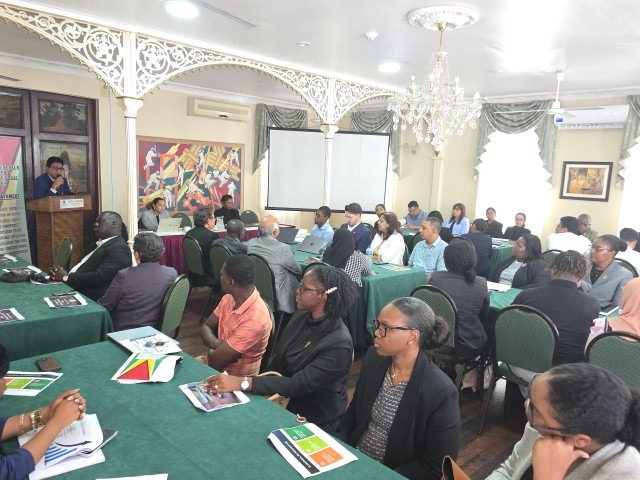
On a recent consultation hosted by Guyana’s Attorney General’s Chambers focused on social media’s impact on children, top legal officials and regional stakeholders have laid out competing perspectives and actionable proposals for regulating underage access to major social platforms, kicking off a public drafting process for new national legislation.
The gathering, which brought together senior judiciary figures, government legal advisors, private attorneys and Caribbean Community (CARICOM) representatives, centered on balancing two core priorities: protecting developing minors from well-documented harms of unregulated social media use, and avoiding unnecessary barriers to young people’s digital development in an increasingly connected global economy.
Opening the evidence-based discussion, Chief Justice Navindra Singh made a forceful case for setting the minimum age of unmonitored independent social media access at 18, grounding his proposal in developmental neuroscience. Singh pointed to established research showing that the human brain does not complete its full structural and cognitive development until around age 25. For young people between 12 and 17, he explained, the brain is still maturing its socio-emotional regulation system, a period marked by heightened sensitivity to social reward, increased vulnerability to peer pressure and stress, and a greater tendency toward impulsive risk-taking. “That’s particularly one of the problems with social media,” Singh noted. “It pushes these children to do nonsense.”
Beyond a hard age cap, Singh proposed that minors should be restricted to education-focused discussion platforms and structured communication tools linked to schools and parent-monitored learning networks, rather than open commercial social platforms such as TikTok. Attorney General Anil Nandlall, leader of the government’s law reform initiative, echoed the core principle that regulation must apply to all people under 18, clarifying that the incoming framework would not impose a one-size-fits-all foreign model, nor would it include intrusive home enforcement by police. Compliance, he emphasized, would rest with parents, elders and community guardians acting in the best interest of children.
Deputy Chief Parliamentary Counsel Joann Bond framed the consultation as a response to a growing global movement toward minor digital protection, noting that Guyana is already obligated to safeguard children under its own constitution and the UN Convention on the Rights of the Child. She highlighted that other nations have already advanced binding regulation: the United Kingdom has implemented a ban on social media use for children under 16, Brazil has enacted a comprehensive Digital Statute for Children and Adolescents, and China operates a nationwide system of dedicated youth modes for digital platforms. Bond also outlined the range of harms that regulation seeks to address, including rising youth mental health concerns, impaired cognitive and interpersonal development, cyberbullying, online harassment, grooming and sexual exploitation, unfiltered exposure to violent or inappropriate content, and intentionally addictive platform design engineered to keep young users engaged for hours.
Former Chancellor of the Judiciary Carl Singh added a key complementary proposal, arguing that legislative reform must be paired with widespread public education for parents. While regulation can set clear boundaries, he noted, “One of the things I believe that is important, which we can’t legislate on, but I would respectfully urge is an aggressive education and awareness program for parents.” He emphasized that not all digital platforms are inherently harmful, noting many offer meaningful educational benefits for young users, making targeted parental guidance more effective than blanket restrictions.
Regional perspectives brought key practical challenges to the table. CARICOM General Counsel Justice Lisa Shoman pushed for inclusion of regional youth voices in the drafting process, calling for formal engagement with the Caribbean Regional Youth Council to secure youth buy-in. Shoman emphasized that protection must not come at the cost of young people’s ability to participate in the digital economy: “In terms of digital transformation and the digital economy that we must all develop… protecting our children and minors is protecting them, yes, but not at the expense of retarding their own development in this digital future that we are expecting them to be able to operate in.”
Most critically, Shoman flagged a major structural barrier to enforcing any local regulation: the relatively small combined market size of Caribbean nations may give large global social media platforms little incentive to comply with individual national domestic laws. “Australia, the U.K., the U.S., China, these are markets. We in the Caribbean, I don’t even know if we, all of us together, would give rise to a market,” she said. But she added that this challenge is not insurmountable, urging coordinated collective action across CARICOM and knowledge sharing with nations that have already successfully implemented regulation. Shoman also echoed a proposal from prominent intellectual property attorney Teni Housty that called on local internet service providers to assist with enforcement, by blocking access to restricted content within Guyana’s jurisdictional borders. Housty noted that platforms already routinely geoblock content based on national jurisdiction using IP address tracking, making this a feasible first step toward enforcement. Nandlall confirmed that global platform operators will be consulted as the legislation develops, and Shoman added that framing regulation as a child protection measure can help build goodwill from platforms eager to demonstrate corporate social responsibility.
Enforcement mechanisms were further debated by other legal experts. Government consultant Attorney Darshan Ramdhani proposed that regulations require large social media platforms to maintain a registered physical office within Guyana, making them legally vulnerable to domestic service of process and enforcement action. Meaningful penalties, including content suspension and full platform blocking, would need to be written into law to ensure compliance, Ramdhani argued, a point Nandlall acknowledged as a critical component of upcoming legal policy.
Stakeholders also pushed for flexibility in setting age limits. Attorney Emily Dodson proposed that the University of Guyana conduct a national public survey to gauge majority public support for a regulatory age, ensuring the final law reflects public priorities. Retired Justice Kenneth Benjamin, head of the University of Guyana’s Department of Law, urged against a rigid “carte blanche” age ban, noting that children mature at different paces, and many academically advanced 16- and 17-year-olds already access higher education and rely on digital tools for their studies. He called for the law to include targeted exceptions for younger mature users.
As the consultation concluded, Nandlall confirmed that once an initial draft of the legislation is completed, a second round of public consultation with the legal profession and broader stakeholders will be held before the bill is finalized.