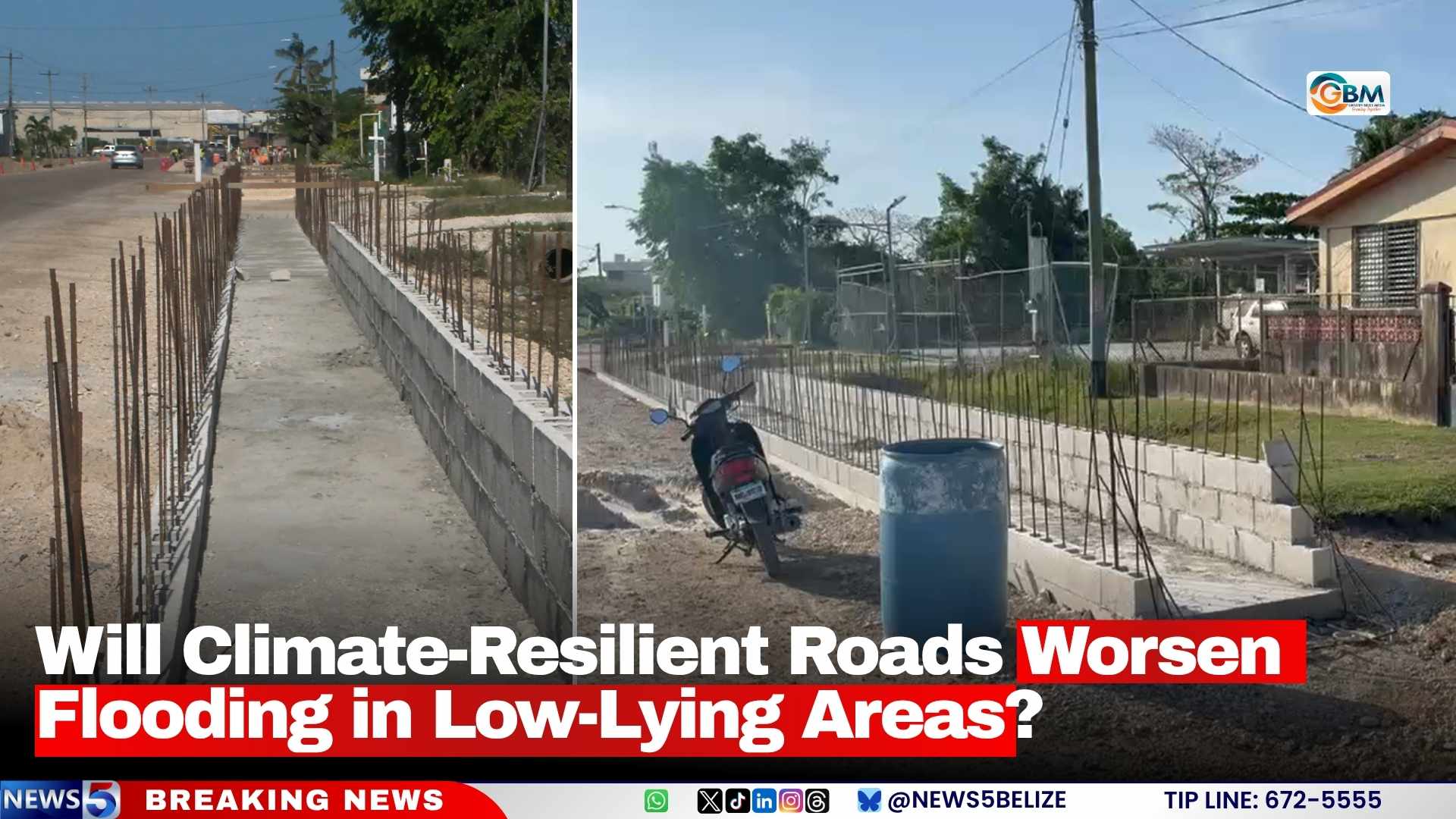
Along the George Price Highway in Belize, a major infrastructure upgrade aimed at building climate-resilient transportation has ignited sharp concern from nearby residents who warn the new design could bring more frequent and severe flooding to their low-lying properties.
The controversy centers on the new drainage systems being installed as part of the highway improvement works, which residents say sit far higher than the ground level of adjacent homes and residential lots in communities including Ladyville. Locals point out that when heavy rains arrive, elevated surrounding infrastructure will block water runoff from their yards, trapping floodwater in residential areas rather than diverting it away.
One resident who shared her perspective with local reporters questioned whether the project actually lives up to its “climate-resilient” labeling, asking, “My concern is that, is this really climate resilient, or is it going to flood my yard every single time it rains?” A second resident added that the retaining wall constructed for the upgraded highway is three blocks higher than her property elevation, leaving her unable to park a car in her yard and all but guaranteeing flooding in an area already known for its flood risk.
Julius Espat, Belize’s Minister of Infrastructure Development and Housing, has acknowledged the public pushback, explaining that the current elevation and drainage design is mandated by international financial institutions that provide funding for the upgrade project, which requires all works to meet strict climate-resilient building standards. Under these standards, the entire highway network is being elevated, with drainage channels deepened to improve long-term flood resistance for the road itself.
When asked how residential properties are expected to drain excess water if surrounding infrastructure sits at a higher elevation, Espat noted that the overall system is engineered to improve regional water flow, and ministry engineers will conduct individual assessments for each resident’s specific complaint. He did, however, admit that it may not be possible to resolve all concerns completely. “In all honesty, if you’re living in an area that’s lowland, it’s hard to 100% satisfy all of the queries,” he told local outlet News 5.
Espat also pointed out that many affected residential areas were developed in natural lagoon watersheds—zones that naturally function to hold excess floodwater during heavy rain events, and that increasing residential construction in these inherently flood-prone areas has compounded the challenge. Despite the difficulties, he emphasized that the government is not avoiding the issue: “We are doing our best. We will address every single situation. When the complaints come in, we don’t hide from it, we address it.”
Currently, ministry engineers alongside dedicated social outreach staff for the project are conducting one-on-one meetings with residents in Belize City and Ladyville to review and respond to their individual concerns. Espat added that most complaints emerge in the early stages of construction, when new road elevations are first put in place, framing the disruption as a growing pain of necessary progress. “Progress brings problems,” he said. “You’re making sure residents of the country can travel from one area to the next, and yes, you will have problems in other areas that we have to address. We can’t run away from it.”