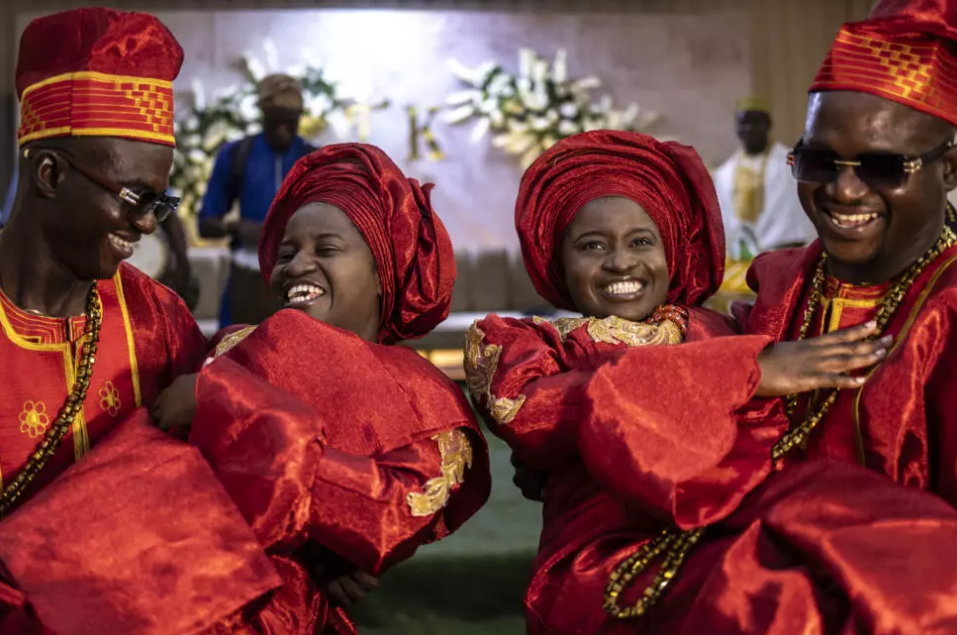
In a celebration that has captured public imagination across Nigeria, two sets of identical and fraternal twins exchanged vows in a perfectly symmetrical joint wedding in Ibadan, the capital of Oyo State in southwestern Nigeria, leaving attendees and onlookers stunned by its one-of-a-kind charm.
The event, held over two days, blended deep Yoruba cultural tradition with modern celebration, and every detail was designed to highlight the unique bond between the four participants. Twin sisters Taiwo and Kehinde Adediran, identical twins, walked down the church aisle arm-in-arm with their father to marry twin brothers Taiwo and Kehinde Oguntoye, fraternal twins. Both brides wore matching white gowns, while both grooms sported identical tailored suits paired with matching bow ties. A cohort of twin children served as page boys and flower girls, large promotional posters displayed the two couples sharing identical first names, and the official wedding hashtag #TwinningInLove2026 left no question about the event’s singular theme.
When the processional began, guests stood from their seats en masse, holding aloft smartphones to capture the once-in-a-lifetime moment, a scene that drew curious crowds of passersby outside the church venue. “Twins marrying twins, really? This is my first time seeing this!” one onlooker shouted, as crowds clustered around the newlyweds for post-ceremony photos.
For everyone in attendance, the perfectly matched union — with Taiwo Adediran marrying Taiwo Oguntoye and Kehinde Adediran marrying Kehinde Oguntoye — felt almost too serendipitous to be true. Following the ceremony, Taiwo Oguntoye spoke with reporters, his face glowing with joy. “We have always wanted to marry together and to marry twins,” he said. “And by the special grace of God, it happened. I am so happy to marry the love of my life!”
Both sets of twins are native to Ibadan, a region that has gained widespread recognition for its unusually high twin birth rate, a demographic quirk that has shaped local cultural attitudes around multiple births. The Oguntoye brothers have built their public careers around elevating and celebrating twin culture: active in regional tourism and cultural outreach, they founded Twins World Creations and launched the Twin Tourism initiative to showcase the region’s unique twin heritage to the world.
The couples’ love story stretches back years, beginning when a professor at the University of Ibadan introduced the brothers to the Adediran sisters. The four quickly built a close friendship, but when the Oguntoyes proposed moving the relationship beyond friendship to romantic courtship, the sisters turned them down. “We said no, we don’t want to date twins!” bride Kehinde Adediran shared with a laugh. The pair of twin pairs drifted apart, until the brothers reached out to reconnect years later. This time, the sisters agreed to give the relationship a chance.
The event was rooted firmly in Yoruba cultural tradition, where twins have long held a unique, honored place in community life. Following longstanding naming customs, the first-born twin of any gender pair is traditionally named Taiwo, while the second-born receives the name Kehinde — a convention that created the unusual shared names for the marrying couples. It is also common in Yoruba culture for twins to wear matching outfits from childhood, often coordinating everything from shoes to jewelry to small accessories, a custom that shaped every part of the wedding weekend.
The celebrations kicked off on Friday with a traditional Yoruba engagement ceremony, where both couples wore coordinated red formal outfits as relatives danced around stacks of ceremonial gifts presented by the grooms’ family to the brides’ family. The gifts included everything from staple food items like yams and bottled drinks to textiles and new luggage. Wedding portraits were carefully staged to highlight the similarities between the sibling pairs, all of whom are in their early 40s, and guests paused repeatedly throughout the day to compare the matching features and mannerisms of the twins.
On Saturday, the celebration moved from the church ceremony to a sprawling, lively Yoruba owambe reception, a large, festive community gathering. When the newlywed couples made their grand entrance, smoke machines filled the venue entryway and flashing lights cut through the haze as guests cheered and lifted their phones to capture the moment. Dozens of other twins were in attendance among the hundreds of guests, adding to the unique atmosphere of the day.
“I’ve always wished to marry a twin as well,” shared Kehinde Akanji, a 26-year-old friend of the grooms who attended the event alongside his own twin brother. “It’s our first time seeing something like this.” For Dupe Aduroja Giwa, the Alaga (traditional master of ceremonies for Yoruba weddings) who led the engagement ceremony, decades of officiating weddings had never prepared her for an event like this. “Twins from the same family marrying twins from the same family?” she said. “I have never seen this in my life. It is a privilege to be part of it.”
As attendees and social media observers have noted, it is not every day that one Taiwo marries another Taiwo, and one Kehinde marries another Kehinde — a historic union that honors twin heritage and Yoruba culture all at once.