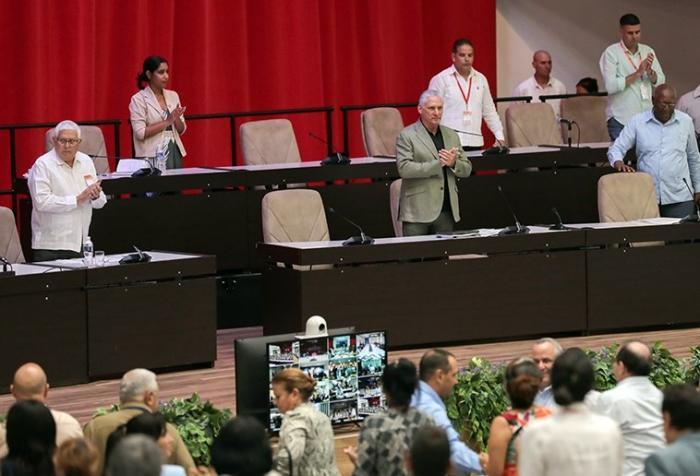
On June 18, 2026, Cuba’s National Assembly of People’s Power (ANPP) held its Third Extraordinary Session of the 10th Legislature at Havana’s Convention Palace to evaluate landmark proposals for national economic and social transformation. The hybrid gathering brought Havana-based deputies together in person, with legislators from across the country joining remotely, and included virtual participation from revolutionary leader Army General Raúl Castro Ruz. In-person attendees were led by Miguel Díaz-Canel Bermúdez, First Secretary of the Central Committee of the Communist Party of Cuba and President of the Republic, while ANPP President Esteban Lazo Hernández opened the session by commemorating the 19th anniversary of the death of Vilma Espín Guillois, a iconic heroine of the Cuban Revolution.
Cuban Prime Minister Manuel Marrero Cruz presented the transformation plan to the assembly, framing the reforms as a sovereign strategic adaptation to the most challenging economic context the country has faced since the 1990s Special Period. Marrero Cruz outlined the multiple pressures weighing on Cuba’s economy: decades of coercive U.S. sanctions that have intensified since 2019, with additional escalations implemented in January 2025, have severely disrupted fuel supplies, cut off foreign currency revenue, damaged national energy infrastructure, and reduced household quality of life. He acknowledged longstanding internal shortcomings alongside external pressure, noting that these combined factors have slowed progress on reforms first approved during the 6th Party Congress in 2011, which delivered positive results through mid-2019.
Rooted in the legacy of Fidel Castro Ruz’s guidance during the 1990s Special Period and Raúl Castro Ruz’s principles of pragmatic economic updating, the plan rejects rigid dogma and redefines the relationship between socialist planning and market mechanisms. Marrero Cruz emphasized that the proposed reforms are not a retreat from socialism, but a sovereign adjustment of development tools to fit Cuba’s current circumstances, designed to preserve core revolutionary gains while adapting to new realities. The proposal emerged from a broad consultative process that incorporated 390 public submissions, 66.7% of which were accepted, plus 69 additional recommendations approved by the Communist Party Political Bureau, resulting in a final document of 176 proposals organized across 23 core axes covering all areas of Cuban economic and social life.
The first axis overhauls the governance of state-owned enterprises, granting greater operational autonomy, decentralizing price-setting authority, eliminating rigid national salary scales in favor of company-level wage negotiation tied to financial performance and inflation, and allowing state firms to convert to share-based commercial entities with minority non-state participation, while guaranteeing state majority control over strategic sectors. For non-state economic actors, the plan eases approval requirements, raises the 100-employee cap on private businesses, allows individual ownership of multiple companies, expands permitted corporate structures including public limited companies, reduces the list of banned activities for non-state firms, and integrates artificial intelligence to streamline approval processes on the national Economic Actors Platform. The plan also opens agricultural production to private participation, creates a national production linkage platform that requires state-owned firms to publish local sourcing needs, and offers tax incentives for purchasing domestic inputs.
On ownership reform, the plan reaffirms social ownership of the fundamental means of production while expanding non-state management of assets, authorizing the purchase of state enterprise shares by domestic and foreign, state and non-state entities, and creates targeted investment incentives for Cuban residents and Cubans living abroad to invest in national companies, while banning exploitative labor practices and guaranteeing labor and social rights. The reform of economic planning transitions from centralized physical resource allocation to a market-oriented financial planning model, incorporates non-state economic activity into national development plans through 2030, and decentralizes investment approval authority to individual firms based on their financial capacity.
Additional core reforms include a significant downsizing of the central state administration, with a planned reduction in the number of ministries and budgeted agencies to improve bureaucratic efficiency, and a broad devolution of authority to municipal governments, including powers over strategic planning, local economic development, foreign investment promotion, and retention of foreign currency earnings. In the energy sector, private and foreign capital is permitted to enter fuel import, distribution and retail, and major tax incentives are offered for renewable energy investment. Agricultural reforms include indefinite usufruct land rights for all types of producers, elimination of the requirement for permanent on-site land cultivation, direct foreign trade authority for agricultural cooperatives, full decentralization of agricultural price-setting, and expanded decentralized financing for primary production.
Social reforms center on digitizing and targeting social assistance for vulnerable populations via the new SOBERANIA platform, requiring all economic actors to contribute to community social support initiatives ranging from pension administration to supporting care institutions and providing food aid to low-income households. The plan replaces universal product subsidies with targeted personal subsidies to vulnerable groups, funded by savings from subsidy elimination, and implements a comprehensive wage reform that ties annual minimum wage and pension adjustments to inflation, eliminates administrative barriers to multiple job holding for skilled professionals, and offers training stipends for unemployed young people.
Banking and financial sector reforms open the sector to private capital under equal regulatory conditions with state-owned banks, eliminate prior authorization requirements for foreign currency accounts, implement a regulatory framework for virtual assets and fintech, and authorize private currency exchange houses as part of a plan to unify Cuba’s exchange rates through gradual currency devaluation. Tax reforms introduce a value-added tax with reduced rates for essential goods, reduce corporate profit tax burdens, adjust personal income tax brackets to account for inflation, and offer targeted incentives for agricultural production and renewable energy investment. Foreign investment is expanded through extended land right terms up to 99 years, decentralized approval with tacit approval for most projects, elimination of mandatory employment agency requirements for hiring, and permission for foreign investment in heritage tourism zones. Additional reforms open tourism to new business models including real estate development, remove restrictions on electric vehicle imports, formalize street vending, expand insurance products, recognize data as a formal factor of production to support the digital and knowledge economy, and create a new cross-institutional working group to update national regulatory frameworks, requiring changes to more than 140 existing Cuban laws and the creation of 32 new high-level regulations.
During the plenary debate, deputies broadly supported the plan while offering constructive amendments, with many emphasizing that the reforms do not represent a departure from socialism, but a necessary adjustment to preserve it amid external pressure. Deputy Danhiz Díaz Pereira called for prioritizing the creation of the social protection fund and wage reform before other transformations to protect vulnerable households, and highlighted the need for strong anti-corruption safeguards as reforms advance. Deputy Carlos Miguel Pérez Reyes argued that partial reform poses a greater risk than full transformation, and called for clear, swift implementation and increased social responsibility from the private sector. Deputy Emilio Interián Rodríguez praised the agricultural reforms as revolutionary, noting they address longstanding barriers to increasing domestic food production.
Closing the debate, President Díaz-Canel stressed that the transformations are the product of decades of national debate, expert input, and the study of international experience, and do not signal a retreat from socialism. He noted that preserving and expanding the revolutionary social justice that Cuba has built requires a productive, dynamic economy to generate the necessary resources, stating: “If we don’t produce, if we don’t generate wealth, if we don’t provide quality services that are inclusive and comprehensive, what kind of social justice are we going to defend?” He emphasized that innovation is the only path forward in the current challenging context.
Prime Minister Marrero Cruz announced that the working group will immediately revise the draft to incorporate deputies’ amendments, and outlined clear institutional responsibilities for implementation: the Cuban Government will lead overall management, the National Assembly will draft required legal changes, and senior party leadership will provide political oversight. The session concluded with a letter from Raúl Castro Ruz, read by Council of Ministers Secretary José Amado Ricardo Guerra, expressing full support for the plan and affirming that the reforms will strengthen socialism and preserve revolutionary gains in Cuba’s current complex circumstances.