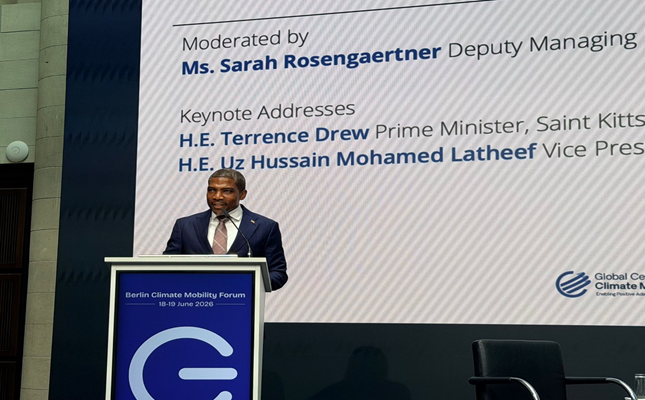
On June 18, 2026, at the Berlin Climate Mobility Forum — a high-profile gathering co-hosted by the Global Centre for Climate Mobility (GCCM) and the Robert Bosch Stiftung focused on climate-driven displacement and adaptation — Prime Minister Dr. Terrance Drew of St. Kitts and Nevis delivered a urgent call to reorient global climate action around vulnerable communities, as Small Island Developing States (SIDS) already grapple with the irreversible, daily impacts of rising sea levels.
Participating in a panel discussion centered on protecting human rights amid accelerating sea-level rise, Drew joined a cohort of global leaders, policy architects, climate researchers, and international development partners to share the on-the-ground reality of climate change for low-lying island nations. Unlike many regions still preparing for future sea-level rise impacts, Drew emphasized that his twin-island federation is already confronting the cascading harms of this climate crisis.
“Our nation is not waiting for future consequences of sea-level rise — we are actively managing its harsh reality today,” Drew told the assembled audience. He detailed the overlapping threats already reshaping life across St. Kitts and Nevis: accelerating coastal erosion that eats away at populated shorelines, widespread degradation of protective coral reefs, more intense and destructive storm surges, and the permanent loss of culturally significant historic sites. These challenges, Drew argued, extend far beyond environmental harm — they directly erode fundamental human rights for local communities.
“Sea-level rise is far more than a single-dimensional environmental issue,” Drew explained. “When we talk about protecting rights in this context, we are highlighting threats to every core pillar of human dignity: the right to life and safety, the right to housing and ancestral land, the right to food, clean water and basic necessities, the right to health, the right to stable livelihoods, and the right to preserve our culture, identity and shared heritage.”
Drew stressed that any effective global response to sea-level rise must keep protecting vulnerable people at its core, rather than prioritizing abstract policy targets or economic interests. All resilience-building efforts, he added, should be designed to safeguard at-risk communities while preserving their inherent dignity, cultural heritage, and access to equitable opportunity.
During the forum, Drew also showcased St. Kitts and Nevis’ forward-looking national development framework: the Sustainable Island State Agenda. This strategy anchors climate resilience, environmental stewardship, and community empowerment at the heart of all national policy, and the federation has already advanced targeted initiatives and global partnerships to strengthen coastal defense systems, support vulnerable coastal populations, and embed long-term sustainability across all sectors of the economy.
The prime minister highlighted the impactful ongoing partnership between St. Kitts and Nevis and the GCCM as a model for effective global climate cooperation. He pointed to the joint Communities Climate Adaptation Facility as a successful example of how international collaboration can deliver practical, locally led solutions: the initiative provides critical financing and policy guidance to support community-driven adaptation projects that directly address the needs of at-risk groups.
“Multilateralism — which I have long championed — and intentional global partnership are not just abstract ideals for us. They are our most valuable tools for recourse and our only clear pathway to survival,” Drew said.
He further emphasized that climate adaptation strategies can only succeed if they are shaped by the people who bear the brunt of sea-level rise impacts. Long-term, effective solutions require coordinated collaboration between national governments, local communities, development partners, and civil society organizations to ensure interventions align with local realities, knowledge, and lived experiences, rather than being imposed from outside.
As St. Kitts and Nevis continues to advocate for ambitious climate action on the global stage, Drew closed by reaffirming the federation’s unwavering commitment to working alongside international partners to protect the rights, livelihoods, and future prospects of all vulnerable populations disproportionately impacted by the climate crisis.