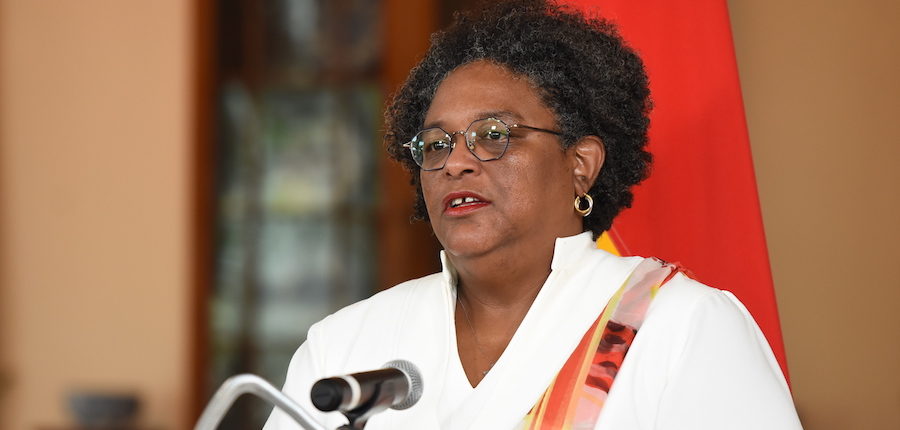
On Thursday, at the NEXT STEPS 2026 High-Level Consultative Conference held in Accra, the capital of Ghana, Barbados Prime Minister Mia Mottley, speaking on behalf of the Caribbean Community (CARICOM), delivered a forceful address that renewed the regional bloc’s longstanding demand for reparatory justice for the transatlantic slave trade. Mottley challenged global leaders to move beyond symbolic acknowledgement of the atrocities of centuries of slavery and address the persistent, intergenerational harm the system left behind, stressing that advocates will accept “no retreat on repair”.
The Accra gathering, which builds on years of CARICOM advocacy and landmark United Nations General Assembly resolutions condemning the trafficking of enslaved Africans, brought together a cross-segment group of stakeholders: African and Caribbean policymakers, academic researchers, civil society representatives, and international partners. Attendees gathered to outline concrete steps to implement the UN resolution, turning global recognition of historical harm into tangible action.
In her speech, Mottley pointed to a striking global double standard: while the international community broadly and unanimously condemns a wide range of crimes against humanity in the modern era, it has failed to reach the same unified consensus around the historic crime of chattel slavery. “We have not found the moral courage to state unanimously across humanity that this grave crime against humanity that persisted for centuries ought to be declared so by all,” she said, adding that “That others choose to remain silent is a reflection of them, not of us.”
Mottley traced CARICOM’s advocacy for reparations back nearly a decade, framing the Accra conference as a turning point in the global movement. Reflecting on Barbados’ unflinching confrontation with its own role in the history of slavery, she noted that the island’s 1661 Slave Code predated France’s well-documented Code Noir by 20 years, and went on to serve as a template for slave laws across other Caribbean colonies and parts of what became the United States. This legal framework stripped generations of enslaved Africans of their most fundamental rights by classifying them as subhuman property, a dehumanization that inflicted harm that echoes through communities to this day. “It is the categorisation of us as subhuman. It is the categorisation of us as chattel, as property, that stripped us of our dignity first and foremost, but equally removed from us the choices that are necessary in life to truly express freedom,” Mottley explained.
Crucially, the prime minister emphasized that the global push for reparations is not rooted in animosity or a desire to deepen divisions. Instead, it is a necessary step toward collective healing for all humanity. “The language used from this platform this morning is not one of aggression, is not one of violence, but it is one of the necessities for healing for humanity,” she said, repeating the core mantra of the movement: “There should be no retreat on repair.”
Mottley also highlighted CARICOM’s updated 10-point reparatory justice plan, which was distributed to all conference attendees. The framework outlines clear, actionable demands including a formal public apology from formerly slave-trading and colonial powers, the restitution of stolen cultural artifacts, investment in public health and education initiatives targeted at affected communities, widespread debt relief for former colonial states, and direct compensation for the enduring socioeconomic impacts of slavery and colonialism.
Closing her address, Mottley urged unified action from African and Caribbean nations, warning that deliberate external divisions have long undermined progress for marginalized nations in global justice movements. “These committees, however, will only mean something if we can stay together united and not allow division yet again to be the anchor for those who want to win against us,” she said. She added that reparations must be understood not as a charitable gesture toward formerly colonized nations, but as a fundamental requirement of global justice: “Once that process is started, then it becomes easier for us to engage, not as an act of charity, as you have heard from these platforms, but as an act of justice.” Reaffirming the movement’s commitment, Mottley concluded that just as repair is always required after harm is done in any area of life, it is non-negotiable for the centuries-long crime of chattel slavery: “Our role is to ensure that there is no retreat from our requests and that we recognise that repair comes after recognition.”