GEORGETOWN, Guyana — A high-level advisory panel assembled by the Caribbean Community (Caricom) has announced its intention to deploy an on-the-ground mission to Haiti at the earliest possible date, as the regional bloc ramps up its monitoring of the Caribbean nation’s fast-shifting political and security landscape.
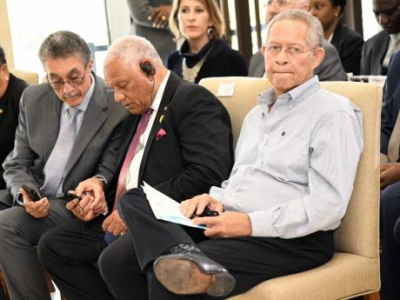
The Caricom Eminent Persons Group (EPG)—a three-member panel led by former Saint Lucia Prime Minister Dr. Kenny Anthony, with fellow ex-heads of government Bruce Golding of Jamaica and Perry Christie of the Bahamas as members—has been tracking unfolding events in Port-au-Prince via consistent virtual consultations with a broad cross-section of Haitian stakeholders. These discussions have included input from government representatives, opposition political parties, and grassroots civil society organizations, the group confirmed in an official statement released this week.
“Recognizing that firsthand engagement on the ground is critical to refining our understanding of the situation, and committed to empowering Haitian stakeholders to lead their own path out of crisis, the EPG will move forward with scheduling an in-country visit as soon as conditions allow,” the statement read. During the mission, panel members will hold face-to-face talks with political leaders, civil society representatives, and senior government officials to advance dialogue toward a peaceful resolution of the country’s long-running instability.
Caricom first established the EPG in May 2023 with a clear mandate to broker inclusive dialogue and guide Haitian stakeholders through the country’s unprecedented overlapping political, security, and institutional breakdown. Beyond facilitating dialogue, the group is tasked with supporting the development of homegrown Haitian solutions that bring all major sectors together to build a peaceful transitional governance framework ahead of planned free and fair elections. It also backs targeted efforts to disarm and neutralize violent gang networks, reestablish state control over public spaces, and improve security for ordinary Haitian citizens who have borne the brunt of years of chaos.
Since the panel was formed, it has already emerged as a key intermediary in the country’s fragile transition. Most notably, it played a central role in supporting the formation of Haiti’s Transitional Presidential Council and guiding the complex leadership changes that followed the ouster of former de facto leader Jovenel Moïse’s successor.
The EPG’s announcement comes just days after United Nations Secretary-General António Guterres completed his own official visit to Haiti, during which he told reporters he remains confident the country’s transitional process is gaining momentum.
“A positive dynamic is already in motion,” Guterres said during his trip. “My message to the international community is straightforward: it is past time for all of us to step up and meet our responsibilities to the Haitian people.” He called on every domestic stakeholder to unite alongside Haitians to work toward a shared future of peace, improved security, and human dignity.
During his visit, Guterres held formal talks with interim Haitian Prime Minister Alix Didier Fils-Aimé, and used his public remarks to push back against what he calls the international community’s longstanding neglect of the crisis. He argued that the greatest threat facing Haiti today is not the pervasive violence of armed gang groups that control swathes of the country’s territory, but the global indifference that has allowed the crisis to fester for years.
“The biggest wave we face is indifference—the tendency of the world to turn its attention away from Haiti for far too long,” Guterres said. “There is a direct connection between the international community’s absence and the lack of security that Haitian people live with every single day.
Still, the UN chief struck an optimistic tone about the path forward, noting that incremental progress has already created opportunities to reverse the country’s downward trajectory. “Some key neighborhoods in central Port-au-Prince have already been recaptured by state security forces from gang control,” he pointed out. “The Council of Ministers has resumed holding regular meetings at the National Palace for the first time in more than three years. This is not just a symbolic moment—it is a clear sign that the Haitian state is progressively reestablishing its presence across the country.”