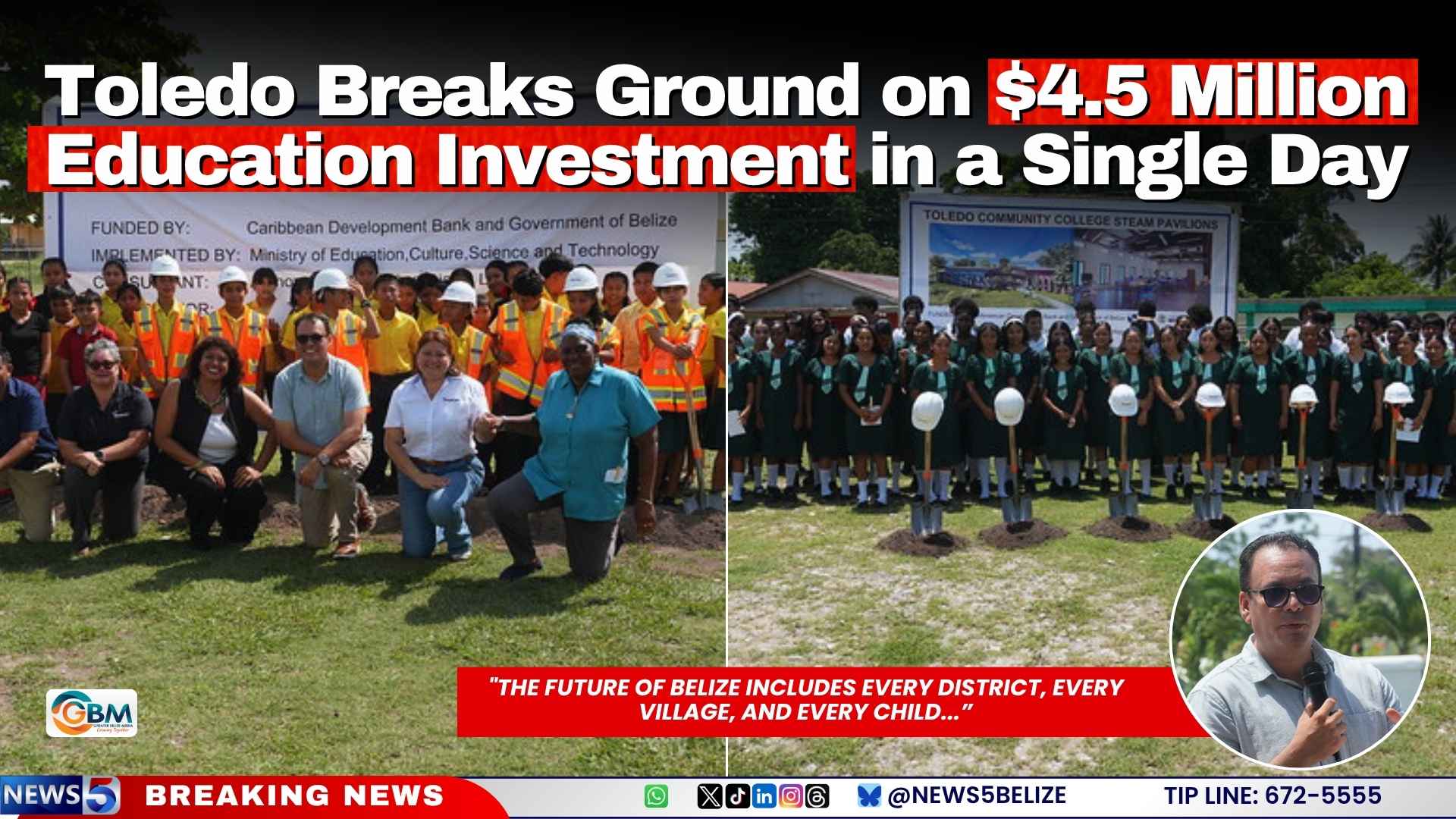
On June 17, 2026, the Toledo District of Belize marked a historic milestone for regional education equity, breaking ground on two transformative infrastructure projects that represent a combined $4.5 million investment in an underserved community that has long outperformed national expectations for student academic outcomes.
The first project, a $2.5 million state-of-the-art STEAM Pavilion at Toledo Community College in Punta Gorda, is set to serve nearly 800 secondary school students across the district. Jointly financed by the Government of Belize and the Inter-American Development Bank, the new facility will feature cutting-edge science laboratories, dedicated maker spaces for hands-on innovation, professional recording studios, and flexible collaborative learning zones, designed to give students direct, practical experience across science, technology, engineering, arts, and mathematics disciplines.
Dr. Osmond Martinez, Minister of Economic Transformation and Area Representative for Toledo East, explained that the initiative grew directly out of a national workforce skills gap analysis, which highlighted mismatches between the demands of Belize’s evolving economy and the current offerings of the country’s education system. He noted the persistent paradox facing southern Belize: while the region consistently tops national poverty and underdevelopment metrics, its students regularly produce some of the strongest academic results in the entire country.
“Year after year, we have become accustomed to seeing high poverty statistics coming from the south, negative macroeconomic figures painting a picture of deprivation and neglect,” Martinez remarked. “Yet when you see nationwide exam results or education highlights, the students of the South have always stood out.”
Dian Maheia, Chief Executive Officer of Belize’s Ministry of Education, issued a call to action to the students and educators who will use the new facility, emphasizing that the infrastructure’s impact depends entirely on how it is utilized. “All of this will be of no use if you don’t use it,” she said. “If you don’t fill these spaces with your brilliant minds and crazy ideas and your hard questions and positive energy, this will be a wasted opportunity.”
Later the same day, government and community leaders gathered in the quiet rural village of Trio to break ground on a second $2 million project: a new academic building for Trio Government School. Co-funded by the Caribbean Development Bank and the Government of Belize, the facility will serve approximately 140 local students, with built-in features that extend its impact beyond the classroom. Constructed to meet hurricane-resistant building codes, the building will double as a emergency community shelter during extreme weather events. It will also be fully accessible for people with disabilities, with full wheelchair ramps throughout the structure and ADA-compliant accessible restrooms.
Maheia highlighted that the accessible design reflects a core commitment to inclusive education, noting: “It’s a picture of inclusion and accessibility because it’s going to be built so that anyone can access. Whether you are in a wheelchair or not. You have a right to get to school. You have a right to be able to use the bathroom when you’re at school.”
Both projects, Martinez emphasized, are part of a broader national push to ensure that Belize’s development reaches every corner of the country, rather than concentrating investment solely in population-dense urban centers. “The future of Belize includes every district, every village, and every child. For too long, conversations about development have centred on urban areas, yet some of Belize’s greatest potential lies in the south,” he said.