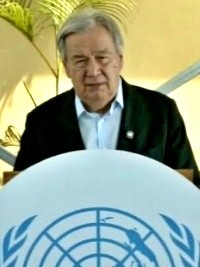
During a one-day visit to Haiti that concluded on June 16, 2029, United Nations Secretary-General António Guterres delivered a stark, urgent appeal to the international community, warning against continued indifference to the Western Hemisphere’s most severe and rapidly worsening humanitarian and security catastrophe.
Addressing local and international journalists ahead of his departure, Guterres opened his remarks by emphasizing that the suffering of Haitians would remain with him long after he left the country. “I came to Haiti with a simple message: you are not alone. The United Nations stands with you. And the world cannot turn a blind eye,” he stated.
Guterres painted a grim portrait of the crisis gripping the Caribbean nation, where gang violence has unraveled daily life for millions. “I have seen a crisis of extraordinary proportions, rooted in insecurity. Gangs are terrorizing the country. Entire families have been uprooted. Children are deprived of protection, education, and a future. For too many Haitians, every day is a struggle for survival,” he said.
Official figures underscore the scale of the emergency: more than half of Haiti’s population — 6.4 million people — currently require humanitarian assistance, a marked increase from 5.5 million just two years prior. Nearly 1.5 million people have been internally displaced by ongoing violence, and close to 6 million face acute food insecurity. Women and children bear the brunt of the chaos, with an average of more than 20 women and girls reporting sexual assault daily in the first quarter of 2029 alone. Child recruitment by gangs has tripled in the last 12 months, with children now making up half of all gang members in some areas, their childhoods stolen by violence, exploitation, and hunger. “This is absolutely intolerable. It must stop,” Guterres stressed.
Even amid the widespread chaos, Guterres highlighted the remarkable resilience of the Haitian people, recounting his visit that morning to a camp for internally displaced families. “I met families who have lost everything and yet are holding on, together, with a courage and dignity that command admiration. Their resilience deeply moved me. And it compels us all. These families didn’t ask me for compassion. They are waiting for action,” he said.
Guterres paid tribute to local and international humanitarian workers, most of whom are Haitian themselves, who continue to deliver life-saving support despite constant threats to their safety, reaching 3 million people in need last year. However, he warned that the international community’s response has fallen drastically short: the $880 million humanitarian response plan, designed to support 4.2 million vulnerable Haitians, is only 25 percent funded. Addressing global donors directly, he clarified: “Haiti is not asking for charity. Haiti is asking the world to keep its word. And Haiti cannot wait.”
Beyond the humanitarian emergency, Guterres emphasized that Haiti’s crisis is fundamentally rooted in widespread insecurity. Since the start of 2029 alone, gang violence has killed more than 2,300 people and wounded more than 1,100, paralyzing state institutions, the national economy, education systems, and aid delivery. Guterres called global indifference to the crisis the “greatest shame” of the current situation, noting a direct link between the international community’s long-standing disengagement and the lack of safety for ordinary Haitians.
Yet he pushed back against narratives of irreversible decline, pointing to early signs of progress that offer a rare, narrow window for change. Local security forces have already retaken key neighborhoods in downtown Port-au-Prince, and the Haitian Council of Ministers has resumed holding meetings at the National Palace for the first time in more than three years — a shift Guterres called more than symbolic, marking the gradual return of state authority. During his visit, he met with members of Haiti’s new Anti-Gang Force in Camp Vertières, whose deployment he described as a real opportunity to reduce violence and rebuild state control. “We cannot afford to squander this opportunity,” he said.
While the Anti-Gang Force is not a United Nations operation, Guterres confirmed it receives full logistical and operational support from the UN’s Integrated Office in Haiti (BINUH). He thanked the governments of Haiti and the Dominican Republic for their critical cross-border cooperation, and praised Haitian police and security personnel who continue to hold the line against gangs, often at the cost of their lives. To sustain these early gains, he said, the force needs enhanced training, equipment, and coordinated support, all delivered in strict compliance with international human rights standards. “Human rights and the fight against impunity are not an obstacle to security: They are a prerequisite and the foundation of public trust,” he explained.
Guterres outlined the core long-term steps needed to lock in progress: the full disarmament, dismantling, and reintegration of gang members under Haitian national leadership, the rebuilding of a functional justice system, and an end to the flow of illegal weapons into the country — most of which are manufactured outside Haiti’s borders. Security progress alone, he added, is not enough: it must be paired with accelerated political progress.
During his visit, Guterres held frank talks with Haitian Prime Minister Alix Didier Fils-Aimé and representatives from across Haitian civil society, delivering a clear message that the Haitian people have already waited too long for change. “The opportunity before us today may not come again — I am counting on Haitian leaders to seize it,” he said. He called for an accelerated inclusive political transition, the restoration of public trust, and the organization of credible democratic elections — the only legitimate path to restoring constitutional order and functional democratic institutions, a process that must be led entirely by the Haitian people. The UN, led by Special Representative Carlos Ruiz Massieu through BINUH, remains fully committed to facilitating dialogue and supporting homegrown Haitian solutions, he confirmed.
With early transition gains creating new momentum for change, Guterres outlined three core responsibilities the international community must now meet: rapidly and fully deploying the security support mission with resources scaled to match on-the-ground progress, supporting political transition and long-term recovery in core sectors including education, health, and job creation to give young Haitians a dignified alternative to gang life, and providing sustained, fully funded humanitarian aid aligned with existing needs. Above all, he said, the world must center the voices and priorities of the Haitian people.
Closing his remarks, Guterres said he left Haiti with a message of cautious hope, noting that for the first time in years, there is a visible light at the end of the tunnel. Haiti, he argued, is not defined by its current hardships: it is home to a vibrant, creative young population, a engaged global diaspora, and a cultural legacy that resonates across the world. Recalling the 1803 Battle of Vertières, where Haitian revolutionaries defeated colonial forces to win the world’s first successful Black slave uprising, Guterres said he is confident the Haitian people will once again achieve the impossible. “This people, I am convinced, will free themselves from the grip of the gangs — and reclaim their security, their institutions, their future,” he said. “Our role is not to act in your place. Our place is by your side. And we will be there — until the very end.”