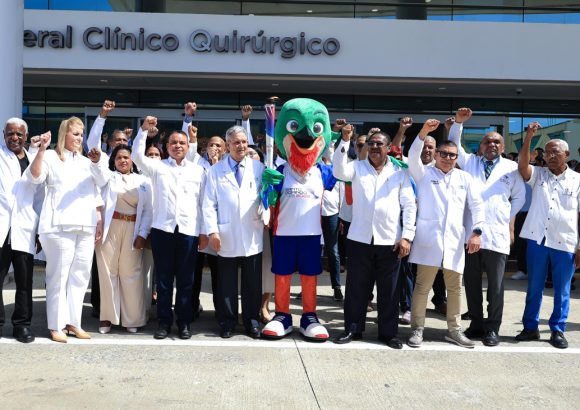
As the Dominican Republic enters its final preparation phase for the 2026 Central American and Caribbean Games hosted in Santo Domingo, a historic symbolic gesture has put the spotlight on the country’s public health preparations: the National Health Service (SNS) has officially received the Games’ torch in a ceremony held at the Ciudad Sanitaria Dr. Luis Eduardo Aybar.
Marking the first time the ceremonial torch has been accepted by a health institution in the history of the regional Games, the event brought together over 100 frontline and managerial healthcare professionals from the country’s public health network. In a symbolic handover, the official Santo Domingo 2026 Games mascot passed the torch to SNS Executive Director Julio Landrón, kicking off the formal rollout of the event’s medical support plan.
During his remarks at the ceremony, Landrón emphasized the unprecedented nature of the torch handover to a health complex, noting that the moment underscores the central role the public health system will play in delivering a safe, successful competition. Scheduled to run from July 24 to August 8, 2026, the Games will draw thousands of athletes, official delegations, international visitors, and local spectators to venues across Santo Domingo, making robust and accessible medical care a top priority for organizers.
To meet this demand, Landrón outlined that all hospitals and primary health centers located within close proximity of Games venues will be integrated into a dedicated, coordinated medical response network. This specialized system is designed to deliver rapid, efficient care in any scenario, from minor training injuries to emergency health incidents. Per explicit directives from Dominican President Luis Abinader, all medical services for participating athletes, delegation members, visiting guests, and spectators will be provided completely free of charge, reaffirming the government’s commitment to an accessible, welcoming event.
José Joaquín Puello, a neurosurgeon and president of the Ciudad Sanitaria Dr. Luis Eduardo Aybar, echoed Landrón’s remarks, highlighting the months of advanced planning that have gone into preparing the country’s hospital network for the Games. Puello stressed that deliberate, comprehensive healthcare planning is non-negotiable for the overall success of the regional event, adding that Dominican medical teams have completed specialized training and are fully equipped to deliver high-quality care to all attendees. The goal, he noted, is to ensure every participant and visitor leaves the Games with a positive, safe experience.
Health authorities across the country have framed infrastructure and capacity upgrades to public hospitals and specialized medical centers as one of the most critical long-term legacies of the 2026 Games. Beyond supporting the event itself, these improvements will leave a permanent enhanced health infrastructure that benefits Dominican communities for decades after the closing ceremony, turning Games preparations into a public investment that extends far beyond sports.