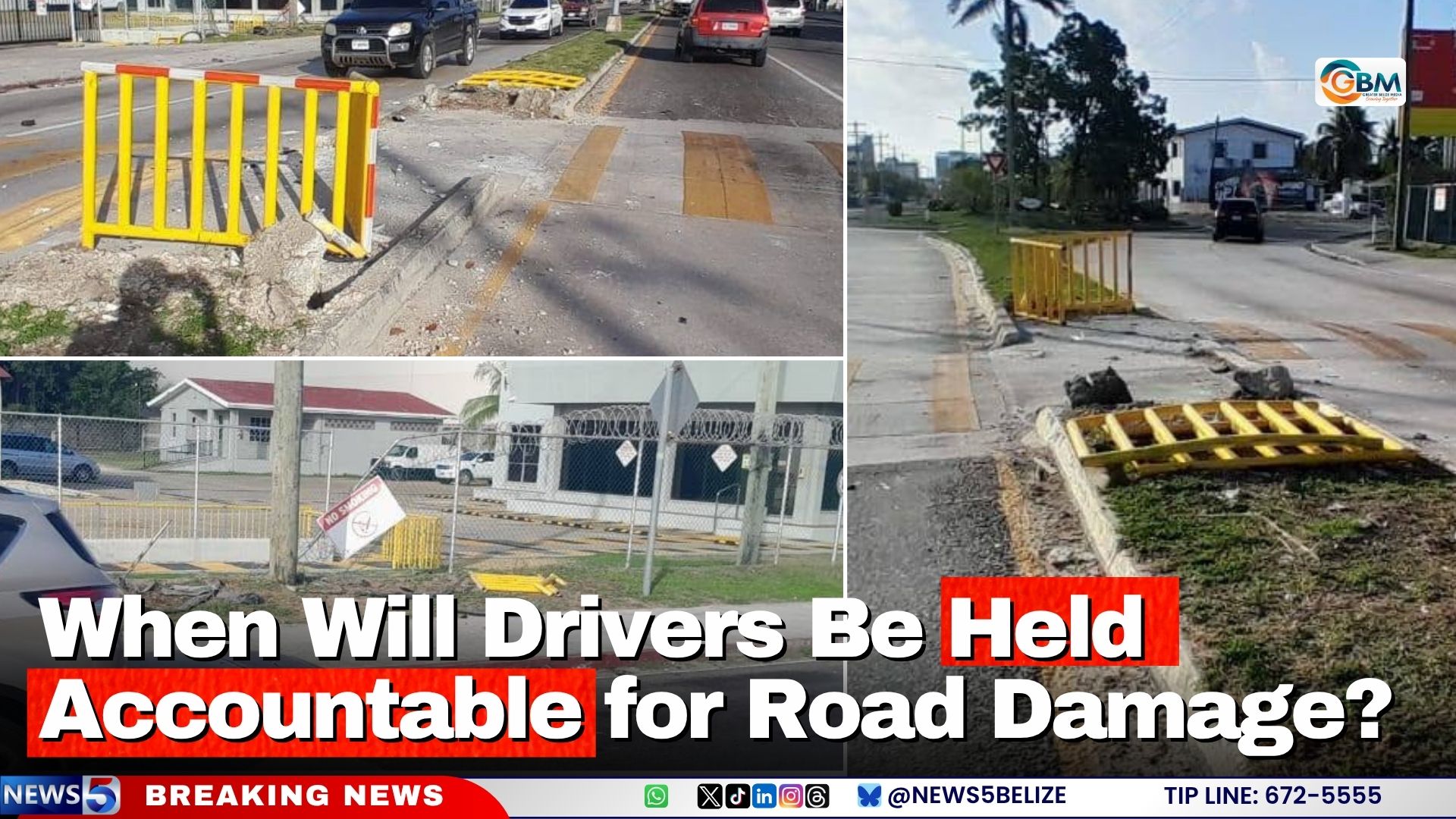
On June 15, 2026, authorities in Belize have raised urgent questions about accountability and public responsibility after newly restored pedestrian safety rails along the Philip Goldson Highway were damaged once again, leaving public funds — and ordinary taxpayers — to cover the repeated repair costs.
In an official public statement released online Wednesday morning, the Belizean Ministry of Infrastructure Development and Housing (MIDH) shared visual evidence of the damaged safety infrastructure at the entrance to Belize City. The site is no stranger to such incidents: this is the second time the recently replaced and freshly painted rails have been damaged in the same exact location.
Ministry officials expressed deep frustration over the repeated destruction, noting that the damage appears to be a result of deliberate vandalism combined with consistent driver negligence. “It is disheartening, to say the least, to see what appears to be the deliberate vandalism of these safety rails. Our team had just replaced them and painted them. We are really our own worst enemy, it seems,” the MIDH statement read.
While individual damaged rails may seem like a minor issue to fix, the cumulative cost of repeated repairs imposes a growing strain on public budgets that comes directly out of the pockets of Belizean taxpayers. Chief Engineer Evondale Moody told local outlet News 5 that these recurring repairs have evolved into a steady, unnecessary drain on the MIDH’s limited resources, labeling the repeated costs a “significant financial burden” for the government agency.
Moody went on to outline the scope of the ongoing problem, explaining that the ministry is forced to allocate time, labor and materials to repairing or replacing damaged road safety infrastructure — including traffic signs, highway guardrails and pedestrian safety rails — nearly every single week. “While we continue to educate the public, these incidents persist,” he added.
The news of the latest damage has sparked widespread discussion among members of the public online, with many offering divergent perspectives on the root of the problem and potential solutions. One social media user argued that the issue extends far beyond poor driving or occasional accidents, pointing to a deeper cultural challenge that requires systemic intervention.
“Part of the problem is fixing the psychology of society. Much harder than fixing a road,” the user wrote, noting that long-term progress will require targeted investment in public education to build stronger civic pride and a shared sense of community responsibility for public infrastructure.
Other commentators focused on a lack of meaningful legal accountability for people who cause the damage, arguing that repeated incidents persist because those responsible face no consequences for their actions. They noted that while the broader public works to advance progress across Belize, a small number of bad actors continue to undermine collective efforts with impunity.
At the center of the ongoing public debate is a core policy question: who should be responsible for covering the cost of these repairs — the general public through taxes, or the individuals who cause the damage? One online participant offered a concrete proposal, arguing that holding offenders legally accountable through jail time, required hard labor, and mandatory restitution for repair costs would deter future incidents.
As of Wednesday morning, MIDH officials have not announced any new policy changes or enforcement measures to address the recurring problem, leaving the ongoing burden of repair costs on Belizean taxpayers for the time being.