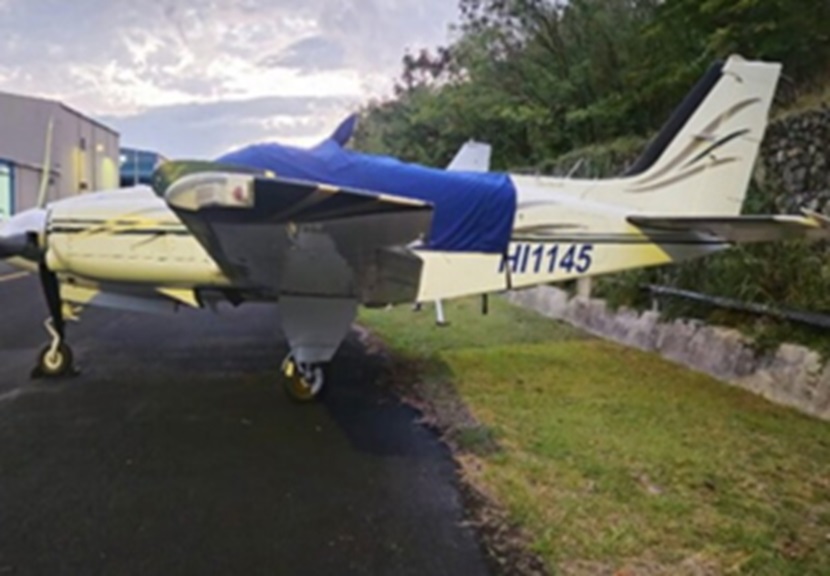
In an official update released Monday, the government of St Vincent and the Grenadines has confirmed that a Dominican Republic-registered aircraft that disappeared mid-flight last weekend while traveling to Tobago has been located, with all people on board alive. The announcement came from Deputy Prime Minister and National Security Minister St Clair Leacock during a local radio address, who noted that a coordinated search effort involving international, regional and local agencies successfully tracked down the twin-engine plane. However, he declined to disclose the exact location of the recovered aircraft.
A prior public notice from the Ministry of Tourism, Civil Aviation and Sustainable Development outlined the basic details of the flight: the plane, identified as a B58T or 58P Pressurized Beechcraft Baron with registration number HI-1145, departed Argyle International Airport in St Vincent at 11:52 a.m. local time this past Friday, carrying only two people on board. The aircraft was scheduled to complete its 65-minute journey and land at Tobago’s A.N.R. Robinson International Airport shortly after departure.
Leacock told radio listeners that he had maintained constant communication with local police leadership and regional security bodies throughout the search operation, including the Barbados-headquartered Regional Security System (RSS) and the Trinidad-based Caribbean Community (CARICOM) Implementation Agency for Crime and Security (IMPACS). He added that local authorities have already compiled information on all individuals linked to the missing aircraft, but refused to publicly share full details of the ongoing investigation.
The security minister explained that disclosing sensitive operational details at this stage would put the ongoing work of search and investigative agencies at risk, adding that intelligence and security teams are continuing to closely monitor all developments related to the incident. He emphasized that authorities are prioritizing the investigation of the people operating and traveling on the aircraft over the plane itself, noting that the aircraft cannot operate without human control, and that investigators are working to determine the appropriate next steps in the probe.
Before contact with the plane was lost, its flight path was tracked by popular public flight monitoring platform Flightradar24. Data from the site showed the aircraft was operating under visual flight rules (VFR), maintaining an altitude of 4,025 feet and a cruising speed of 142 knots. All tracking signals cut off abruptly while the plane was over the Southern Caribbean Sea, with the last recorded position placing it in the vicinity of Grenadian or Venezuelan territorial waters.