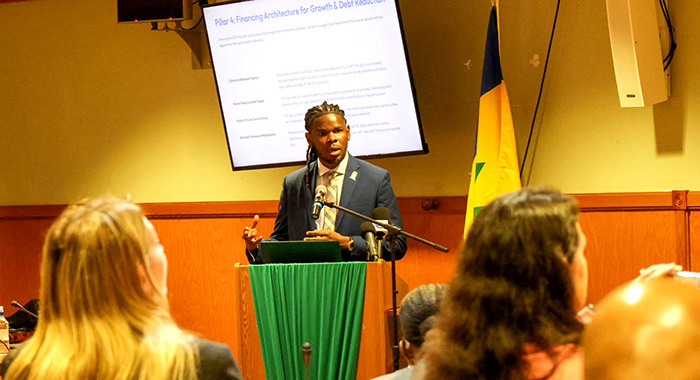
At the SVG Development Partners Roundtable held in Kingstown on Tuesday, Ambassador of Finance and Investments Kevin Hope laid out an urgent, bold strategy to pull St. Vincent and the Grenadines (SVG) out of deep fiscal distress and persistent systemic poverty. In a presentation framing SVG’s current reality as a “tale of two cities,” Hope outlined the stark macroeconomic challenges facing the island nation and introduced a coordinated five-year Growth and Stabilisation Plan for 2026–2030, paired with a newly launched 15-year long-term national development framework.
According to official data, SVG will end 2025 with a fiscal deficit equal to 12.3% of gross domestic product. A decade of consecutive shortfalls, compounded by a string of devastating external shocks, has pushed the country’s fiscal and debt trajectory into unsustainable territory, Hope warned. Prime Minister Godwin Friday previously raised alarm that public debt has already climbed above 113% of GDP, and on current policy trajectories, it will surge to 144.5% of GDP by 2031 without immediate intervention. Hope echoed this warning, noting that inaction would only force far harsher austerity measures on the country in the future.
Hope traced the origins of the current crisis to a combination of sequential global and local shocks: the 2020 COVID-19 pandemic, the 2021 eruption of the La Soufriere volcano, economic spillovers from the Russia-Ukraine war, 2024’s Hurricane Beryl, and accumulated long-term fiscal slippages. Beyond these one-off events, deep structural weaknesses have exacerbated the problem, including unsustainable expansion of the public wage bill, widespread tax concessions and expenditures, and inconsistent effectiveness and efficiency of public capital spending, he added.
The fiscal crisis has unfolded alongside fragile social conditions that any policy correction must account for, Hope emphasized. Data from the 2018–2019 Country Poverty Assessment puts national poverty at 25.8%, with 33.7% of households classified as vulnerable to falling into poverty, and 5.9% of the population experiencing food indigence. These figures mean one in four SVG households lives in poverty, and one in three faces immediate risk of poverty.
Hope also highlighted a puzzling “labour market paradox” plaguing the country: between 2016 and 2024–25, the formal labour market grew by 22.5%, yet 2022 data puts overall unemployment at 20.8%, with youth unemployment reaching nearly 35%. Large-scale infrastructure projects, including the modern port development and the new Arnos Vale Hospital, face high demand for certified technical trades, but most skilled workers on these projects are imported from other regional countries. This gap exposes a critical national skills mismatch, Hope said. Compounding the issue, anecdotal evidence suggests nearly half of all unemployed people have stopped actively searching for work, driven by geographic barriers or misalignment between expected and offered wages.
To reverse these trends, Hope placed micro, small, and medium-sized enterprises (MSMEs) at the core of the government’s new growth strategy. MSMEs currently generate roughly 60% of total national output and 45% of all jobs in SVG, a country where the services sector makes up 81% of GDP. The path out of indebtedness relies on intentional public-private partnership, Hope argued, with the government’s role shifting to creating incentives, providing critical tools and resources, and enabling the private sector to drive sustainable expansion.
Several foundational institutional reforms are already underway to support this shift: a new Department of Private Sector Development has been established within the Prime Minister’s Office under the Ministry of Finance, and a Private Sector Advisory Committee has been convened to identify regulatory barriers, cut red tape, and reduce the time and cost of doing business. Other ongoing initiatives include strengthening the investment promotion agency Invest SVG and the Centre for Enterprise Development, and drafting new MSME and Investment legislation through the Attorney General’s Chambers.
A key distinction of the government’s new plan is its prioritization: it is framed as “Growth and Stabilisation,” not “Stabilisation and Growth.” While restoring fiscal and debt sustainability is a non-negotiable goal, Hope explained, the government’s top priority remains creating quality, well-paid jobs for Vincentians, and growth must precede harsh austerity to protect livelihoods. Alongside the five-year immediate plan, the government is launching a 15-year national development strategy running from 2027 to 2042 to anchor long-term progress.
Core macro-fiscal targets for the plan include doubling SVG’s baseline trend growth from 2.5–2.7% to 5% in the medium term, then sustaining 4–5% annual growth; achieving and maintaining a 3% of GDP primary surplus by 2030; and meeting the Eastern Caribbean Currency Union (ECCU) mandatory debt target of 60% of GDP by 2035. “Fiscal sustainability is non-negotiable, growth must be structural, not subsidised, and ultimately… people are the ultimate dividends,” Hope said.
On public sector reform, Hope framed proposed rationalization of ministries and state-owned enterprises (SOEs) as a productivity improvement exercise, not an austerity cuts program. “Rationalisation ought not to be a bad word,” he said. “It really speaks to how do we make the public sector more productive and more efficient, and as such, how do we do more with less?” Rapid assessments of SOE performance are already underway, with public expenditure reviews, strengthened tax administration, and better utilization of administrative data central to the government’s efficiency goals. Recognizing that sharp fiscal adjustment can carry social costs, Hope said the government is pursuing a home-grown, phased reform approach that explicitly protects poor and vulnerable households from adverse impacts.
To finance the plan, Hope called on international development partners to support SVG’s priorities, outlining four core financing pillars: better leveraging of global climate finance to address climate vulnerability; developing innovative debt instruments to lower government borrowing costs; expanding public-private partnerships across key sectors; and boosting domestic resource mobilization by cracking down on tax leakages and strengthening compliance. The government is also actively engaging the SVG diaspora, with recent outreach events across multiple international cities, and is exploring initiatives to allow diaspora members to take equity stakes in national development projects.
In closing, Hope reiterated that all macroeconomic targets and policy reforms must be measured by their impact on the daily lives of ordinary Vincentians, with a core commitment to cutting poverty and unemployment to single digits. “This is ambitious, but this is again why we’re here — to really work towards trying to solve around the socio-economic challenges for St. Vincent and the Grenadines,” he said.
Representatives from a wide range of international and regional partners, including the United Nations, Caribbean Development Bank, World Bank, CAF development bank, European Union, Canada, Germany, China, the United Kingdom, CARICOM Development Fund, UNICEF, UNFPA, WFP, PAHO, and GIZ, broadly endorsed the government’s strategic direction. Partners called for stronger cross-stakeholder coordination, integration of a regional perspective into planning, and explicit ongoing focus on supporting the poorest and most vulnerable Vincentians throughout reform implementation.