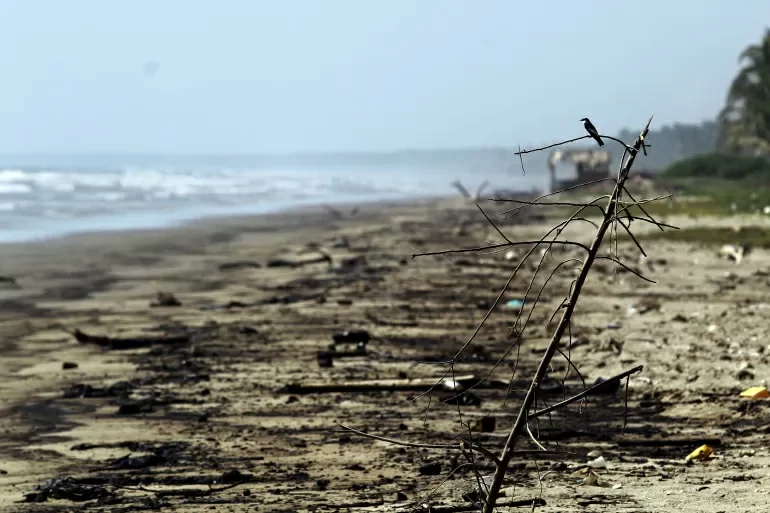
A new cross-border oil leak originating from waters near Trinidad and Tobago has reached Venezuela’s coastline, triggering a formal environmental and diplomatic alert from Caracas that risks pushing already frayed bilateral relations to a breaking point.
Venezuela’s Ministry of Foreign Affairs issued a public statement Friday warning that the unregulated spill poses severe risks to the region’s sensitive coastal marine ecosystems, local artisanal and commercial fishing industries, and small coastal communities that depend on marine resources for their livelihoods. The statement formally demands that the government of Trinidad and Tobago accept full accountability for the incident, take immediate emergency action to stop the spread of the leak and prevent further contamination events, and provide complete public transparency on the leak’s root cause, the total volume of oil released, and the full scope of potential environmental damage.
In response to Caracas’ allegations, authorities in Port of Spain have launched a full investigation into the suspected spill. Energy Minister Roodal Moonilal confirmed to Reuters that the country’s air guard and coast guard have been deployed to conduct on-site marine surveys, supplemented by drone monitoring to map the extent of any pollution and confirm the facts of the incident. Trinidad and Tobago’s Ministry of Foreign Affairs has also reached out to the Venezuelan embassy in Port of Spain to request additional details and coordinate preliminary information sharing.
While Venezuelan officials have not yet released a detailed list of specific affected coastal areas, independent satellite imagery has confirmed the presence of an active oil slick moving toward the Venezuelan coastline. The close geographic proximity of the two countries – their maritime territories lie just 10 kilometers apart at the closest point – means any pollution event originating near Trinidad and Tobago spreads rapidly to Venezuelan waters, explaining the immediate impact reported by Caracas.
Bilateral relations between the two neighboring Caribbean nations have remained tense since Prime Minister Kamla Persad-Bissessar took office in 2022. Persad-Bissessar’s administration has implemented strict restrictive migration policies targeting Venezuelan refugees fleeing the country’s ongoing political and economic crisis, and has significantly deepened diplomatic and economic ties with the United States. Tensions escalated further earlier this year following the controversial 2024 arrest of Venezuelan President Nicolás Maduro in an international incident that split regional diplomacy.
This latest spill echoes a nearly identical incident just five months prior, in February 2024, when an oil tanker sank in Trinidad and Tobago’s territorial waters. The resulting oil slick drifted north into Venezuelan territorial waters, triggering a similar diplomatic row between the two governments that left long-running environmental damage along Venezuela’s southern coast.
International observers tracking Caribbean regional relations warn that this new set of mutual accusations over the oil leak could push the already fragile bilateral relationship into a deeper crisis, with both environmental damage and economic harm to local communities hanging in the balance. Regional diplomatic bodies have called for urgent, transparent collaborative action between the two governments to contain the spill, mitigate environmental harm, and prevent further diplomatic escalation that would undermine efforts to address the crisis.