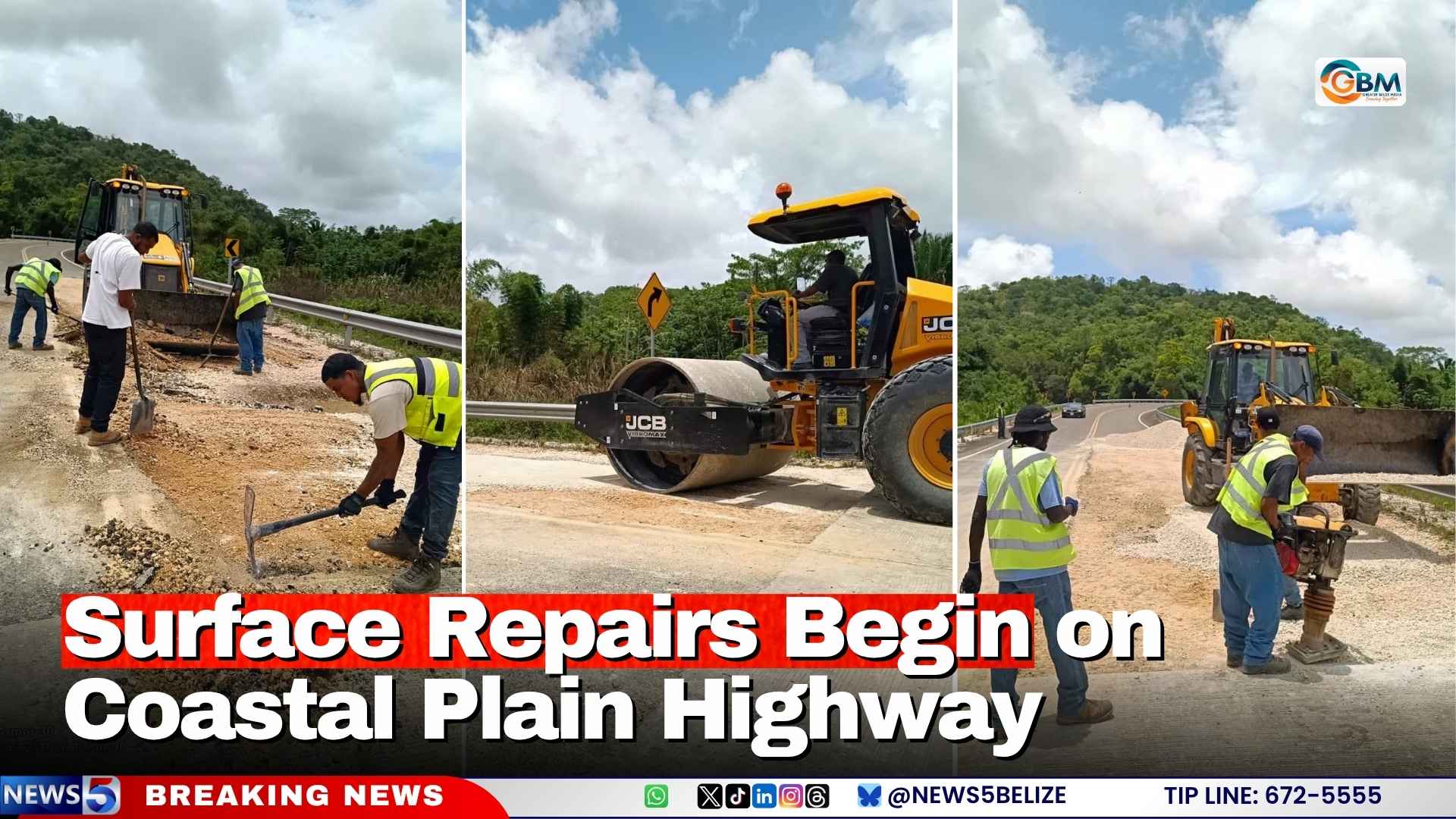
Four years from now, in June 12 2026, infrastructure teams have launched emergency surface repair operations on Coastal Plain Highway, after days of intense heavy rainfall exposed widespread superficial damage to key stretches of the major coastal roadway.
Leading government engineering official Evondale Moody, chief engineer for the project, has moved quickly to reassure the public that the road’s core structural integrity has not been compromised by the recent flood events. In an exclusive interview with local outlet News 5, Moody clarified that the only damage sustained is limited to the road’s outermost wearing course, the top layer of surface dressing designed to protect the underlying pavement from daily wear and tear, which has simply stripped away in affected areas. No damage has been detected to the main structural pavement itself.
The most impacted stretch, located at Mile 22 near the Gales Point community, has seen recurrent flooding in the wake of the heavy rains. However, Moody noted that a series of infrastructure upgrades carried out in recent years have already proven their value, with floodwaters receding far faster than would have been possible before the improvements. Those upgrades included replacing old, water-damaged asphalt with solid concrete paving, adding extra drainage culverts to channel excess water away, and reworking drainage systems near the Kwamina and Dead Man bridges to direct floodwaters straight out into the nearby ocean. According to Moody, those pre-emptive upgrades worked exactly as intended: even though the stretch was temporarily submerged under floodwaters, the road structure remained completely intact throughout the event.
Even with the successful performance of previous upgrades, Moody issued a cautious note that chronic flooding in this particular stretch of highway cannot be completely eliminated through engineering alone. The entire area sits within a large natural catchment basin that funnels massive volumes of rainwater into the low-lying stretch of road during major storm events. While raising the entire roadway high enough to avoid any flooding is technically possible, Moody explained that such a project would carry an prohibitive economic cost that makes it unfeasible at this time.
Local transportation authorities confirmed that repair work to replace the stripped surface dressing on affected sections got underway early on the morning of June 12, and are working to complete repairs as quickly as possible to minimize traffic disruptions for residents and commercial traffic along the coastal corridor.