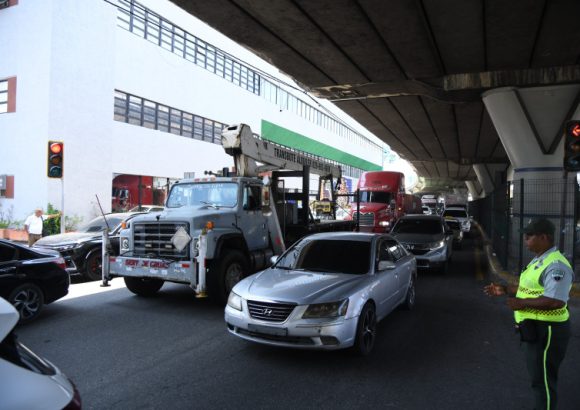
A top business leader in the Dominican Republic has thrown his organization’s full weight behind a public advocacy campaign from leading national newspaper Listin Diario, which calls for strict restrictions on heavy truck and trailer movement during peak daytime working hours to cut down on crippling traffic congestion in the country’s two largest urban areas, Greater Santo Domingo and Santiago. The proposal, outlined in the outlet’s recent editorial titled “Heavy Vehicles in Peak Hours,” has earned clear backing from Iván García, president of the Dominican Federation of Merchants (FDC).
García highlighted that national transit agencies Intrant and RD Vial, the governing bodies responsible for managing the country’s highway network, have long had the authority to regulate movement of large heavy-duty vehicles including flatbed trucks, double-axle trucks and double-van trucks. He pointed to recurring public safety and traffic problems linked to unregulated heavy truck passage through urban and town centers across the country, specifically naming the central towns of Mao and Esperanza as locations that have seen repeated collisions involving large freight trucks hauling construction materials and food supplies toward the capital.
After the town of Esperanza banned through traffic for heavy trucks, most vehicles were rerouted through the Guayacanes intersection – a shift that did little to resolve underlying safety and gridlock issues that plague communities across the nation, according to García. He emphasized that large freight vehicles create persistent, unnecessary congestion in urban cores, particularly in Santo Domingo, the country’s capital and most populous urban center.
García argued that the geographic constraints of the Dominican Republic make off-peak overnight travel entirely feasible for long-haul heavy freight operators. The longest intercity route for trucks heading to the capital stretches just 130 kilometers, a trip that can easily be completed if drivers depart by 10:00 p.m., arriving at their destination between 3:00 a.m. and 4:00 a.m. This shift would keep both highway and urban street traffic flowing freely for passenger vehicles and smaller commercial vehicles during daylight working hours, he explained.
The FDC president also drew a key distinction between large long-haul freight trucks and smaller local delivery vehicles. He noted that long-haul flatbed trucks typically measure 40 feet in length, and double-axle configurations can stretch up to 80 feet total. By contrast, smaller delivery trucks used for last-mile distribution to local businesses are only around 15 feet long, and do not create the same major traffic disruptions as their larger long-haul counterparts.
García said the Dominican Federation of Merchants has long been aware of this public safety and traffic crisis, having first discussed the issue with the National Federation of Transport Workers (Fenatrado) two decades ago. He expressed hope that the high-profile campaign from Listin Diario, the country’s most enduring and well-established media outlet, would draw meaningful attention from both national regulatory authorities and private business and transport sectors. The FDC stands fully behind the outlet’s proposal, he confirmed.
While García acknowledged that implementing the new restrictions would require domestic merchants to adjust their own operational schedules to coordinate overnight dispatches and goodsreceipts, he stressed that the commercial sector is fully willing to make this adjustment for the public good. “This will even require us to get up earlier to receive the goods, but I understand that we all have to pay the price, the cost of this sacrifice, for the benefit of the majority of the country,” García stated. He added that the commercial sector is already prepared to open warehouse facilities as early as 5:00 a.m. to accept incoming freight shipments from overnight long-haul runs.
Listin Diario’s editorial clarifies that the current crisis is not the result of a lack of existing regulation. The National Institute of Transit and Land Transportation (INTRANT) has already put formal restricted hours in place for heavy vehicle traffic in urban areas, but the existing rules are not being enforced by authorities, leaving congestion and safety risks unaddressed.