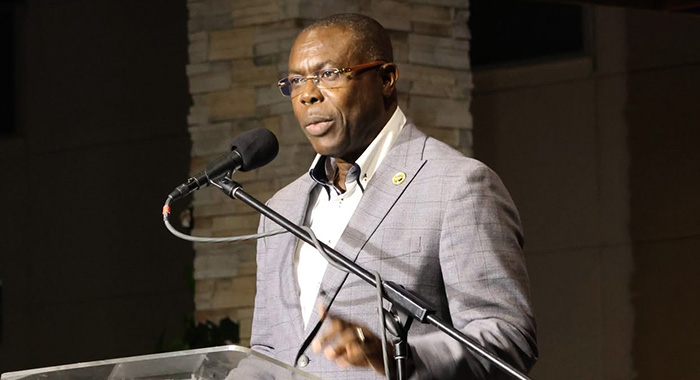
At the closing cocktail event for the first day of the Development Partners Round Table in Villa on Tuesday, Caribbean Development Bank (CDB) Vice President Isaac Solomon delivered high praise to the Government of St. Vincent and the Grenadines (SVG), highlighting the small island nation’s rare combination of confidence, clarity, and humility in its engagement with international development partners. Solomon emphasized that this open, collaborative approach has already laid critical groundwork for impactful external support — but stressed that progress now depends on translating verbal commitments into tangible on-the-ground action.
Solomon noted that convening a round table of this scale does not occur by chance. Such events, he explained, only come together when a national government demonstrates the confidence to welcome external scrutiny, the clarity to lay out a cohesive national development vision, and the humility to acknowledge it cannot address complex challenges alone. “That combination is rarer than it should be. I think it deserves recognition,” he told attendees.
The CDB delegation, Solomon added, was particularly struck by the candor and rigor of the morning presentations delivered by SVG Prime Minister Godwin Friday and the country’s Finance and Investment Ambassador Kevin Hope. Unlike many engagements with development partners that either downplay obstacles or become overwhelmed by them, Solomon said the SVG administration offered an unflinching, grounded, and analytically rigorous assessment of the country’s current position. Officials plainly named key challenges: persistent fiscal pressures, the heavy burden of climate vulnerability, and deep-seated structural constraints shaped by SVG’s geography and history as a small island developing state. At the same time, the government refused to frame these barriers as insurmountable, instead laying out a coherent, nationally owned development vision that provides a clear framework for partners to align their support around.
This openness from the SVG side set a productive tone for cross-partner discussions, Solomon observed. In response to the country’s clear direction, development partners in attendance made concrete commitments, held substantive talks about coordination, and forged a shared sense of collective purpose — outcomes Solomon described as far from trivial. He credited both the SVG government and the local United Nations team for creating the conditions for this collaborative dialogue.
From CDB’s institutional perspective, Solomon confirmed that SVG’s development priorities and reform trajectory align closely with the bank’s own core strategic goals of inclusive economic growth, climate resilience, and investment in human capital. This alignment, he stressed, is not valuable because it validates CDB’s internal framework, but because it allows the bank to deliver genuinely useful support tailored to SVG’s self-defined needs. “When a country has defined its own direction with this degree of clarity, a development bank’s job becomes more straightforward. It becomes one of deploying our instruments in service of that direction, not in competition with it. That is the kind of partner we intend to be,” Solomon said.
Moving beyond discussions of institutional alignment, Solomon warned that the complex challenges SVG faces cannot be solved by financing alone. In today’s more challenging global economic landscape, meaningful progress requires the right policy tools, coordinated action across partners, and sustained political will to see long-term reforms through. He noted that this political will is clearly present in SVG, and it is now the responsibility of development partners to match that commitment with equivalent energy and action.
Solomon pointed out that the global operating environment has grown significantly more hostile for small island developing states (SIDS) over the past five years, marked by soaring financing costs, shifting geopolitical alliances, and an accelerating frequency of extreme climate events. These pressures impact SIDS far more severely than large economies, which can absorb shocks that smaller nations cannot. For SVG, Solomon said this reality is not abstract: the country is still navigating the long recovery process following the 2021 eruption of La Soufriere, and the significant fiscal compression that followed the disaster, as it works to shift from post-eruption recovery to long-term transformation and resilience building.
Crucially, Solomon noted that SVG is uniquely well-positioned to capitalize on the current global moment, as the international community reconsiders how it supports climate-vulnerable small states. Global debates around the Bridgetown Initiative — a Barbados-led push to overhaul the global financial system, allowing developing nations to address climate change without taking on unsustainable debt — and broader reforms to the global development finance architecture have created a new opening for SIDS to shape global policy. SVG lived experience with climate shocks gives the country a powerful, evidence-based voice in these negotiations, and its transparent, collaborative governance style makes it a strong leader in this space, Solomon added.
Responding to Prime Minister Friday’s opening observation that SVG’s development needs are too large and multi-faceted for any single institution to address, and that success depends on partners aligning their contributions to deliver more than the sum of their parts, Solomon pushed back against the idea that this gap is a weakness. “This is not a gap to apologise for. It is simply the nature of small island development finance,” he said. The core question, he argued, is whether partners can organize effectively to meet that reality — and the first day of the round table demonstrated that this is possible.
Despite the positive momentum, Solomon reminded attendees that the ultimate success of the round table will be measured by tangible improvements in the lives of ordinary Vincentians, not just productive dialogue. He reaffirmed CDB’s commitment to supporting SVG beyond financing, offering ongoing policy dialogue and advocacy for the country’s priorities in broader international forums. “We come to this as a leading voice and also as a committed partner, grateful for the invitation and clear about the responsibility that comes with it,” he said. Closing out the first day of discussions, Solomon called the event a success: “This has been a good day — a day that began with honesty about the challenges ahead, moved through serious substantive conversations, and ends here among partners with a sense of shared purpose.”