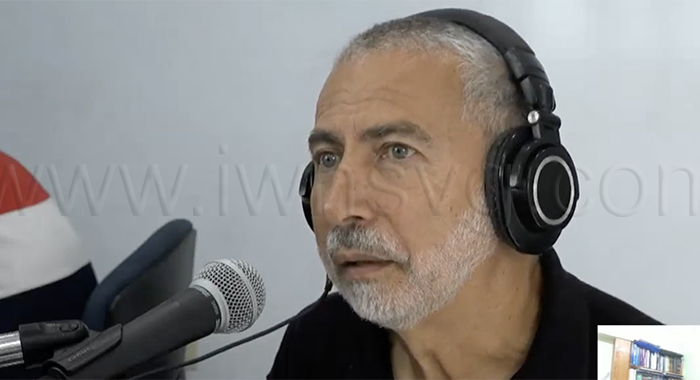
Amid swirling online criticism over the leadership transition at Saint Vincent and the Grenadines’ state-run National Insurance Services (NIS), chairman Stephen Joachim has publicly defended the board’s recommendation of Ronette Lewis, the current General Manager of the Centre for Enterprise Development, as the agency’s incoming executive director, pushing back against claims the top role must be held by a trained actuary.
In an interview with Boom FM on Monday, Joachim confirmed that Lewis’ appointment will go into effect on July 1, 2026, following the departure of nine-year incumbent Stuart Haynes, an actuary who accepted a new role in St. Kitts. Appointed NIS chairman by the current New Democratic Party (NDP) administration, Joachim expressed full confidence in Lewis’ ability to lead, saying, “I think she will do a terrific job.”
Much of the public pushback has circulated on social media, where commentators have questioned both the board’s selection of Lewis and its broader succession planning process. Joachim pushed back sharply against what he framed as uninformed, unqualified online attacks, echoing a previous description of loud social media critics as “internet crazies” from a political colleague. “You can’t run a country by social media, despite what these [people] think,” he said, challenging online critics to produce their own professional track records before judging the board’s decision. “What have you accomplished in your life? What makes you think that you’re in a better place to judge the actions and decisions taken by certain people when you have never been in those positions or have any idea what you’re talking about?”
At the core of the criticism is the argument that NIS must be led by an actuary, given the agency’s social security mandate. Joachim rejected this assumption outright, arguing that the role requires a skilled business and people manager, not a specialist actuary. He explained that core actuarial work for the agency is already outsourced to external experts on a regular basis, and that the NIS already retains in-house specialists with actuarial, investment, accounting, and legal expertise on staff and its board. “Every three years, the NIS conducts an actuarial report and we hire external actuaries. They do the evaluations and the assumptions… The manager, the director, has to implement those decisions. There is no actuarial skills being used in running the NIS. None. Zero. Nada,” Joachim said.
He added that even the previous incumbent Haynes would confirm that day-to-day leadership of the agency does not rely on actuarial training. “If anybody doubts me, speak to Stuart Haynes. He will tell you: ‘Steve, I do not use my actuarial skills to manage the NIS. This is about managing.’” “Why do you need an actuary? People just say it because Stuart was an actuary,” he argued, noting that the agency needs a leader who can navigate its people-focused operations, a need Lewis as an experienced business leader is well-equipped to meet.
To counter claims that the board hand-picked Lewis outside of a formal process, Joachim laid out a full, transparent breakdown of the recruitment procedure, which launched after Haynes announced his departure even before Joachim’s formal appointment as chairman. The board asked Haynes to draft a formal job description, then contracted independent human resources consultant Janelle Allen, described by Joachim as the top HR specialist in the region, to manage the full search process. In total, the search attracted 54 qualified applicants, all of which were scored independently by Allen. A three-person board selection committee reviewed the top 10 candidates, plus scanned the remaining 44 to ensure no qualified applicants were overlooked, before shortlisting four final candidates: two Vincentians, one Trinidadian, and one Jamaican. After the Trinidadian candidate withdrew for family reasons, the remaining three candidates completed two rounds of assessment: a standard formal interview, and a second round requiring a public presentation on NIS policy and operational topics. “You can’t say we didn’t do a thorough process,” Joachim insisted.
Joachim also dismissed circulating rumors that the NIS board had unilaterally imposed Lewis as its pick and even threatened to resign over the appointment, labeling those claims as outright false. He clarified that under NIS governing law, the board only issues a recommendation for the role, with the final appointment made by the national Cabinet. “The board does not hire anybody. The board makes a recommendation to Cabinet as to who we think is the best person to be in that position. Cabinet appoints a director and deputy director,” he explained. Prior to Cabinet’s vote, the NIS leadership held a full briefing with Prime Minister Godwin Friday, who holds ministerial responsibility for the agency, walking through the full recruitment process, selection outcome, and rationale for the pick. “We met with the Prime Minister. We told him the process we had gone through… and the ultimate selection and the rationale and the reason why,” Joachim said. “Cabinet then appoints. They agreed with the decision.”
Joachim further noted that overriding the board’s recommendation without compelling reason would undermine fundamental corporate governance principles for the state agency. “For the Cabinet to overrule the board means that they would have to have very good reasons. Furthermore, why would you appoint a director when you didn’t consider the views of the board? What the heck’s the point of a board then?” he said. He added that such an override would represent a return to the governance practices of the Unity Labour Party, which was voted out of office in the November 2025 general election after nearly 25 years in power.