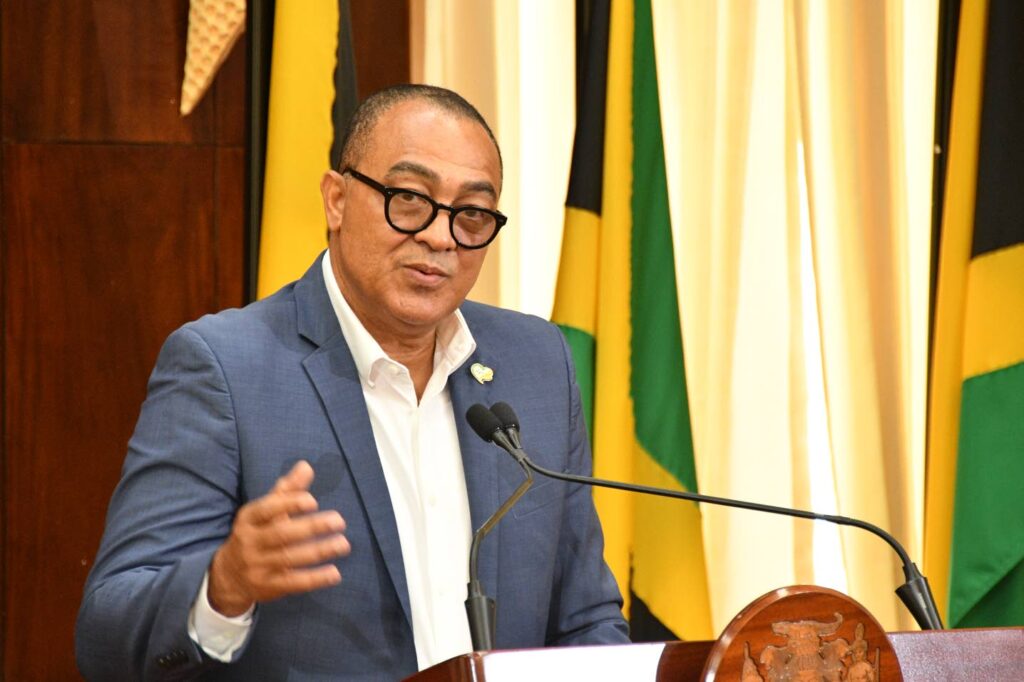
Jamaica’s Ministry of Health and Wellness is launching a multi-pronged strategy to address longstanding public grievances over subpar customer service at government-run health facilities, Health Minister Dr Christopher Tufton confirmed Wednesday. Speaking at the opening ceremony of the Carol Picart Courtyard at Kingston’s Victoria Jubilee Hospital, Tufton framed the new measures as a complementary reform to ongoing government investments in facility construction and infrastructure upgrades, noting that physical improvements alone cannot deliver a stronger, more patient-centered health system.
“We cannot build new buildings, equip them, and don’t have a different mindset. That’s the future of a reformed, improved health system,” Tufton told assembled health officials and industry stakeholders. “We need to focus on the people and on the attitude as to how we improve.”
At the core of the new oversight framework is a program modeled after the private sector’s mystery shopper initiative, which will deploy so-called “mystery patients” to pose as ordinary care seekers in public health waiting areas and triage queues. These undercover observers will document staff availability, responsiveness and adherence to customer service standards, compiling detailed reports for ministry leadership. Tufton explained that the program is designed to capture unfiltered, real-world insights into daily operations, rather than the polished, prepared displays that often accompany pre-announced inspections.
Complementing the mystery patient program is a brand-new internal investigations department created specifically to probe formal complaints of service failure. The specialized unit will dispatch independent investigators to affected facilities to collect witness statements, gather evidence and produce formal reports for both the Minister’s office and the Permanent Secretary’s office. Tufton emphasized that the unit will eliminate the longstanding culture of unaccountability for poor service, stating that “the days of people doing things with excuses, we have to bring that to an end.” All investigation findings will be reviewed by a governing board, which will issue disciplinary or corrective recommendations based on the evidence.
Tufton also announced that unannounced spot checks by the Minister and other senior ministry officials will become a regular occurrence across all public health institutions. He joked that pre-announced visits often trigger temporary, surface-level improvements — from cleaned floors to suddenly compliant staff uniform policies — that disappear as soon as official visitors leave. Unannounced checks, by contrast, will reveal the true daily conditions patients face.
The Minister stressed that the reforms are not intended as a rebuke of the health system’s overall workforce, acknowledging that the vast majority of patients receive adequate care and that the system serves more than three million patients annually across Jamaica, an enormous operational responsibility. He urged health staff not to become defensive, but to commit to incremental improvement. “I am not saying all of this to say that I am here to prosecute anyone,” he said. “It’s a huge portfolio that involves millions of Jamaicans. It’s a big task.”
Even so, Tufton made clear that the ministry will not tolerate persistent poor performance that undermines billions in government investment into public health. For staff who lack proper service training, the ministry will provide additional retraining to bring their performance up to standard. But for staff who refuse to adopt patient-focused practices, Tufton said, the ministry will take firm action: “who refuses to learn, they may have to go somewhere where they like the job. Because obviously they don’t like the job if they refuse to learn.”