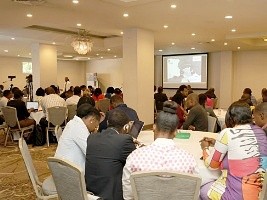
Against a backdrop of escalating instability driven by armed criminal groups and unregulated urban expansion, Haiti’s national and local governance stakeholders gathered this week for the 10th iteration of “Territories Thursday,” a landmark forum focused on examining how strategic land-use planning can counter rising urban insecurity across the Caribbean nation.
The event brought together a cross-sector lineup of experts, policymakers, and international partners to unpack the deep links between haphazard urban development, criminal encroachment on national territory, and systemic governance failures that have eroded public safety. Leading opening presentations were David Telcy, an agronomist who coordinates the Quality and Methodology Unit at Haiti’s National Center for Geospatial Information (CNIGS), and Wadelène Coriolan, a computer engineer and Deputy Mayor of the commune of Gressier. Additional insights were shared by Christine Stephenson, Executive Technical Secretary of the Interministerial Committee for Land-Use Planning (CIAT), and Denoil Anténor, a trained lawyer and graduate of the École Normale Supérieure who serves as President of the National Federation of Haitian Mayors (FENAMH).
Supplementing the domestic stakeholder perspectives were technical and evidence-based contributions from two specialized experts: anthropologist and sociologist Derinx Petit Jean, and Juan Marquez, Deputy Country Director for the United Nations Office on Drugs and Crime (UNODC). The pair delivered data-backed analysis of shifting urban population dynamics and the unique security challenges that have left Haiti grappling with widespread instability.
Leveraging geospatial maps and curated statistical datasets, panelists collectively emphasized the grave security risks that stem from unplanned, unregulated urbanization. They also drew sharp attention to how transnational criminal networks have exploited weak territorial governance to occupy and misuse Haitian land for illicit activities. According to the forum’s collective findings, these criminal encroachments do not only amplify national instability: they also undermine institutional control over territory, block inclusive local economic development, and fuel the growth of illegal markets that continue to erode quality of life for Haitian citizens.
Speaking on behalf of the Haitian government, Secretary of State for Local Government Sharina Lochard opened the event by praising the productive collaboration between Haiti’s Ministry of the Interior and Territorial Communities (MICT) and the International Council for Territorial Development that made the forum possible. She acknowledged the extraordinary complexity of the work facing local authorities in Haiti’s current crisis context, noting that municipal and communal leaders are on the front lines of efforts to control, manage, and organize national territory amid widespread violence.
Lochard reaffirmed the Haitian government’s core strategic priorities: restoring national security, stabilizing governance, advancing economic recovery, and moving forward with long-delayed democratic elections. She stressed that strengthening decentralized local governance is a non-negotiable prerequisite to improving land management practices and building cities that are safer, more resilient, and better organized to serve residents.
For the event’s organizing bodies, the 10th edition of “Territories Thursday” is part of an ongoing, collective effort to advance public and institutional dialogue around the policy and planning mechanisms needed to build well-governed territories and secure urban spaces across Haiti. Closing the forum, Lochard reaffirmed the central role of intentional planning in advancing national stability, noting: “Land-use planning is a key lever for strengthening local governance and sustainably improving the living conditions of our people.”