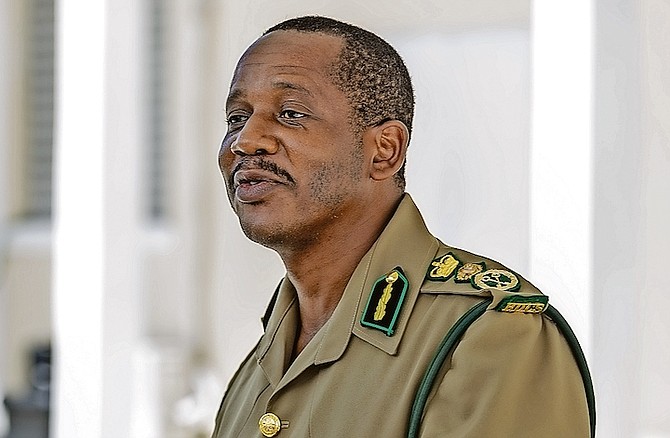
At the recent signing-on ceremony for the 81st cohort of Squad A, Bahamas Department of Corrections Commissioner Doan Cleare made controversial and striking remarks that laid bare a persistent recruitment crisis plaguing the island nation’s uniformed correctional services. While addressing the new group of incoming trainees, Cleare drew sharp distinctions between how the department will handle disciplinary issues for female and male recruits, rooted in a stark imbalance in qualified applicant pools.
Cleare openly warned female trainees that a single major misstep would lead to immediate termination, explaining that the department already holds a waiting list of more than 400 qualified women eager to join the ranks. For struggling male recruits, however, he said leadership would take a more lenient approach, attempting to guide and “massage” underperforming men into meeting standards — a concession born out of a years-long shortage of qualified male candidates. He did note that repeated or severe misconduct would still result in dismissal for male recruits.
The scale of the recruitment shortfall became clear when Cleare outlined the department’s targets and final intake numbers. Originally, the department planned to bring in 70 men and 30 women for the new recruit class. After being unable to meet the male quota despite a nationwide search, leadership was forced to adjust the target to 60 men and 40 women. Even with that revised goal, the current cohort stands at 41 men and 38 women; seven additional recruits are set to join this week, but the department will still end up 12 men short of the adjusted target.
Commissioner Cleare emphasized that the gender gap is not a reflection of women’s ability to perform correctional work, noting that female applicants consistently meet the department’s minimum entry requirements. Rather, uniformed branches still maintain a need for more male personnel for operational reasons, and qualified male candidates have become increasingly hard to source. Cleare and his team traveled to every island across the Bahamas archipelago to recruit, yet still failed to fill all open male spots.
The core barrier to entry, Cleare explained, is a failure among many male applicants to meet the minimum educational requirement of five Bahamas Junior Certificate (BJC) passes. Most male candidates only present two or three passes, which is not enough to qualify for recruitment.
Tracing the origins of the shortage, Cleare said the decline in qualified male applicants first became noticeable around 2012 and 2013. By 2021, he confirmed that other major Bahamian uniformed services — including the Royal Bahamas Police Force and Royal Bahamas Defence Force — are grappling with the same recruitment challenge. Speaking on the sidelines of the ceremony, Cleare linked the shortage to broader educational and social disparities, particularly in the more populated islands of New Providence and Grand Bahama.
Growing up on a smaller Family Island, Cleare recalled that male students were traditionally eager to learn and focused on their education. But in the country’s two most populated islands, he said, many young men are drawn to gang activity, adopt disruptive behavior in classrooms, and often choose substance use including marijuana and alcohol over pursuing their education. When these young men struggle to find work later in life, he added, they often blame the government rather than their own lack of qualifications.
Cleare pointed to the government’s National Youth Guard programme as a promising potential pipeline to expand the pool of qualified young men for uniformed services. However, he noted that the Department of Corrections has often been slow to access this talent pool: by the time corrections officials connect with programme participants, police and defence force recruiters have already hired all the qualified male candidates, leaving only female applicants for corrections.
Beyond the general gender gap in recruitment, Cleare also highlighted a shortage of skilled tradespeople within the department, noting that the BDOCS has recently lost retired workers with specialized technical skills including air-conditioning repair, fencing, and plumbing, with no qualified recruits waiting to fill those roles.
Department officials estimate that the recruit trainee programme typically sees a dropout rate between one and two percent, a relatively small share of the overall incoming class.