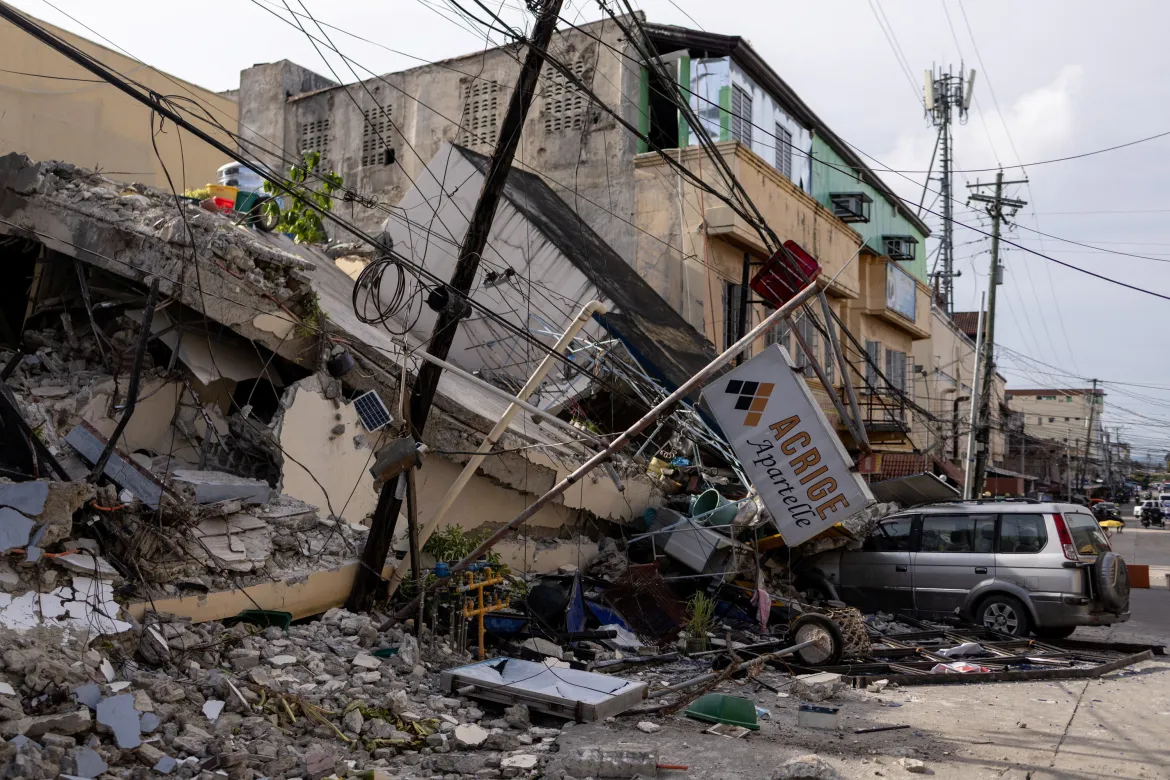
On Monday morning, a powerful magnitude 7.8 offshore earthquake struck the southern region of the Philippines, leaving a grim trail of death, destruction and displacement across coastal Mindanao. As of initial official updates, the disaster has claimed at least 32 lives, left more than 200 people injured, and triggered a 1-meter tsunami that swept across nearby shorelines. Most casualties were reported in structures that crumbled or suffered severe damage during the shaking.
The epicenter of the quake, recorded at 7:37 a.m. local time, was located in the sea off Mindanao, with General Santos, a major port city and regional tuna export hub home to over 700,000 residents, bearing the brunt of the damage. Multiple low-rise buildings across the city, including a public supermarket, a warehouse and a local grade school, collapsed or sustained catastrophic structural damage, leaving at least 12 people unaccounted for. Search and rescue teams have been deployed in urgent operations to locate potential survivors trapped beneath rubble.
Further north, in the municipality of Glan within Sarangani province, the shaking triggered a destructive landslide that killed 13 local villagers. Provincial disaster mitigation official Rene Punzalan confirmed to Philippines’ DZBB radio network that an additional four residents also died in quake-related incidents across Sarangani. The disaster also disrupted the first day of classes at a rural grade school in Malita, Davao Occidental, where more than 100 uniformed students and a dozen teachers had gathered for a traditional flag-raising ceremony ahead of lessons, on their first day back after a two-month summer break. What was meant to be an exciting day of new beginnings quickly devolved into chaos, as the ground beneath the coconut-fringed school compound shook violently. “Their excitement on the first day of school turned to trauma,” school principal Rosavel Cachuela told the Associated Press. Fortunately, the children remained mostly calm and stayed in their seats during the shaking, avoiding any casualties, though a nearby storage shed collapsed and damaged a parked motorcycle.
Witnesses described sudden, intense shaking that sent residents fleeing for open ground. Rod Sosmeña, regional director of the Office of Civil Defense, who was traveling through General Santos when the quake hit, said his pickup truck jerked so violently he initially thought he had suffered a flat tire. “The shaking was very strong and people dashed out of houses into the streets,” Sosmeña recalled.
Beyond the Philippines, smaller tsunami waves were recorded as far afield as Indonesia, Palau and southern Japan, while minor tsunami damage was documented in at least one southern Philippine coastal village. Teresito Bacolcol, director of the Philippine Institute of Volcanology and Seismology, confirmed that the 7.8-magnitude event is the most powerful earthquake to hit the archipelago nation this year. He has issued urgent warnings urging residents to seek official guidance before returning to damaged structures, as powerful aftershocks could trigger further collapses of already weakened buildings.
The international community has quickly moved to offer support to Philippine emergency response efforts. The United States, a long-standing treaty ally of the Philippines, announced it was already coordinating with Manila and stood ready to deploy assistance. France and New Zealand have also issued statements of solidarity and offered support to the disaster response.