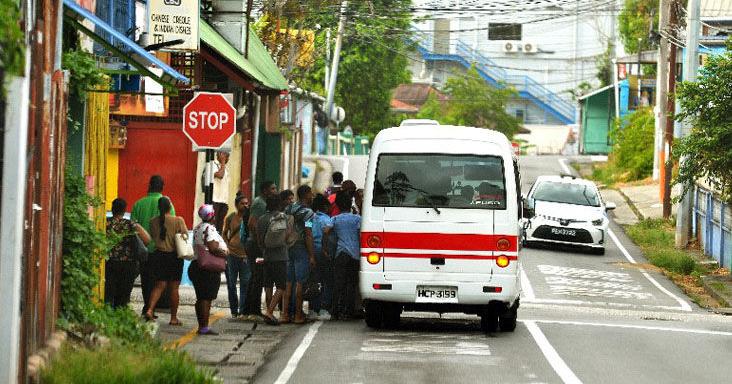
What was supposed to be a 48-hour work stoppage by Trinidad’s maxi-taxi operators ended much earlier than planned for most drivers, with the majority of operators returning to public roads by the second day, after widespread disruption left hundreds of commuters stranded just one day prior.
Local newspaper the Express documented a clear uptick in operating maxi-taxis across multiple population centers on Tuesday, including the busy hubs of Curepe and Chaguanas. In South Trinidad, brown and black band maxi-taxis were back on their routes in full force by the morning.
The industrial action launched on Monday, when operators from all six of the country’s maxi-taxi routes held a first day of what they called “rest and reflection” to push for action on a slate of long-simmering grievances. Their top complaints included unregulated competition from unlicensed “PH” private vehicles and unauthorised white buses, which have siphoned off customers and cut into drivers’ livelihoods for months. Monday’s stoppage brought widespread transport chaos, with hundreds of daily commuters unable to find reliable rides to work, school, and essential appointments.
Late Monday, leaders of all maxi-taxi associations held a marathon, nearly five-hour negotiating session with Minister of Transport and Civil Aviation Eli Zakour. While many participating operators left the talks saying they had not secured the concessions they needed, only the Route Two Taxi Association initially announced it would extend the strike into a second day. Even that extension was cut short, however: by 6 p.m. on Tuesday, Route Two operators had also resumed normal service.
Route Two president Brenton Knights explained that consideration for stranded commuters and fatigue among drivers was the primary factor behind the decision to end the strike early, even though the association never received a formal written commitment from the transport ministry to address their core demands.
“We made the call to stand down because we saw commuters going through hardship we never intended to inflict, and we could see our own drivers and supporters were growing weary,” Knights told the Express. He added that the association recognized the need to step back, reassess its strategy, and pivot to a new approach rather than repeating tactics that had not delivered results.
“If you do the same thing over and over expecting different outcomes, that’s the definition of insanity. We know we need to regroup, reset, and come at this from a new angle,” Knights said. He noted that the association is keeping all options on the table moving forward, including continuing good-faith negotiations, pursuing legal action to force policy changes, and keeping what he called an “element of surprise” for future action if needed.
Knights pushed back on the position Zakour outlined during Monday’s talks, in which the minister claimed the ministry was already doing substantial work to address the industry’s concerns and that operators had little justification for their complaints. He also refuted Zakour’s claim that the Route Two association failed to raise these issues a decade ago, calling the assertion entirely false. “They are politicians, after all – it’s in their nature,” Knights added.
When the Express visited the red band maxi-taxi stand on St Joseph Road in Arima Tuesday morning, passenger volumes were far lower than on a typical weekday, with barely any commuters gathered at the stand in the early hours. Unlike normal operations where dozens of taxis queue for passengers, only occasional vehicles pulled in to pick up waiting riders before departing immediately.
One passenger waiting at the stand around 7 a.m. expressed relief that service had resumed, explaining she had waited for more than three hours on Monday to secure a ride to work. Roughly five minutes after she arrived, a maxi-taxi pulled into the stand, and the 15 waiting commuters quickly boarded to continue their journeys. Passing by the Arima Bus Terminus just after 6:50 a.m., the Express observed long lines of stranded passengers, but those lines had cleared significantly by 7:30 a.m. as more drivers returned to service.
In a public statement released to members and industry stakeholders Tuesday, the Route Two association thanked its supporters for their solidarity during the industrial action. The union noted that the strike came after months of patient diplomacy that had only produced empty verbal promises from government officials. “We remain unwavering on the issues that impact the daily livelihoods, personal safety, and long-term financial survival of every single red band maxi-taxi operator,” the statement read.
The association reaffirmed its commitment to securing its full set of just demands, noting that while other route associations chose to return to work early to give the ministry time to deliberate on their concerns, Route Two had made clear it would only soften its position after receiving binding, official written commitments.
Along with cracking down on unlicensed competition, the association’s list of demands includes raising the maximum highway speed limit for maxi-taxis from 65 km/h to 80 km/h – a change operators say will improve road safety and boost route productivity. Other asks include long-overdue upgrades to overcrowded transport hubs and bus terminals, the introduction of clear formal rules governing the transfer of vehicle licenses in cases of driver illness or death, the payment of outstanding arrears for school transport services provided by operators, and the creation of a structured, accessible contribution system for maxi-taxi drivers to pay into the country’s National Insurance System, as most are self-employed.