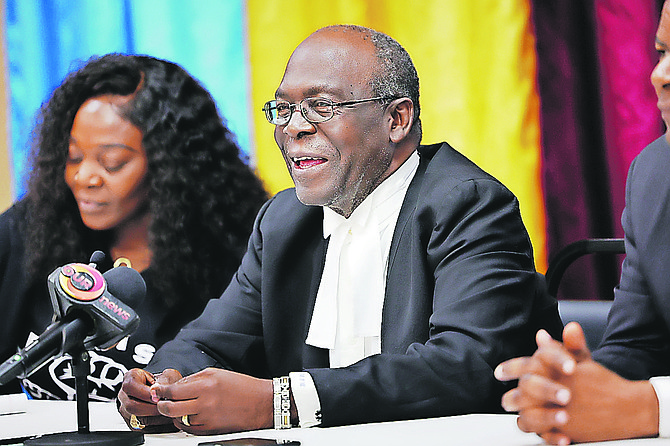
As The Bahamas prepares to mark its annual Labour Day tribute to the nation’s modern labour movement founder, a deep rift within the country’s organized labour community has resulted in plans for two separate worker parades, stirring fears of lasting division among ranks.
Obie Ferguson KC, president of the Trades Union Congress (TUC), the umbrella body representing a coalition of Bahamian trade unions, has confirmed the organisation will stage its own independent march this Friday, June 5, tracing a historic route long associated with Sir Randol Fawkes – the man widely hailed as the father of the country’s contemporary labour movement. The march will kick off at 9 a.m. from the House of Labour on Wulff Road, with participants instructed to arrive for assembly by 8 a.m. Attendees will travel west along Wulff Road before turning north on Baillou Hill Road, concluding the procession at Southern Recreation Ground, the site where Fawkes delivered many of his most iconic speeches advocating for Bahamian workers’ rights. To keep the event focused on its core labour mission, the TUC has required all participants to wear black pants paired with a white Labour Day shirt, and banned all clothing displaying political party affiliations. Just one official banner will lead the procession.
This separate event marks the second consecutive year the TUC has broken away from the nation’s traditional Labour Day parade. The longstanding main event typically gathers participants further east on Wulff Road at Windsor Park, before marching north along East Street through downtown Nassau and Bay Street, ending near Clifford Park and Arawak Cay. Last year, Ferguson announced the TUC and its affiliate unions would not participate in the traditional parade, but public records only confirm the organisation hosted an independent celebration, not a full separate march.
For Ferguson and TUC leadership, the breakaway is not an act of division, but a deliberate effort to restore Labour Day to its original, worker-centred roots as envisioned by Fawkes. “What we are doing is the beginning of returning to what it used to be, which delivered real benefits for all working people, not just trade union leaders,” Ferguson explained in an interview. “Sir Randol’s message was always focused on advancing the interests of every working Bahamian. We want to keep that legacy pure, open to all working people and their families, with no exclusion.”
Ferguson added that all necessary legal approvals have been secured, with the Royal Bahamas Police Force fully notified of the march route and timeline. One of the core grievances driving the split, he noted, is growing concern that the traditional parade has become increasingly politicized in recent years, particularly during election cycles, when large contingents of marchers display party branding and colours – a shift that dilutes the day’s focus on workers’ rights. “It’s almost like Independence Day: it is a special, sacred day for our nation’s workers, and we don’t want unnecessary political confusion overshadowing what Sir Randol Fawkes fought for,” he said. “We are carrying out exactly what he intended for working Bahamians. We have a clear worker’s agenda, and we will remain the unapologetic mouthpiece for all workers facing discrimination and unfair treatment.”
Multiple TUC affiliate unions have publicly backed the organisation’s decision, echoing concerns about political overreach in the traditional event. Deron Brooks, president of the Bahamas Customs, Immigration and Allied Workers Union, noted the TUC’s route is an exact recreation of the path Fawkes himself took for historic Labour Day marches. “This isn’t about division – we’re just following the path Sir Randol laid out,” Brooks said. “Individual unions retain the right to mark the day as they choose, but we as an umbrella body are calling for collective observance of the original tradition. Our union stood with the TUC last year, and we are standing with them again this year.”
Tyrone Butler, president of the Bahamas Taxicab Union, whose organisation will also march with the TUC, praised the ban on political clothing as a critical step to reclaim the day’s purpose. “This has always been the position of responsible unions: Labour Day is for workers, not political parties,” Butler said. “Political parties took advantage of the event, starting in an election year, and it became an annual tradition that has nothing to do with the rights of working people. It’s a disservice to every hard-working Bahamian to let politicians hijack a day that was created to honor workers.”
Even small vendor groups are backing the initiative. Karen Brown, president of the RM Bailey Park and Allied Vendors Association, said her members will join the TUC march to honor the movement’s roots. “This is a day for workers, and we are returning to the fight Sir Randol started,” Brown said. “We’re proud to wear our black and white and march to honor what this day is really about.”
But not all figures in the Bahamian labour movement support the split. Veteran trade unionist Dave Beckford, a former candidate for the presidency of the Bahamas Hotel, Catering and Allied Workers Union who will participate in Friday’s traditional parade, argues the separate procession will only cement public perceptions of a fractured labour movement, contradicting Fawkes’ own legacy as a unifying force for workers.
“To me, a separate route undermines everything we talk about when we say we need a united front for workers,” Beckford said. “It deepens division at a time when we need to stand together. Sir Randol Fawkes was a uniter, not a divider. This isn’t necessary. It also places an unnecessary extra strain on the Royal Bahamas Police Force, which now has to police two separate marches. It’s disappointing to see TUC leadership take this path, when it sends a clear message of disunity to the public.”
Bahamas’ Minister of Labour Pia Glover-Rolle noted the split is not unprecedented, confirming the TUC took the same step last year, when many of its affiliate unions still chose to participate in the main parade despite the organisation’s breakaway. “This isn’t the first time the TUC has broken away to host their own march,” Glover-Rolle said. “Last year’s independent event saw low turnout, and many of their own affiliates still joined the main workers’ march. At the end of the day, Labour Day is the workers’ march, and any group is free to mark it as they choose.”
Ferguson pushed back against claims of division, noting public response to the TUC’s plans has been overwhelmingly positive, and framing the breakaway as the first step in a broader return to the labour movement’s core mission of advocating for working people. He also referenced longstanding unaddressed concerns about the planned upgrade of the House of Labour, the historic starting point for the TUC’s march, as part of the organisation’s push for renewed focus on core labour priorities.