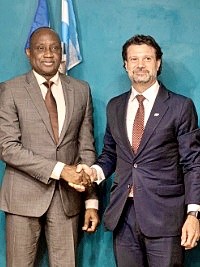
On June 1, 2026, high-level defense officials from Haiti and Argentina held a targeted working meeting in Port-au-Prince centered on expanding collaborative ties in defense and public security, addressing the growing security challenges facing the Caribbean nation. Haiti’s Minister of Defense Mario Andrésol hosted Pablo André Graziano, Argentina’s interim Chargé d’Affaires in Haiti, for discussions that covered multiple priority areas of mutual cooperation.
In response to a formal cooperation request submitted by the Haitian government, Graziano reaffirmed Argentina’s long-term commitment to deepening military partnership with Haiti. He outlined a concrete next step: Argentina stands ready to receive Haitian military cadets into its army, navy, and air force academies in the coming months, a training initiative designed to boost the professional development of Haiti’s Armed Forces (FAd’H).
Beyond training, Graziano stressed that strengthening the institutional capacity of Haiti’s military is a critical step to ensure the force can fully integrate into regional security cooperation frameworks, supporting collective stability across the Americas.
During the talks, Minister Andrésol underlined that nations across the region share a set of pressing transnational security challenges, including terrorism, transnational organized crime, and a range of other cross-border threats that no single country can address alone. Against this backdrop, he argued that the full restoration and steady strengthening of Haiti’s national armed forces are core requirements for consolidating domestic stability and upholding regional security balance.
The meeting also delved into cooperation frameworks involving Haiti’s Ministry of Defense and the Gang Suppression Force (GSF). Both representatives reaffirmed the urgent need to enhance coordination and complementary action across Haiti’s security institutions. Specifically, they highlighted the critical importance of improving operational alignment between the GSF, the Haitian National Police (PNH), and FAd’H to boost the effectiveness of counter-offensives against armed criminal groups that have destabilized large swathes of Haiti.
Additionally, the two sides discussed plans to develop formal cooperation mechanisms focused on building the institutional and operational capacity of Haiti’s public security forces. The ultimate goal of this effort is to enable Haitian institutions to fully take over their domestic security responsibilities, and gradually assume control from the Multinational Security Support Mission once its mandate concludes.