In a coordinated announcement made on May 31, multiple education unions across Suriname have declared a nationwide work stoppage, set to begin Monday, June 1, following years of broken commitments, overdue pay, and unfulfilled policy agreements with authorities. The unified industrial action, called a “landelijk beraad” or national consultation, requires all participating teaching staff to stay home from work until official negotiations deliver tangible, actionable results, union leaders confirmed.
The strike brings together a broad coalition of Surinamese education organizations: all five member unions of the Federation of Organizations of Teachers in Suriname (FOLS) – SOB, KOB, COB, BLTO, and IOB – are joined by the Teachers’ Union (BvL), the Alliance for Teachers in Suriname (ALS), the Syndicate for Educators, and the Suriname Higher Education Teachers Union (DoHOS), which has pledged full solidarity. The Association of Scientific Staff at the University (VWPU) has also expressed public understanding for the industrial action, signaling widespread discontent across all levels of the country’s education sector.
Union organizers emphasize that the decision to strike comes after years of unaddressed demands. A comprehensive list of educator requests has been on the table for policymakers for an extended period, with almost no meaningful progress toward implementation. Most critically, thousands of teaching staff across Suriname still await rightfully owed payments, including end-of-year gratifications, correct salary scale adjustments, overdue allowances, and other legally mandated financial benefits. Some educators have waited for these funds since 2020; many have already retired without receiving what they are owed, and a number have passed away never accessing their entitled compensation.
Beyond immediate financial grievances, unions warn that the ongoing neglect of educator needs has triggered an alarming brain drain crisis that threatens Suriname’s long-term educational quality. Persistent financial insecurity and professional demotivation have pushed hundreds of qualified, experienced teachers to leave the profession entirely, seeking higher-paying roles in other domestic sectors or relocating abroad to secure stable incomes for their families. This steady outflow of educational expertise, unions argue, does irreversible damage to the life prospects of Suriname’s younger generation, eroding the foundation of the country’s public education system.
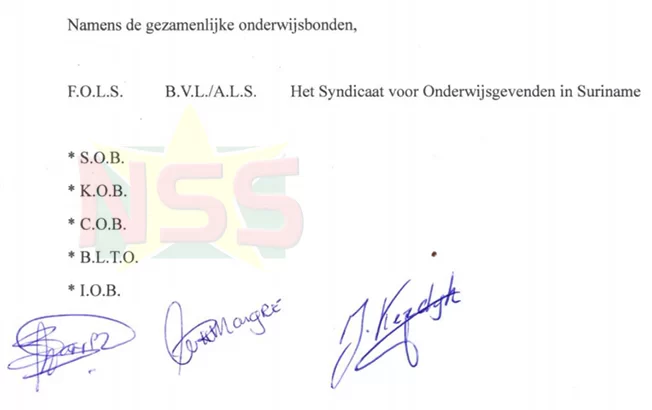
“Enough is enough,” the coalition stated in a joint signed declaration. Union leaders note that educators have fulfilled their professional responsibilities to students and communities for years, and it is now time for government authorities to meet their legal and contractual obligations. The work stoppage will remain in place until the coalition receives an official invitation to negotiations focused not on new empty promises, but on immediate implementation of the full demands package and resolution of all outstanding financial commitments.
The unified bloc makes clear it will no longer accept delays, postponements, or non-binding commitments from authorities. Describing the work stoppage as a defining line in the sand, the unions said in their closing statement: “No more words, no more excuses, no more delays. It is time for action, respect, and results.”