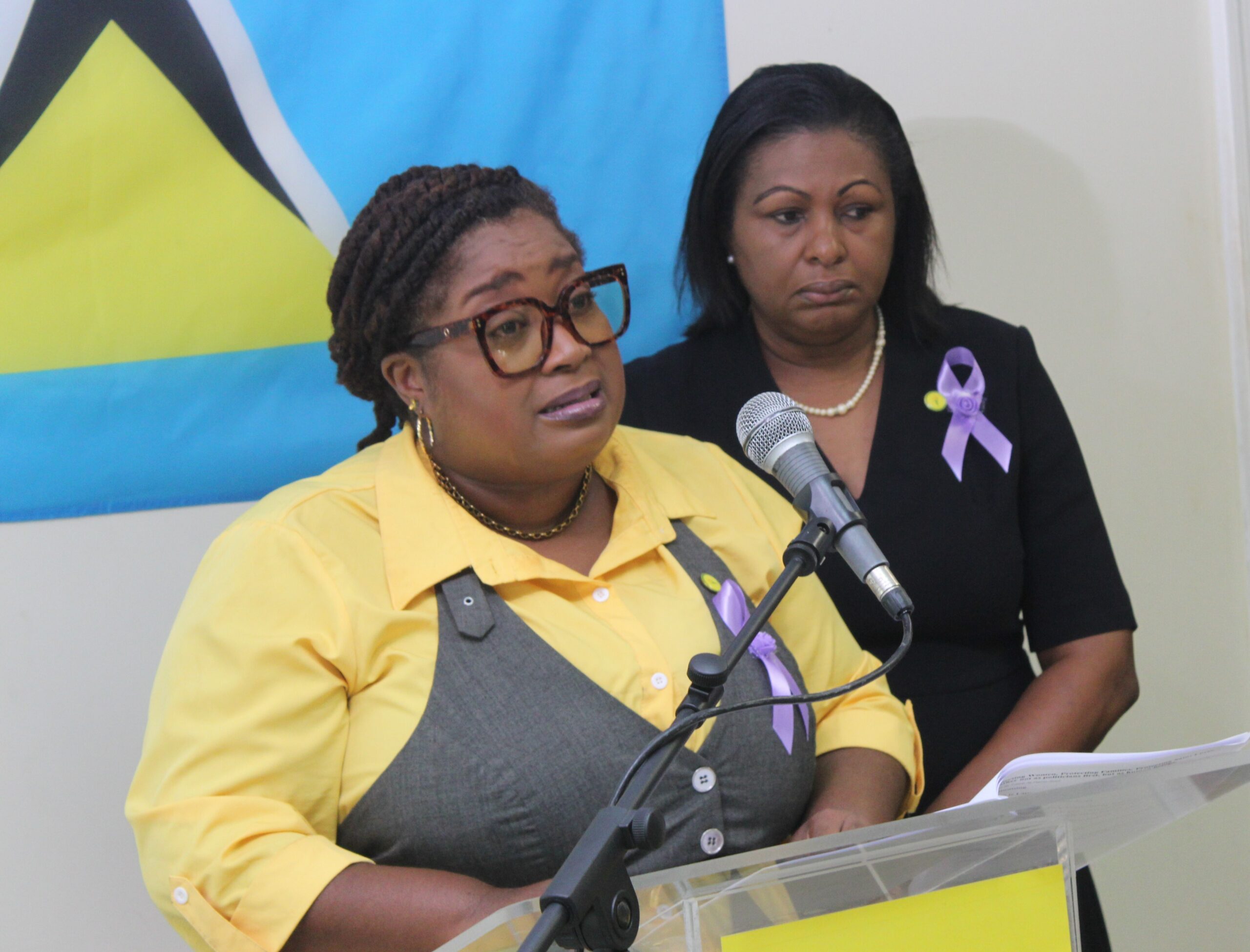
In a press conference held Thursday, three opposition United Workers Party (UWP) figures have called for urgent, systemic action to address a growing crisis of violent crime, gender-based violence and domestic abuse in Saint Lucia, following the recent death of Joy St Omer, a woman who spoke up against abuse before being killed. The gathering was led by former government minister Sarah Flood-Beaubrun, joined by 2021 general election UWP candidates Laura Jn Pierre-Noel and Titus Preville, all united in their demand for stronger protection frameworks and meaningful political will to implement long-overdue reforms.
Opening the remarks, community leader Jn Pierre-Noel opened with a personal anecdote to illustrate the gap in formal support for vulnerable women. Last summer, she sheltered a young woman fleeing a life-threatening abusive situation for more than six months – a choice that likely saved the woman’s life. Reflecting on St Omer’s recent killing, Jn Pierre-Noel emphasized that St Omer’s tragedy is not an isolated event, but a symptom of a widespread, hidden crisis where countless Saint Lucian women endure abuse behind closed doors. Many stay silent out of fear, shame, financial dependence, or distrust that help will actually arrive, she explained, pointing to past cases of other women who spoke out against abuse and were ultimately killed.
Abuse, Jn Pierre-Noel noted, does not start with fatal violence. It begins gradually, through patterns of control, manipulation, social isolation and deepening emotional trauma that often go unnoticed by outside communities. Too often, loved ones and community members spot warning signs but fail to intervene. She called for a fundamental cultural and systemic shift: a Saint Lucia where victims are believed, where women feel safe seeking help, and where support systems intervene before crisis escalates into tragedy. She acknowledged that the nation has repeatedly encouraged women to speak up, but has failed to build a safe environment for them to do so – a failure that must be corrected immediately. Beyond formal policy change, she stressed, the crisis requires widespread compassion: domestic abuse is not only a legal issue, but a social, cultural and public health crisis that demands action from every sector of society, from government and opposition to churches, schools, community leaders and individual citizens.
Economist and former candidate Titus Preville echoed the call for urgent action, arguing that expressions of grief after tragedies like St Omer’s killing are not enough to drive change. He outlined the multi-layered costs of unaddressed crime and violence that weaken Saint Lucia’s social fabric across every dimension. Socially, widespread violent crime erodes trust between community members and leaves pervasive fear in its wake. Emotionally, the constant anxiety generated by unaddressed violence contributes to chronic health conditions across the population. From a spiritual perspective, Preville framed violent criminal acts as morally corrupting that undermine the nation’s core values. Economically, he added, prolonged high levels of crime act as a crippling drag on national development, holding back progress across every sector.
Preville emphasized that ultimate responsibility for reducing crime rests with the sitting national government, regardless of which party holds power. The administration in office must provide coordinated cross-societal leadership, he said, noting that crime prevention must be made a top national priority and requires strong, independent institutions that are not politicized for partisan gain.
Former minister Flood-Beaubrun, a 29-year veteran of Saint Lucian politics and a practicing lawyer, opened with a sharp question that framed the entire press conference: “What is a plan without the political will to implement it?” She argued that current approaches to curbing violent crime and domestic abuse have clearly failed, pointing out that St Omer followed every step the existing system required to protect herself, yet the system still failed to save her life. For that reason, she is calling for a formal public commission of enquiry into St Omer’s death, alongside a complete overhaul of the nation’s broken justice, legal and judicial frameworks. Reforms to domestic violence policy cannot succeed if they are forced to operate within a fundamentally broken system, she explained.
Flood-Beaubrun noted that she has watched countless past commissions, consultations and policy recommendations gather dust without ever being implemented, urging the current government to synthesize past expert proposals into a comprehensive national master plan, developed with input from leading criminologists and policy experts. She wove the nation’s Christian identity into her argument, noting that the constitution acknowledges the supremacy of God, and argued that widespread personal responsibility rooted in faith can drive ethical change – but was careful to clarify that she is not calling for prayer alone to solve the crisis. Practical, concrete policy action is equally necessary, she stressed. She also argued that the scale and brutality of current crime in Saint Lucia reflects a broader spiritual void, calling for a national return to faith-based values alongside systemic reform.
Across all three speakers, the core message was consistent: the status quo is no longer acceptable, and the time for incremental change and unimplemented plans has passed.