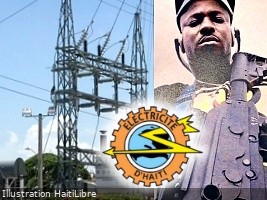
Haiti’s already crumbling public infrastructure faced a devastating new blow on May 28, 2026, when an armed gang led by notoriously powerful gang chief known as “Krisla” seized full control of Electricity of Haiti (EDH) Power Plant #2. The strategic facility, located in the Thorland district of Carrefour municipality, was the last operational power plant serving the Port-au-Prince metropolitan area, leaving the capital region on the brink of a total energy collapse.
Preceded by a week of explicit takeover threats, the gang’s incursion unfolded without major violent confrontation: the armed contingent ordered all on-site plant personnel to evacuate immediately, and internal sources confirm no employees suffered physical harm, nor was the plant infrastructure significantly damaged during the seizure. In a striking justification for the occupation of critical public infrastructure, Krisla laid out a clear, unorthodox demand: Carrefour must be guaranteed a continuous 8-hour daily power supply, specifically to ensure uninterrupted broadcast of 2026 FIFA World Cup matches.
The takeover is not an isolated disruption, but the final blow to a national energy sector already teetering on collapse. As early as June 2025, the Péligre hydroelectric plant, one of Haiti’s largest power generation facilities, was taken offline, and sabotage left five 115 kV high-voltage transmission pylons destroyed. Of the three power plants operating in Carrefour that supplied the capital, only Power Plant #2 remained functional before this incident, contributing just 5 megawatts of steady power to the EDH national grid.
With that plant now under gang control, the entire Port-au-Prince metropolitan area is forced to depend entirely on power supplied by private energy firm E-Power, which can only deliver 25 megawatts to the grid. This meager supply is enough to serve only 10 of the 45 public energy circuits that serve the capital region, leaving the vast majority of residents and businesses without access to consistent public power.
The seizure has deepened an ongoing crisis of essential public services that has already been brought to its knees by widespread gang influence across the Haitian capital. Schools, medical facilities, public transportation networks, and other core services that already struggled to operate amid persistent instability now face even greater disruption, pushing the already vulnerable metropolitan population deeper into crisis.