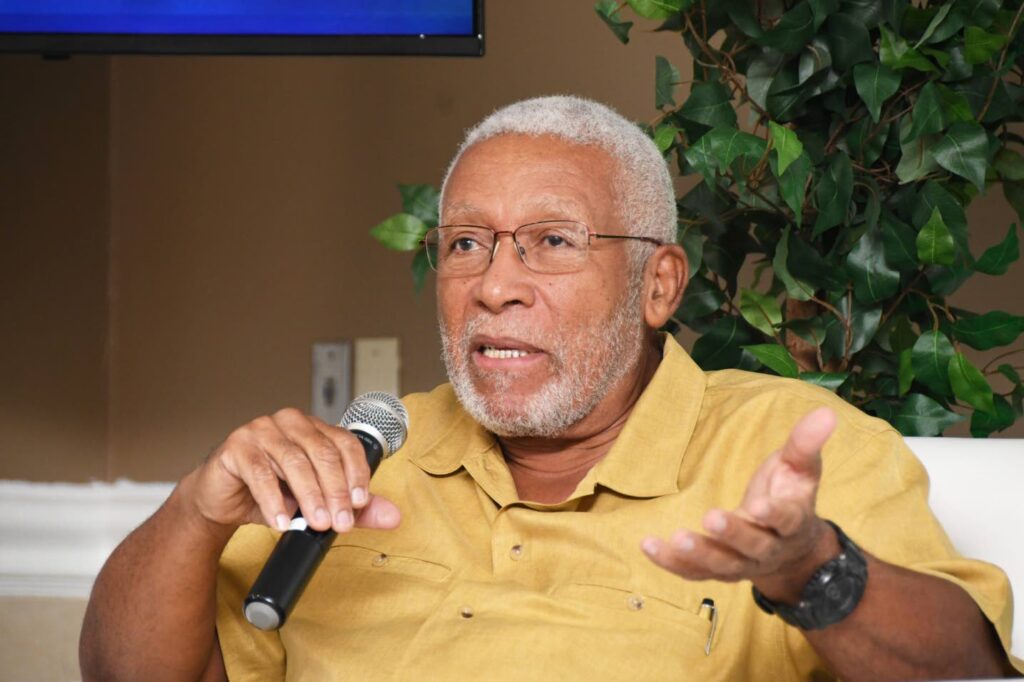
At a recent policy roundtable hosted by Jamaicans for Justice at New Kingston’s Courtleigh Hotel, former Commissioner of Police and retired Rear Admiral Hardley Lewin delivered a sharp rebuke of repeated delays and excuses from Jamaica’s government and Jamaica Constabulary Force (JCF) leadership over the deployment of body-worn cameras for planned police operations.
Lewin opened his remarks by acknowledging the Jamaican government’s substantial $2-billion investment in boosting the JCF’s crime-fighting capacity, including plans to acquire thousands of additional body-worn cameras by 2029, a timeline first announced by Deputy Commissioner of Police Warren Clarke at the same event. He commended the government for the large-scale national security spending that has modernized the force, but made clear that progress on high-impact transparency and crime prevention tools remains unacceptably slow.
The former head of both the JCF and Jamaica Defence Force argued that closed-circuit television (CCTV) infrastructure, particularly the national JamaicaEye public surveillance program, represents the most transformative shift in Jamaican law enforcement since the adoption of police automobiles. He emphasized that the core mission of policing is not solving crime after the fact, but preventing crime from occurring in the first place. While official policing metrics often rely on case clearance rates to measure effectiveness, Lewin noted that deterrence and prevention are the true markers of success — and CCTV technology is irreplaceable for advancing that goal. He pushed for the government to prioritize expanding JamaicaEye with the same urgency it has applied to other policing priorities.
Turning to body-worn cameras, Lewin pushed back against the range of justifications officials have cited for the slow rollout, from claims the devices cannot operate in stealth mode to assertions they cannot be properly affixed to some officers’ uniforms. He dismissed these excuses as nonsensical goalpost-shifting, saying “they take us for fools” with repeated delays.
Lewin also publicly defended the Independent Commission of Investigations (Indecom), the national police oversight body that has repeatedly demanded immediate deployment of body-worn cameras across all operations, particularly those expected to involve confrontations with armed suspects. The call for expanded camera use has grown more urgent amid a sharp uptick in fatal police shootings across Jamaica.
Without body-worn camera footage, Lewin explained, Indecom is left powerless to resolve conflicting accounts of officer-involved shootings. When multiple officers provide consistent but uncorroborated statements about a shooting, and witnesses are unavailable while the suspect is killed, the oversight body has no way to independently verify what occurred. This leaves innocent officers who used force legitimately unfairly tainted by suspicion, and makes it impossible to hold officers accountable when they act outside the rules. Lewin stressed that the number of fatal police shootings is not the core issue: what matters is transparency, accountability, and verifiable proof that any use of deadly force was justified.
Lewin went a step further, claiming that ongoing resistance to rolling out body-worn cameras for planned operations betrays a “sinister purpose”. Drawing on a 2025 June 22 op-ed he published in the *Jamaica Observer* titled “Those police fatal shootings”, he argued that prolonged delays are a deliberate strategy to avoid scrutiny from international partners and advocacy groups. He acknowledged that a “ends justify the means” approach to fighting violent crime is popular among many Jamaicans who have suffered from years of rampant homicide and criminal activity, but challenged the public to consider what kind of nation it wants to be. “Is it a nation governed by laws, rules, and regulations that affect all equally, or is it acceptable to break our own laws to enforce laws and protect our people?” he asked.
Addressing rank-and-file and leadership of the JCF directly, Lewin noted that the force currently has more officers, more resources, and more highly educated, well-trained personnel than at any point in its history, with more resources promised in coming years. He urged officers to reject popular but unlawful shortcuts to crime reduction: “Criminals do not play by the rules, and that is what makes them criminals. If you play outside the rules it makes you a criminal also.” He ended by warning officers that those who praise extrajudicial tactics today will be the first to abandon them when public and political pressure mounts.