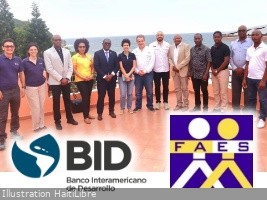
Against a backdrop of persistent insecurity, widespread displacement, and operational hurdles across Haiti, a joint mission by the Inter-American Development Bank (IDB) and Haiti’s Economic and Social Assistance Fund (FAES) has wrapped up a three-day tour of the country’s North Department, highlighting the progress of collaborative development projects and reaffirming both institutions’ commitment to supporting vulnerable Haitian communities.
The IDB delegation traveled across five key northern cities and towns—Cap-Haïtien, Trou-du-Nord, Terrier Rouge, Ouanaminthe, and Fort-Liberté—to conduct on-the-ground inspections of ongoing projects and hold strategic working sessions to align on future cooperation. The tour kicked off with site visits to community-focused projects under construction in Trou-du-Nord and Terrier Rouge, including a critical water crossing infrastructure, a new educational facility, and multiple public works projects designed to expand access to basic services for local residents.
Following the initial site inspections, a core strategic meeting was held in Cap-Haïtien, where FAES leadership presented a full overview of the institution’s project portfolio, detailed the on-the-ground challenges that have delayed implementation, and outlined proposed adjustments to improve program delivery. The delegation then traveled to Ouanaminthe to visit the reception center for displaced populations operated by Haiti’s National Migration Office (ONM), before moving on to Fort-Liberté to assess road rehabilitation work underway in the Cité Nebert neighborhood. Throughout all stops, talks centered on addressing the unmet priority needs of local communities, measuring the real-world social impact of existing interventions, and refining operational mechanisms to boost program efficiency.
In his address to IDB representatives during the mission, FAES Director General Kesner Romilus emphasized the institution’s unwavering commitment to upholding transparency, administrative accountability, and result-driven delivery for social projects that target Haiti’s most marginalized groups. Romilus confirmed that since the partnership was launched in 2018, the collaboration between FAES and IDB has successfully mobilized more than $500 million across multiple development programs, which have already directly benefited more than 650,000 Haitians across every department of the country.
Even as Haiti continues to grapple with a volatile national context defined by rising insecurity, mass internal population displacement, and persistent logistical barriers that complicate project implementation, FAES has committed to continuing its core mission of reducing poverty and addressing food insecurity, with long-term support from the IDB. This latest tour of the North Department marks a key milestone in strengthening institutional ties between the two organizations, providing a clear assessment of progress to date, and mapping out new strategic directions for future interventions that better serve Haitian communities in need.