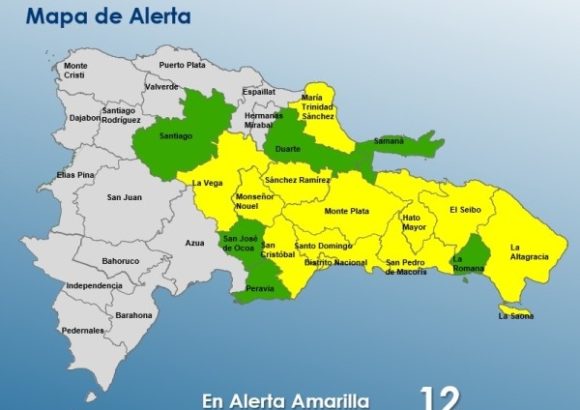
On Tuesday, the Dominican Republic’s Emergency Operations Center (COE) rolled out an expanded network of severe weather alerts across the country, ramping up preparedness measures in response to predicted dangerous precipitation and storm activity. Eleven provinces and the National District have been placed under yellow alert, the second-highest warning level, while six more provinces remain under lower-level green alert as atmospheric conditions set the stage for heavy rain, thunderstorms and potential flash flooding.
Meteorological and hydrological agencies, the National Institute of Meteorology (Indomet) and the National Institute of Water Resources (Indrhi), have traced the unstable weather pattern to three overlapping atmospheric drivers: a low-pressure trough lingering over the region, a tropical wave moving south of Hispaniola, and increased daytime heating that is amplifying atmospheric instability. These combined conditions are forecast to trigger intense localized downpours, severe electrical storms, powerful wind gusts, and even isolated episodes of hail across multiple regions of the nation.
The areas elevated to yellow alert include Monte Plata, Sánchez Ramírez, Santo Domingo, San Cristóbal, El Seibo, Hato Mayor, San Pedro de Macorís, Monseñor Nouel, La Vega, María Trinidad Sánchez and La Altagracia, in addition to the capital’s National District. The six provinces maintaining green alert are Duarte, particularly the low-lying Bajo Yuna region, San José de Ocoa, Peravia, Santiago, La Romana and Samaná. Green alert status indicates that while residents should remain watchful for changing conditions, the threat level is lower than in areas under yellow alert.
Emergency officials have flagged the most at-risk regions for severe weather, including the country’s northeast, the fertile Cibao Valley, the eastern plains, the Central Mountain Range, and all Caribbean coastal areas. To prevent preventable accidents and casualties, the COE has issued clear public safety guidance: residents are strongly advised to avoid attempting to cross swollen rivers, streams and steep ravines where water levels have risen rapidly. Authorities also recommended that the public steer clear of all recreational bathing sites in provinces currently under active weather alert, as fluctuating water conditions can create hidden hazards.