Residents of Houttuin and surrounding communities in Suriname’s Wanica District have officially lodged formal objections to Houston-based energy firm Halliburton’s proposal to build a radioactive materials storage facility in their residential area. Organized under the advocacy group Suriname River Eco & Water Resort Steering Committee, locals submitted two detailed formal complaints to the Wanica Southeast District Commissioner and the National Environmental Authority (NMA), outlining severe, multi-layered concerns over potential threats to the region’s environment, public health, and community safety.
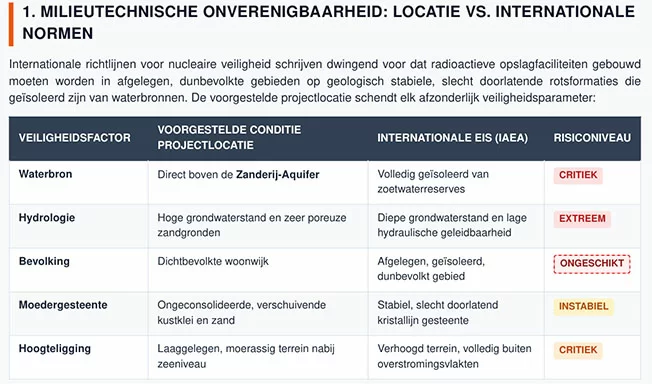
At the core of residents’ opposition is the facility’s proposed location: directly above the Zanderij Aquifer, Suriname’s most critical source of fresh drinking water. The community argues the region’s geological and hydrological features make it categorically unsuitable for radioactive waste storage. Porous sandy soils, high regional groundwater tables, and frequent flood risk create a near-constant threat of radioactive contamination that cannot be mitigated through standard design safeguards, the objection states.
Residents specifically flag the planned storage of radioactive isotopes including Americium-241 and Cesium-137 at the site. They warn that any leak, ground subsidence event, transport accident or extreme flood event could result in irreversible, long-term contamination of the region’s groundwater, agricultural land, and residential neighborhoods, posing lifelong health risks to the local population.
Beyond the inherent risks of the project’s location, residents accuse the NMA and project consultants of systemic lack of transparency around the required Environment Management and Monitoring Plan (MMMP). Critical data required for full public and regulatory assessment—including radioactive activity levels, radiation contour maps, regional groundwater flow models, and emergency disaster response scenarios—is entirely missing from the publicly released documents, according to the complaint.
The community also raises questions over the expertise and independence of TDS Consulting, the firm hired to conduct the project’s environmental impact assessment. Residents note that TDS representatives admitted during public information sessions that the firm lacks specialized expertise in nuclear engineering, radioecology, and radiation safety—core competencies required to properly evaluate the risks of a radioactive storage facility.
Worsening these concerns, residents argue that Suriname as a whole is currently unprepared to handle radiological emergencies. The country lacks specialized nuclear regulatory legislation, independent radiation testing laboratories, specialized medical facilities equipped to treat radiation exposure, and trained response personnel to contain and manage an incident should one occur, the complaint states.
Locals also say they have lost trust in Halliburton as a project operator, pointing to the company’s history of negligence and environmental contamination in prior international operations. The objection specifically references past incidents involving radioactive materials where the company failed to implement adequate safety precautions, according to residents.
Another key grievance is the lack of adequate public outreach: residents say they were notified of project consultation sessions far too late, leaving local community members with very little time to register for the public meetings and prepare formal objections to submit to the NMA.
The objection also extends to a second Halliburton project planned for the same area: an operational base for oil and gas exploration activities. Residents say that during initial information sessions, Halliburton failed to disclose that tools and equipment that have been in contact with radioactive sources would also be stored and handled at the base, leaving communities unaware of additional risks.
In their formal demands, residents are calling on the NMA to reject all permits for the Houttuin radioactive storage facility entirely. They are also requesting an independent international assessment of the project’s risks, the development of modern national legislation for radiation protection and nuclear liability before any similar projects are approved, and a full assessment of alternative sites that meet international safety standards for radioactive material storage. The community emphasizes that such high-risk facilities should never be sited in densely populated residential areas or above critical drinking water reserves.
As of the filing date, neither the NMA nor Halliburton has issued a public response to the formal objections.